




TeraWatt Infrastructure Breaks Ground on EV Charging Site for Port Operations
TeraWatt Infrastructure broke ground on a heavy-duty truck electric charging site that will support fleet operations at the ports of Long Beach and Los Angeles. It is expected to begin operation in mid-2024.

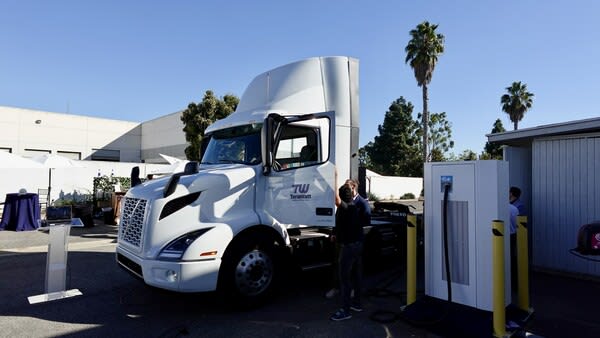
At the groundbreaking event, a Volvo truck was provided to preview TeraWatt's proprietary charging software and was also available for test rides.
Photo: TeraWatt Infrastructure
TeraWatt Infrastructure broke ground at its heavy-duty electric vehicle charging site in Rancho Dominguez, California. Located less than 15 miles north of the ports of Long Beach and Los Angeles, the site is strategically positioned to support sustainable trucking fleet operations in and out of the largest container ports in the United States.
Slated to be operational by mid-2024, the new site will house a total of 20 pull-through and bobtail DC fast-charging stalls and boast an impressive capacity of 7MW — enabling charging for up to 125 trucks per day.
"Our partners in the private sector are playing a key role in building the infrastructure that is needed to power California's zero-emission future," said CARB Chair Liane Randolph. "TeraWatt's upcoming facility in Rancho Dominguez is one example of how the industry is stepping up to build sustainability into the operations of one of the nation's busiest ports."
The site will also feature a driver-amenities building, complete with a lounge, food and beverage services, and Wi-Fi connectivity.
"Deploying the Class 8 VNR Electric takes an entire electromobility ecosystem," said Derik Wilson, commercial electromobility charging and infrastructure manager, Volvo Trucks North America. "Since the Volvo LIGHTS Project, VTNA has continued to work with industry stakeholders, such as TeraWatt, for the increased scaling of charging solutions.
PepsiCo Charging
PepsiCo recently announced that it will be using the Rancho Dominquez site for last-mile delivery charging in the Los Angeles area as the company ramps up fleet electrification efforts. TerraWatt said this initiative underscores a growing commitment from the enterprise sector to adopt sustainable technologies across their logistics and transportation operations.
Charging Site Strategic Locations
TeraWatt said it reinforces its commitment to decarbonizing fleet transportation by acquiring and building charging sites in areas that experience some of the most severe air pollution, in turn ushering in an era of green mobility and cleaner air quality. Recent reports, according to the company, have revealed that South Los Angeles ranks second in the nation for worst places to live for air pollution. The maze of freeway interchanges, railyards, and warehouses in South Los Angeles, in addition to a cluster of landlocked neighborhoods and small cities — including Compton, Maywood, and Paramount — has resulted in residents living with air regularly exceeding the EPA limit of 12 µg/m3.
"The Ports of Los Angeles and Long Beach stand as pivotal hubs for our nation's strategic shipping operations, distinguished as some of the busiest and most critical ports in the country," said Neha Palmer, TeraWatt's CEO and co-founder. "We know that with the proper infrastructure in place, EV adoption will quickly accelerate in this region. We look forward to being at the forefront of this transition by providing the full-stack solutions that enable fleets to seamlessly electrify their operations for both the near and long term."
More Fuel Smarts

How Volvo Updated Its D13 for EPA 2027 [Watch]
Volvo’s updated D13 promises lower emissions without sacrificing performance or fuel economy. Take a closer look at what changed inside the engine in this HDT Spotlight video.
Read More →
Diesel Price Spike Shortens Payback for Natural Gas Trucks, Report Says
Energy Vision estimates fleets could recover the higher purchase price of an RNG-fueled Class 8 tractor in 1.3 to 2.8 years under current fuel-price scenarios.
Read More →
Calstart Becomes Catalyst Mobility, Reflecting Broader Focus
Calstart is now Catalyst Mobility, reflecting the nonprofit’s growing national role in clean transportation, including zero-emission trucks, infrastructure and incentive programs.
Read More →

Record Diesel Prices Squeeze Trucking Fleets
Average U.S. diesel prices have climbed to nearly $6 a gallon, surpassing the 2022 record as tight refinery capacity and Middle East disruptions keep fuel costs elevated.
Read More →
How Fuel Delivery Shapes Engine Performance
Fuel delivery depends on more than what happens at the injector. For fleet, maintenance and technical professionals, looking at the full path from pump to injector can provide useful context for understanding engine performance.
Read More →
East Coast Port Launches $45M Electric Truck Push
The Port Authority of New York and New Jersey announced millions in incentives for zero-emission drayage trucks, yard tractors, and new charging hubs near the port.
Read More →
California Bill Could Shed Light on Electric Truck Prices
Why do battery-electric Class 8 trucks remain so expensive? A California bill headed to Gov. Gavin Newsom would give fleets and state agencies more visibility into what manufacturers charge.
Read More →
Detroit Opens Orders for EPA 2027 Engines
Detroit isn’t starting from scratch to meet EPA 2027 diesel emissions standards. Its Gen 6 DD13 and DD15 engines keep much of today’s platform while updating the fuel and aftertreatment systems.
Read More →
Zero-Emission Truck Corridor Planned for West Coast
California, Oregon, Washington, British Columbia and Baja California are coordinating plans for truck charging and hydrogen fueling from Canada to Mexico.
Read More →
A Closer Look at Kenworth’s Electric T880E Vocational Truck [Video]
Learn more about Kenworth's T880E battery-electric vocational truck at the Paccar Technical Center, including its range, applications, upfitting considerations, and PTO options, in this HDT Spotlight video.
Read More →