





Related: Speed-Limiter Bill Garners Support of Trucking Groups
TCA's Heller: ELD Data Already Transforming Trucking
Dave Heller, vice president of government affairs for the Truckload Carriers Association told the Machinery Haulers Association that ELDs are already providing never-before-seen data on truck use and how drivers spend their days-- all of which that will eventually yield better regulations and more efficient operations.
July 29, 2019
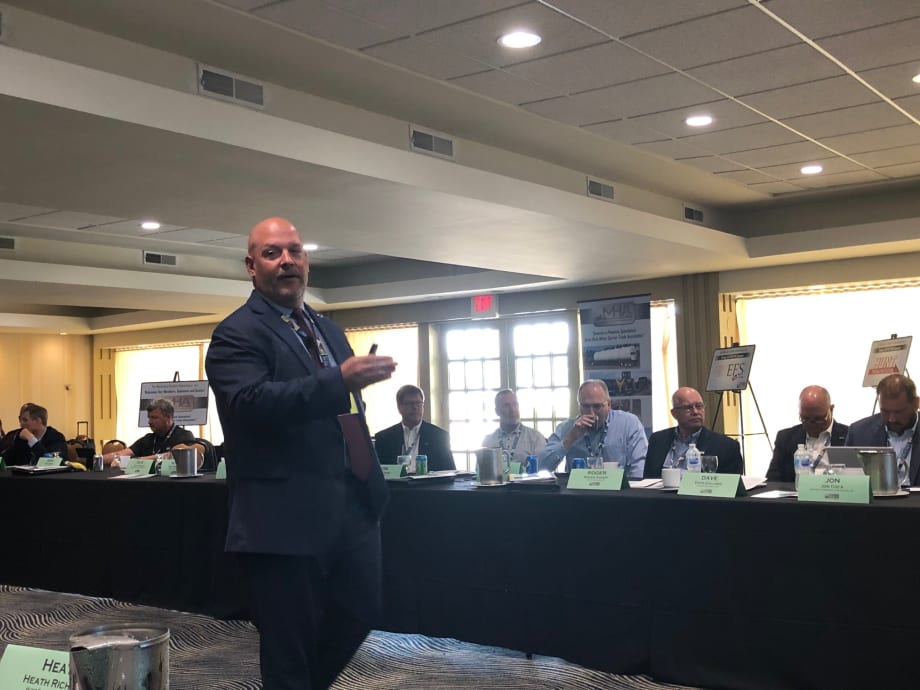
TCA's Dave Heller speaks to the Machinery Haulers Association at its annual meeting in Fontana, Wisconsin, on July 25.
Photo: Jack Roberts
4 min to read
As far as trucking industry advocacy groups go, the Machinery Haulers Association is decidedly small. But what this group lacks in numbers (an issue the group is actively campaigning to reverse), it more than makes up for in its commitment to both industry knowledge and promoting safety.
In keeping with those efforts, the association invited Dave Heller, vice president of government affairs for the Truckload Carriers Association, and a member of the HDT Editorial Advisory Board, to speak at its annual meeting on July 25 in Fontana, Wisconsin on current governmental trends and policymaking affecting the industry.
To begin with, Heller notde that love them or hate them, electronic logging devices (ELDs) are providing the trucking industry with massive amounts of real-time data about how trucks operate and how truck drivers spend their days. This data, Heller said, is now highlighting – with hard information – the need for more flexible Hours of Service rules, highlighting an “epidemic” in unsafe driving caused by smartphones as well as detention time issues and other industry problems.
“ELDs were never going to make you safer,” Heller told attendees at the conference, adding that a Northwestern University study found that accidents have not decreased as a result of the ELD Mandate, which went into effect last year. “They are a compliance tool. It is the Hours of Service which will help make your operations safer. That’s because the data they provide can be used to shape better regulations in the future.”
Some issues remain concerning the ownership of ELD data, Heller said. But, he said, to date, no ELD manufacturers are selling or marketing the data their devices collect to third-party customers the way many social media platforms do. Additionally, Heller said some privacy issues regarding ELDs and the data they collect still need to be worked out.
Heller said some savvy fleet managers are already using ELD data to determine corridors where freight is hot and adjust their operations accordingly. “We can’t make our days any longer,” he noted. “But what we can do is use the data provided by ELDs to make our days more sensible.”
ELDs are also highlighting safety issues, Heller pointed out. Detention has long been an issue for drivers. And now, he said, ELD data confirms that drivers who have been detained often driver faster to make up lost time for an extended period after they get on the road.
“That’s why a speed limiter bill is on tap in Congress,” he said. “Because ELDs have confirmed that speeding is the number-one safety problem and cause of accidents facing trucking. This particular speed limiter bill probably won’t go anywhere, but ELD data is showing us that some sort of speed limiter bill is the right to go in the future.”
Looking at other issues, Heller said that although infrastructure in the U.S. continues to deteriorate at an alarming rate, there is no sign of a bill to fund repairs or new infrastructure in sight. “We now have 47,000 structurally deficient bridges in the country. But because we are nearing the 2020 presidential campaign, it is unlikely anything will get done on this issue, since neither political party wants to give the other one an opportunity to claim a ‘win’ this close to the election.”
The other piece of worrisome news for fleets, Heller said, was the possibility of a sideguard/underride bill becoming law – legislation that would require fleets to retrofit trailers with protective structures designed to limit fatalities in collisions with passenger cars. Should such a bill become law, Heller said it would become the most expensive legislation to ever hit the U.S. trucking industry.
Another measure with the potential to seriously dent the bottom line for fleets is legislation calling for raising the minimum level of insurance for fleets to $4.9 million, instead of the current $750,000 minimum. Heller said proponents of the bill argue that the $750,000 minimum has been on the books since 1980, and that costs, including healthcare, have risen dramatically since then, and therefore that is no longer enough money to substantially cover damages in the event of a major accident.
More Fleet Management

Sponsored•September 16, 2026
Color Match Smarter: Tools That Restore & Perform
For fleet managers and collision repair professionals keeping heavy-duty trucks on the road, getting the color right the first time isn't just about appearance — it's about efficiency, turnaround time, and bottom-line results. Discover how today's digital color tools are transforming the repair process from guesswork to precision.
Read More →
FMCSA Pauses Biennial-Update Enforcement Amid Motus Transition
Carriers whose updates were due on or after June 1 have more time, while FMCSA works to stabilize its new registration system and warns of phishing sites impersonating its new carrier registration system, Motus.
Read More →
Sponsored•September 14, 2026
2026 Blueprint for Countering Smarter Supply Chain Theft
Cargo theft is no longer just the cost of doing business. It's a multi-billion-dollar criminal enterprise exploiting vulnerabilities across your fleet, drivers, and supply chain.
Read More →


Sponsored•September 1, 2026
How Telematics Improves Visibility, Control, and Performance in Refrigerated Fleets
Explore how telematics help refrigerated fleets improve visibility, uptime, efficiency, compliance, and cargo protection across connected cold chain operations.
Read More →
What the U.S.-Canada Trade War Means for Trucking
Escalating U.S.-Canada tariffs could disrupt cross-border freight, reduce truck volumes, raise costs, and create new uncertainty for carriers on both sides of the border.
Read More →
What Are Trucking’s Top Concerns for 2026?
The American Transportation Research Institute wants to know what's worrying trucking fleet managers, drivers, and other stakeholders in its annual Industry Issues survey.
Read More →
American Trucking Associations Looks for a New Leader
ATA President and CEO Chris Spear abruptly left his job at the association on August 21, at a pivotal time for the trucking industry.
Read More →
Public Wi-Fi Cybersecurity Risks: How Truck Drivers and Fleets Can Protect Their Data
Public Wi-Fi can expose truck drivers and fleets to credential theft, malware, and other cyber threats. Here’s how to reduce the risk on the road.
Read More →
For Nicky Cupp, Fleet Innovation Starts With Frustration
HDT Truck Fleet Innovator Nicky Cupp turns everyday pain points at Fraley & Schilling into opportunities for better technology and smarter processes.
Read More →
Adam Buttgenbach’s Approach to Electric Trucks: Start With Where They Fit
HDT Truck Fleet Innovator Adam Buttgenbach helped PepsiCo build one of North America’s largest EV fleets by focusing on where electric trucks make operational sense.
Read More →