





How a Tanker Fleet is Using Unorthodox Trailer Lighting to Fight Rear-End Collisions
Tank Truck Carriers May Add Extra Pulsating Rear Brake Lamp to Trailers
The Federal Motor Carrier Safety Administration is granting a five-year exemption to allow motor carriers operating tank trailers to install a red or amber brake-activated pulsating lamp on the rear of the trailers.
October 8, 2020
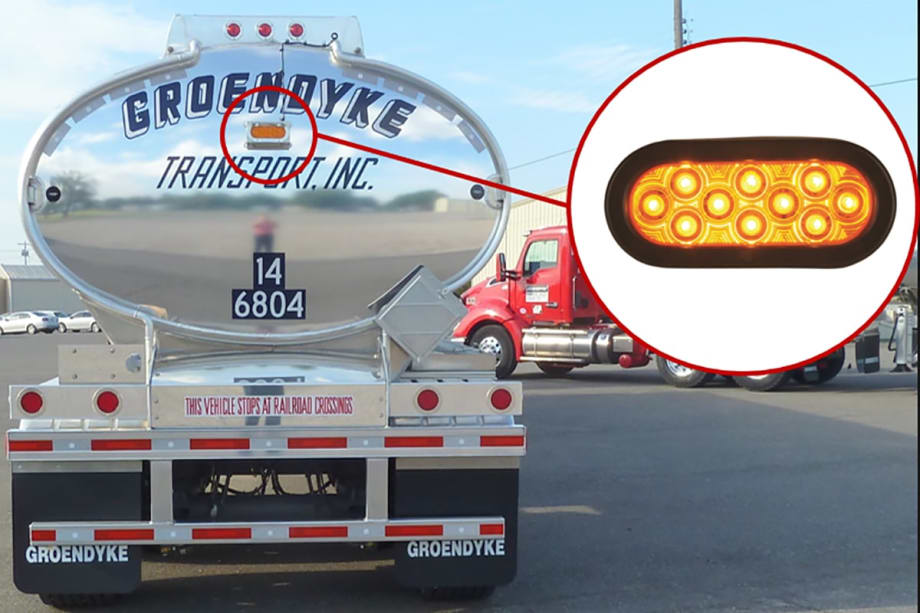
Groendyke Transport was able to cut rear-end collisions by a third by installing an extra brake-activated flashing lamp.
Photo: Groendyke Transport
2 min to read
The Federal Motor Carrier Safety Administration is granting a National Tank Truck Carriers application for a limited five-year exemption to allow motor carriers operating tank trailers to install a red or amber brake-activated pulsating lamp in the upper center position or in an upper dual outboard position on the rear of the trailers.
These lights will be allowed in addition to the steady-burning brake lamps required by the Federal Motor Carrier Safety. The agency said the exemption would likely achieve a level of safety equivalent to or greater than the level of safety provided by the regulation.
Section 393.25(e) of the FMCSRs requires all exterior lamps to be steady-burning, except turn signal lamps, hazard warning signal lamps, school bus warning lamps, amber warning lamps or flashing warning lamps on tow trucks and commercial motor vehicles transporting oversized loads, and warning lamps on emergency and service vehicles.
NTTC in its application argued that the addition of the brake-activated pulsating lamp will improve safety by improving visibility and prevent accidents.
FMCSA previously granted a similar, but not identical, temporary exemption to one of its member companies, Groendyke Transport. In fact, the Oklahoma-based tank truck carrier said it reduced its rear-end crash rate by more than 30% using this spec.
NTTC cited several studies conducted by the National Highway Traffic Safety Administration on the issues of rear-end crashes, distracted driving, and braking signals. NTTC stated: “Research indicates that there are ways to improve the attention-getting qualities of braking systems. Including a pulsating brake lamp on a lead vehicle has quantifiable effect on the drivers of following vehicles and measurably reduces rear-end collisions. Drivers are redirected and altered faster and more efficiently when a pulsating brake lamp draws their attention to the lead vehicle. As a result, rear-end collisions can be prevented or at least reduced.”
The Commercial Vehicle Safety Administration and some other commenters expressed concern that flashing, rotating, or pulsating red lamps are generally permitted only on emergency vehicles. FMCSA responded, however, that those emergency lights are usually high intensity, constantly flashing, rotating or pulsating red lamps visible from all directions on the vehicle and that continuously operate when activated. In contrast, the amber or red brake-activated pulsating lamps requested by NTTC are visible only to the rear of the tanker trailer, and are similar in lamp intensity and flash rate of the vehicle's standard rear hazard warning lamps system currently allowed by the regulations.
And, it said, it couldn’t ignore the results of Groendyke’s experience.
This exemption is applicable Oct., 2020, and ending Oct. 8, 2025.
More Safety & Compliance

FMCSA Pauses Biennial-Update Enforcement Amid Motus Transition
Carriers whose updates were due on or after June 1 have more time, while FMCSA works to stabilize its new registration system and warns of phishing sites impersonating its new carrier registration system, Motus.
Read More →
ZF Expands Commercial Vehicle Push in North America
ZF is expanding its North American commercial-vehicle presence with new transmission applications, electrification, trailer technology and autonomous-driving systems.
Read More →
Truck Drivers Need More Than Another Alert
Fleets have more visibility into truck health, safety events, and driver activity than ever. The next challenge is turning all that information into useful guidance for the person who has to decide what to do next.
Read More →
Tesla Wants a Self-Driving Semi. Are Cameras Enough?
Could Tesla’s camera-only autonomous driving technology work on an 80,000-pound Semi? In this commentary, HDT's Deborah Lockridge takes a look at Tesla, Cybercab, and how autonomous trucks see the road.
Read More →
What DOT’s Automated Vehicle Strategy Means for Trucking
The U.S. Department of Transportation issued a new automated-vehicle strategy that outlines plans for driverless-truck regulations, cross-state freight corridors, and federal safety standards.
Read More →
NYC Expands Speed, Pedestrian Safety Tech Across Fleet
New York City is expanding intelligent speed assistance and pedestrian-alert systems across its municipal fleet, moving the technologies from pilot programs into vehicle procurement and retrofit requirements.
Read More →
FMCSA Removes 110 Truck Driver Training Schools from Certified ELDT List
Federal regulators also are targeting more than 160 additional training providers and launching a nationwide audit of third-party CDL skills testers as part of a broader crackdown on trucking fraud.
Read More →
Beyond DOT Compliance: What Makes a Trucking Fleet Truly Safe?
A trucking fleet can follow every rule and still make unsafe decisions. The real test comes when safety conflicts with freight, productivity, or cost.
Read More →
Hours of Service Pilot Programs: FMCSA Readies for 2027 Rollout
Two pilot programs could eventually reshape hours-of-service rules, giving truck drivers options to pause their 14-hour clock or use longer split sleeper rest periods.
Read More →
New Guide Offers Pet Safety Tips for Truck Drivers
Hundreds of thousands of pets travel in truck cabs. A new safety guide from Volvo Trucks and the Center for Pet Safety offers practical advice for truck drivers who bring dogs and cats along for the ride.
Read More →