




Supreme Court Partially Upholds ATA in L.A. Port Case
The Supreme Court unanimously ruled that the Port of Los Angeles may not impose the placarding and parking requires of its concession plan on trucking companies. This in effect upholds part of the position American Trucking Associations took in pushing for the high court’s review of the port’s concession agreement.

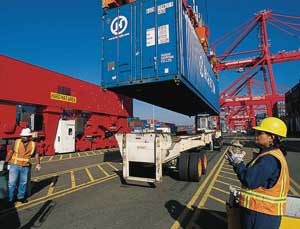

UPDATED---The Supreme Court unanimously ruled that the Port of Los Angeles may not impose the placarding and parking requires of its concession plan on trucking companies.
This in effect upholds part of the position American Trucking Associations took in pushing for the high court’s review of the port’s concession agreement.
The court declined to rule on a second aspect of the matter, concerning how the port enforces its financial-capacity and truck maintenance requirements.
ATA has been pursuing the issues through lower courts since 2008, when the Port of Los Angeles instituted a Clean Truck Program under which drayage carriers must join a concession agreement in order to provide service.
The high court upheld ATA’s contention that the Federal Aviation Administration Authorization Act exempts carriers from the off-street parking and placard provisions of the agreement.
Those provisions require carriers to submit an off-street parking plan, and to mount placards with a phone number so the public can report concerns about safety or the environment.
The issue turned on whether or not the requirement is an act of regulatory authority, which the FAAA would forbid.
Justice Elena Kagan, writing for the unanimous court, said the port was exercising “classic regulatory authority” when it imposed the requirement.
The FAAA “expressly preempts the agreement’s placard and parking requirements,” she wrote.
“(The Port) forced terminal operators – and through them, trucking companies – to alter their conduct by implementing a criminal prohibition punishable by imprisonment.
“That counts as action ‘having the force and effect of law’ if anything does.”
ATA also contended that under a 1954 Supreme Court decision, Castle v. Hayes Freight Lines, the port cannot suspend or revoke a carrier’s access.
The Supreme Court did not take a position on this issue.
Kagan wrote that Castle does not prevent a state from taking a noncompliant truck off the road, and said there is no basis for finding that the port will use the concession agreement to do so.
ATA President and CEO Bill Graves said in a statement that the association is gratified by the decision.
“The decision is sure to send a signal to any other cities who may have been considering similar programs which would impermissibly regulate the port trucking industry,” he said.
A copy of the Supreme Court’s decision is available here.
More Drivers

Driver Trust Can Make or Break the Success of Fleet Safety Technology
New Teletrac Navman research suggests that onboarding, transparency about driver data, and positive feedback can play a significant role in how commercial drivers respond to safety and coaching technology.
Read More →
EEOC Sues KLLM Over Alleged Sex Discrimination in Driver Training
KLLM is facing a federal sex-discrimination lawsuit over policies the EEOC alleges put female truck driver trainees at a disadvantage.
Read More →
FMCSA Moves to Codify English Language Requirements for Commercial Drivers
By changing regulations on English-language proficiency requirements for commercial drivers, rather than relying on a guidance memo, the FMCSA said future administrations won't be able to walk back the Trump administration's stricter enforcement with just a memo.
Read More →
Drivers Put Western Star Trucks to the Test at Star Nation Experience
Watch to get an inside look at the Western Star trucks, technology, and community behind the Star Nation Experience 2026!
Read More →
Trump Administration Looks to Put More Veterans Behind the Wheel
The Freedom Haulers program pulls together existing and expanded programs at several federal agencies to recruit veterans to drive commercial heavy-duty trucks and cut the red tape for them to get a CDL, training, and employment.
Read More →
Putting Mack’s Command Steer to the Test
A test drive of Mack’s Command Steer active steering system evaluates how it can make truck driving easier and less tiring.
Read More →
Competition Heating Up for Truck Drivers
New report reveals rising driver hiring costs, the return of sign-on bonuses, growing AI advantages, and the operational factors shaping driver retention.
Read More →
How Fraley & Schilling Improved Logbook Compliance by Over 50%
Fraley & Schilling needed a way to close a compliance workflow gap in its ELD system without adding more work from driver training, reminders, and back-office follow-ups. It found the answer in a custom driver app.
Read More →
Volvo Goes Gaming
Volvo has roared into American Truck Simulator with two new flagship trucks.
Read More →
What the Best Fleets to Drive For Teach About Driver Retention
Survey fatigue, AI-powered routing, owner-operator expectations, and the decline of social media all emerged as themes from this year's Best Fleets to Drive For program.
Read More →