




Supporters of Higher Truck Weights Hope that Now is Their Time
Trucking and shipping interests are hoping the time is right for them to win long-sought relief from the 80,000-pound federal restriction on truck weights. The restriction has resisted trucking's best efforts for years, mainly due to opposition from the railroads and safety advocates but also because the trucking industry itself has been of two minds on the issue -- some carriers want to run heavier loads, some don't want the expense of the new equipment
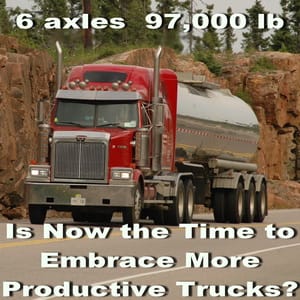
Trucking and shipping interests are hoping the time is right for them to win long-sought relief from the 80,000-pound federal restriction on truck weights.
The restriction has resisted trucking's best efforts for years, mainly due to opposition from the railroads and safety advocates but also because the trucking industry itself has been of two minds on the issue -- some carriers want to run heavier loads, some don't want the expense of the new equipment.
But now the carriers that support a change in the law see a confluence of forces working in their favor. Demand for better fuel efficiency, lower greenhouse gas emissions and less pollution can be met by carrying more freight per truck, and contentious questions about safety can be answered by adding a sixth axle to trucks that are permitted to carry the heavier load, industry officials said last week at a Washington, D.C., conference on productivity and safety.
At the event, which was sponsored by American Trucking Associations and Volvo, the thought emerged that the timing of these forces creates an opportunity to get this perennial public policy debate moving by giving it a forward-looking perspective.
Future Growth Demands Higher Productivity
Rather than simply repeating the tried-and-true mantra that trucking is essential, the industry needs to point to the issues that will shape the public's view of trucking over the next 50 years, said ATA President and CEO Bill Graves.
He cited population growth as an example. The U.S. population is growing by one new person every 12 seconds - "the equivalent of one new Chicago each year," Graves said. It adds up to more cars, more freight, more trucks, more drivers and more congestion: "Truck productivity becomes a critical element of how to resolve that growing issue."
The vehicle for this season's run at the issue is legislation in the House and Senate that would allow states to raise the truck weight limit from 80,000 to 97,000 pounds on Interstate highways, provided the truck is equipped with at least six axles. It includes a provision to increase the heavy vehicle use tax from $550 to $800 a year, to cover the additional expense that these trucks would cause for bridge maintenance.
The legislation faces two hurdles. It must win congressional approval in its own right, and then Congress needs to act on the larger bill of which it is a part - reauthorization of the federal highway program.
Window of Opportunity
The reauthorization bill has been stalled for more than a year due to a lack of political will to pay for the work that needs to be done, but there is a chance that Congress will act on the measure in the first half of 2011.
Rep. John Mica, R-Fla., who is expected to take over leadership of House Transportation and Infrastructure Committee next year, has said he sees a window of opportunity as long as the bill is not funded by a fuel tax increase. On the other hand, the National Commission on Fiscal Responsibility and Reform may have opened the door to just that idea when the majority of the members voted in favor of gradually raising the fuel tax by 15 cents a gallon, starting in 2013, and dedicating that money to the Highway Trust Fund. The outlook for the bill will become clearer later this winter when the Obama administration weighs in with its reauthorization plan.
Winning congressional approval of higher truck weights will be equally difficult but proponents are optimistic.
"I think it's going to be a heavy lift but I also think the opportunity is now," said Randy Mullett, Vice President of Government Relations and Public Affairs for Con-Way.
The productivity argument for raising the limit has been in play for years but in the past has been trumped by rail opposition and concerns about safety. Now the argument may carry more weight, given the general reluctance to add more highway capacity.
"We will have to look at efficiency and improving throughput and productivity if we are not going to build more infrastructure," Mullett said.
Con-Way expects freight volume to increase 26 percent over the next decade, and the industry has few policy options other than more productive trucks to meet that demand, Mullett said.
He said that the weight limit increase would have little impact on Con-Way's truckload business, which tends to cube out before it weighs out. But the efficiencies to be gained in the less-than-truckload are "staggering," he said. "In simplest terms, it's a 50 percent improvement."
Mullett addressed the concern among some carriers that the changeover in equipment would be disruptive to fleets. In fact, he said, the transition would be similar to what the industry experienced in the evolution of trailer lengths from 42 to 45 to 48 to 53 feet: "The changes did not occur overnight and did not wipe out fleets. This is not a zero sum game."
Proponents of raising the limit also see new resonance to the argument that a higher weight limit will improve the industry's environmental and fuel efficiency performance.
Efficiency Deficient
John Runyan, Executive Director of the Coalition for Transportation Productivity, said that a 97,000-pound 6-axle truck can carry 17 percent more ton miles per gallon of fuel than the current industry workhorse at 80,000 pounds on 5 axles. "That lowers the carbon footprint of every item on the truck," he said.
Runyan also cited Department of Transportation figures showing that the reduction in the rate of growth of the nation's truck fleet allowed by the higher limit would save $2.4 billion in pavement restoration costs over 20 years.
CTP, a 175-member group of like-minded carriers and shippers, has been working the issue on Capitol Hill since the diesel price spike in 2008.
Another issue is global competitiveness. John Woodrooffe, director of the Transportation Safety Analysis Division of the University of Michigan Transportation Research Institute, said that U.S. truck productivity, measured by permissible weight, is at the bottom on a list of countries in Europe and North America.
In terms of axle weights, the U.S. productivity disadvantage is 17 percent compared to the United Kingdom, 35 percent compared to Mexico and 27 percent compared to Canada, he said.
"I just have to ask, is our infrastructure really that fragile? Are the laws of physics different here than in these other countries?"
All of that said, the key to congressional acceptance will be safety, said Woodrooffe, Runyan and others at the conference.
It's a point borne out by one Capitol Hill professional who said that if the industry can adequately address the safety issue it might be able to win the increase.
This source, a participant in transportation issues who asked not to be named, said that a year or two ago mention of truck sizes and weights would have made the speaker persona non grata among safety-oriented congressional staff, but now they are more open to the idea.
This source believes trucking's best hope is to take on the safety issue directly. The railroads will remain opposed, but if the safety issue can be taken off the table then the discussion will be about market decisions, the source said.
On Capitol Hill, the source said, you can't keep saying "no" forever.
Runyan said that the 6th axle requirement is key to safety because it helps the truck maintain the same stopping distance as the lighter 5-axle rig.
He cited the experience of the United Kingdom, which raised its weight limits to 97,000 pounds for 6-axle trucks in 2001. An evaluation of the change showed the gains you would expect in productivity, but also a 35 percent decline in truck-related accident fatalities, he said.
He also cited a 2009 study by the University of Wisconsin that found that a 98,000-pound six-axle single trailer vehicle hits the "sweet spot" of productivity and safety. The study projected that had Wisconsin had tha
More Drivers

Truck Drivers Need More Than Another Alert
Fleets have more visibility into truck health, safety events, and driver activity than ever. The next challenge is turning all that information into useful guidance for the person who has to decide what to do next.
Read More →
FMCSA Removes 110 Truck Driver Training Schools from Certified ELDT List
Federal regulators also are targeting more than 160 additional training providers and launching a nationwide audit of third-party CDL skills testers as part of a broader crackdown on trucking fraud.
Read More →
Hours of Service Pilot Programs: FMCSA Readies for 2027 Rollout
Two pilot programs could eventually reshape hours-of-service rules, giving truck drivers options to pause their 14-hour clock or use longer split sleeper rest periods.
Read More →
Medical Cards, English Proficiency Reshape Roadcheck Violations
Medical-card violations jumped to the top of the driver out-of-service list during CVSA’s 2026 International Roadcheck, while English-language proficiency violations appeared among the leading violations for the first time.
Read More →
Driver Trust Can Make or Break the Success of Fleet Safety Technology
New Teletrac Navman research suggests that onboarding, transparency about driver data, and positive feedback can play a significant role in how commercial drivers respond to safety and coaching technology.
Read More →
EEOC Sues KLLM Over Alleged Sex Discrimination in Driver Training
KLLM is facing a federal sex-discrimination lawsuit over policies the EEOC alleges put female truck driver trainees at a disadvantage.
Read More →
FMCSA Moves to Codify English Language Requirements for Commercial Drivers
By changing regulations on English-language proficiency requirements for commercial drivers, rather than relying on a guidance memo, the FMCSA said future administrations won't be able to walk back the Trump administration's stricter enforcement with just a memo.
Read More →
Drivers Put Western Star Trucks to the Test at Star Nation Experience
Watch to get an inside look at the Western Star trucks, technology, and community behind the Star Nation Experience 2026!
Read More →
Trump Administration Looks to Put More Veterans Behind the Wheel
The Freedom Haulers program pulls together existing and expanded programs at several federal agencies to recruit veterans to drive commercial heavy-duty trucks and cut the red tape for them to get a CDL, training, and employment.
Read More →
Putting Mack’s Command Steer to the Test
A test drive of Mack’s Command Steer active steering system evaluates how it can make truck driving easier and less tiring.
Read More →