





You also might like: Electric Truck Project Deploys 100 Trucks in California
Southern California Ports Take Steps to Reduce Delays
As containers pile up, the ports of Long Beach and Los Angeles announced new measures to improve freight movement and reduce delays.
October 1, 2021
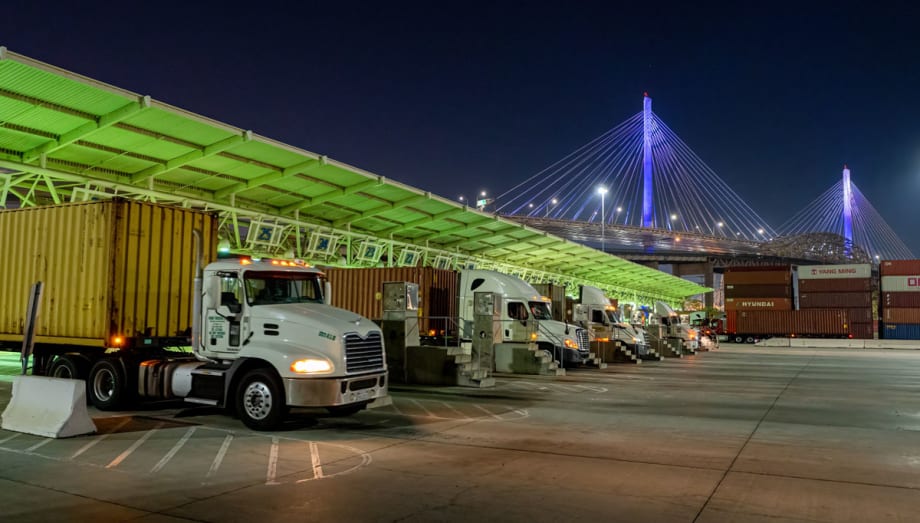
The Port of Long Beach started a pilot program to increase cargo pickup in the late night/early morning hours.
Photo: Port of Long Beach
3 min to read
The southern California ports are struggling with a historic surge in cargo as containers continue to stack up. In late September, there were an estimated 500,000 containers sitting on cargo ships off the coast, according to published reports, with a record 66 ships as of Sept. 29. Ships are waiting an average of six days to unload, compared to two days in more normal times, according to local station KTLA.
In response, the ports of Long Beach and Los Angeles announced new measures to improve freight movement and reduce delays through the ports.
Both ports are expanding the hours during which trucks can pick up and return containers.
The Port of Long Beach will take the first step towards a 24/7 supply chain by maximizing nighttime operations. A pilot program at its largest terminal is designed to increase cargo pickup in the late night/early morning hours. From 11 p.m. to 1:30 a.m. at its TTI Terminal, truckers with appointments during this period will get access whenever they arrive during that time.
TTI also is opening gates from 3-7 a.m. Monday to Thursday for two-way, prearranged “dual transaction” truck appointments to both drop off and pick up container in the same trip.
The Port of Los Angeles will expand weekend operating gate hours during a pilot project dubbed Accelerate Cargo LA.
In addition, both ports have called on marine terminal operators to incentivize the use of all available gate hours, especially night gates, to reduce congestion and maximize cargo throughput capacity.
The ports said they will work closely with the trucking community to ensure that truck operators understand how to take advantage of incentivized gate hours as well as the expanded opportunities to move cargo during non-peak times.
Gene Seroka, the executive director of the Port of Los Angeles, told a local CBS affiliate that the federal government needs to step up and invest in the ports. “This is what 10 years of under-investment looks like,” he said.
And it’s not just the SoCal ports.
Georgia’s Port of Savannah reported backlogs of more than 20 ships last month. Loaded container imports at the port are up more than 30% so far this year. The Georgia Ports Authority Board has approved more than $34 million to help expedite an additional 1.6 million twenty-foot equivalent container units in capacity that will begin coming online in December at the Port of Savannah.
At the Port of Jacksonville in Florida, a new $72 million project ultimately will allow the SSA Jacksonville Container Terminal at Blount Island to accommodate more containers to accommodate up to 500,000 TEUs annually, 150% higher than the current throughput. By the end of this project in 2024, the port aims to increase total TEU throughput by more than 40% to nearly 2 million TEUs annually.
More Fleet Management

Sponsored•September 16, 2026
Color Match Smarter: Tools That Restore & Perform
For fleet managers and collision repair professionals keeping heavy-duty trucks on the road, getting the color right the first time isn't just about appearance — it's about efficiency, turnaround time, and bottom-line results. Discover how today's digital color tools are transforming the repair process from guesswork to precision.
Read More →
FMCSA Pauses Biennial-Update Enforcement Amid Motus Transition
Carriers whose updates were due on or after June 1 have more time, while FMCSA works to stabilize its new registration system and warns of phishing sites impersonating its new carrier registration system, Motus.
Read More →
Sponsored•September 14, 2026
2026 Blueprint for Countering Smarter Supply Chain Theft
Cargo theft is no longer just the cost of doing business. It's a multi-billion-dollar criminal enterprise exploiting vulnerabilities across your fleet, drivers, and supply chain.
Read More →


Sponsored•September 1, 2026
How Telematics Improves Visibility, Control, and Performance in Refrigerated Fleets
Explore how telematics help refrigerated fleets improve visibility, uptime, efficiency, compliance, and cargo protection across connected cold chain operations.
Read More →
What the U.S.-Canada Trade War Means for Trucking
Escalating U.S.-Canada tariffs could disrupt cross-border freight, reduce truck volumes, raise costs, and create new uncertainty for carriers on both sides of the border.
Read More →
What Are Trucking’s Top Concerns for 2026?
The American Transportation Research Institute wants to know what's worrying trucking fleet managers, drivers, and other stakeholders in its annual Industry Issues survey.
Read More →
American Trucking Associations Looks for a New Leader
ATA President and CEO Chris Spear abruptly left his job at the association on August 21, at a pivotal time for the trucking industry.
Read More →
Public Wi-Fi Cybersecurity Risks: How Truck Drivers and Fleets Can Protect Their Data
Public Wi-Fi can expose truck drivers and fleets to credential theft, malware, and other cyber threats. Here’s how to reduce the risk on the road.
Read More →
For Nicky Cupp, Fleet Innovation Starts With Frustration
HDT Truck Fleet Innovator Nicky Cupp turns everyday pain points at Fraley & Schilling into opportunities for better technology and smarter processes.
Read More →
Adam Buttgenbach’s Approach to Electric Trucks: Start With Where They Fit
HDT Truck Fleet Innovator Adam Buttgenbach helped PepsiCo build one of North America’s largest EV fleets by focusing on where electric trucks make operational sense.
Read More →