





Are 'Electric Highways' the Answer to Trucking's Charging Problem?
Siemens Delivers 1 MW Charge to Electric Truck During Testing
Siemens said its new megawatt charging system could redefine long-haul operations with recharge times of around 30 minutes for Class 8 electric trucks.
April 29, 2024
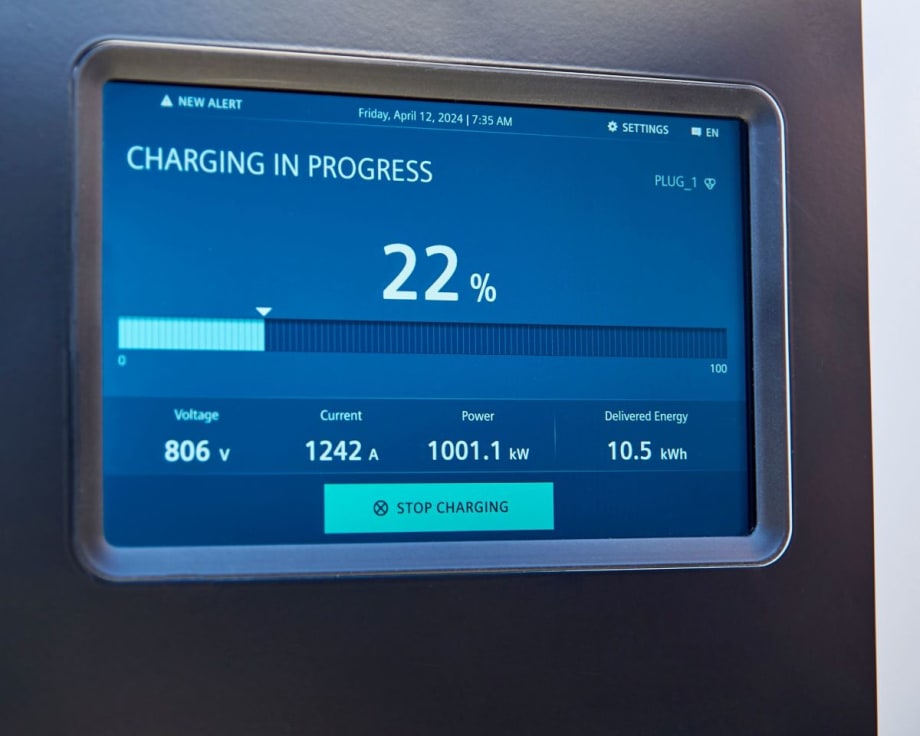
Siemens said electric trucks could be charged from 20 to 80 percent in about 30 minutes at a suitable charging station with an output of around one megawatt using its new charging system.
Photo: Siemens
2 min to read
Siemens Smart Infrastructure said it has completed the first successful 1 megawatt charge for commercial vehicles, calling it a technological breakthrough.
The company said the breakthrough came in a pilot program that brought together a prototype megawatt charging system station from Siemens and a long-haul prototype battery-electric truck from a well-established truck maker.
Currently, commercially available battery-electric trucks can't actually take advantage of a full MCS charge. But Siemens and other companies are developing and installing MCS charging in anticipation of truck technology advancements, noting that faster charging is needed in order for battery-electric vehicles to make sense for many trucking operations.
A Game-Changer for Truck Charging
Growth in the battery electric truck industry is being driven by technological developments in both battery and charger technology, Siemens said in a press release.
In combination with the current Combined Charging System, Siemens said the Megawatt Charging System standard will become a game-changer in heavy-duty electrification. So Siemens has introduced a prototype of the Sicharge Megawatt Charging System and recently announced a successfuly charging pilot with a battery-electric heavy-duty truck.
Siemens' MCS consists of multiple Sicharge UC150 power cabinets, a switching matrix, and a customized MCS dispenser.
The switching matrix is the central element in the MCS, bundling the output power of the charging stations and, depending on the requirement, directing the power to the MCS dispenser.
Batteries commonly used in electric trucks could go from a 20% charge to 80% in about 30 minutes at a suitable charging station with an output of around 1 megawatt.
“Especially in long-distance transport, electric trucks and coaches will need fast MCS during the legally prescribed driving time break," said Markus Mildner, CEO eMobility, Siemens Smart Infrastructure.
“The successful test brings us a big step forward on the technology side and underlines our ambition to actively make transport more sustainable.”
Siemens said the electrification of long-distance trucking will change the business model of transport companies and create room for competitive advantage on several levels.
More and more customers of transport companies are attaching importance to CO2-neutral transportation of their goods – providers who cannot meet this requirement will miss out, the company added.
More Fuel Smarts

How Volvo Updated Its D13 for EPA 2027 [Watch]
Volvo’s updated D13 promises lower emissions without sacrificing performance or fuel economy. Take a closer look at what changed inside the engine in this HDT Spotlight video.
Read More →
Diesel Price Spike Shortens Payback for Natural Gas Trucks, Report Says
Energy Vision estimates fleets could recover the higher purchase price of an RNG-fueled Class 8 tractor in 1.3 to 2.8 years under current fuel-price scenarios.
Read More →
Calstart Becomes Catalyst Mobility, Reflecting Broader Focus
Calstart is now Catalyst Mobility, reflecting the nonprofit’s growing national role in clean transportation, including zero-emission trucks, infrastructure and incentive programs.
Read More →

Record Diesel Prices Squeeze Trucking Fleets
Average U.S. diesel prices have climbed to nearly $6 a gallon, surpassing the 2022 record as tight refinery capacity and Middle East disruptions keep fuel costs elevated.
Read More →
Sponsored•September 9, 2026
How Fuel Delivery Shapes Engine Performance
Fuel delivery depends on more than what happens at the injector. For fleet, maintenance and technical professionals, looking at the full path from pump to injector can provide useful context for understanding engine performance.
Read More →
East Coast Port Launches $45M Electric Truck Push
The Port Authority of New York and New Jersey announced millions in incentives for zero-emission drayage trucks, yard tractors, and new charging hubs near the port.
Read More →
California Bill Could Shed Light on Electric Truck Prices
Why do battery-electric Class 8 trucks remain so expensive? A California bill headed to Gov. Gavin Newsom would give fleets and state agencies more visibility into what manufacturers charge.
Read More →
Detroit Opens Orders for EPA 2027 Engines
Detroit isn’t starting from scratch to meet EPA 2027 diesel emissions standards. Its Gen 6 DD13 and DD15 engines keep much of today’s platform while updating the fuel and aftertreatment systems.
Read More →
Zero-Emission Truck Corridor Planned for West Coast
California, Oregon, Washington, British Columbia and Baja California are coordinating plans for truck charging and hydrogen fueling from Canada to Mexico.
Read More →
A Closer Look at Kenworth’s Electric T880E Vocational Truck [Video]
Learn more about Kenworth's T880E battery-electric vocational truck at the Paccar Technical Center, including its range, applications, upfitting considerations, and PTO options, in this HDT Spotlight video.
Read More →