





Related: Mercedes Shows Autonomous Van Concept for Freight and Passengers
Scania Debuts Reconfigurable Urban Utility Vehicle Concept
Scania's new NXT electric, self-driving concept vehicle can be quickly reconfigured to meet changing fleet needs in the course of a single work day. It can be a commuter bus in the morning and evening, for example, and a refuse truck overnight.
June 10, 2019
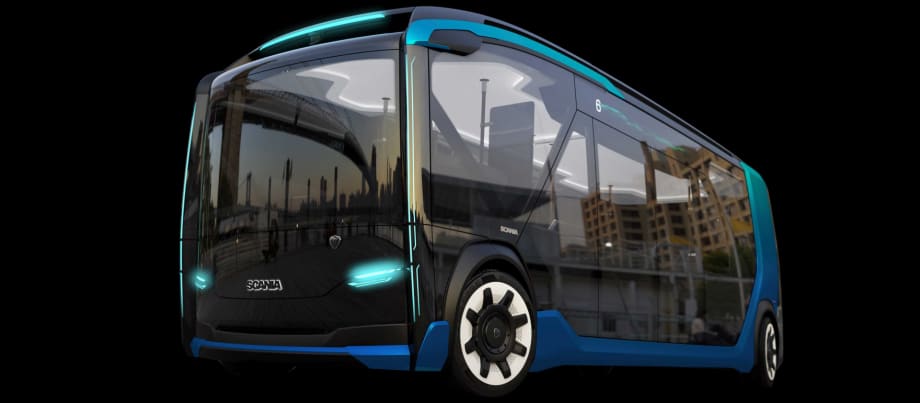
Scania's NXT concept vehicle features front and rear drive modules that can be fitted to a bus body, a distribution truck body or a refuse collector.
Photo: Scania
2 min to read
Is the vehicle a bus? Or a truck?
What if it’s both, depending upon requirements?
That’s the thinking behind Swedish truck maker Scania's new NXT concept vehicle – a modularly designed, self-driving electric vehicle that can change configurations to meet varying urban fleet requirements. The NXT features front and rear drive modules that can be fitted to a bus body, a distribution truck body, or a refuse collector. It can be a commuter bus in the morning and evening, for example, and a refuse truck overnight, and handle next-mile delivery during the day.
The 8-meter (26-foot) bus module is built as one composite unit, substantially reducing weight, Scania said. A bank of cylindrical cell batteries are placed under the floor to make use of otherwise dead space while contributing to overall weight distribution for the vehicle. The NXT tips the scales at less than 17,600 pounds. Scania said the range of it present-day batteries is estimated at 150 miles on a single charge.
Scania designers said the concept vehicle is a way of calling attention to the 24/7 flow of people and goods in cities, which the OEM said needs to be coherently addressed rather than disparately planned. Currently, Scania said, logistics flows in cities are far from being optimized, because goods are delivered during the morning rush hour while most people are also on the move.
Meanwhile, in Europe, commercial transport is largely barred from city centers during nights when people are asleep to keep noise levels down. Scania believes that a new generation of vehicles, like the NXT, based on common chassis and powertrains that can be quickly reconfigured to switch from different applications based on fleet needs or the time of day, is one way of addressing these problems while decreasing congestion and enhancing fleet optimization.
"NXT is a vision of the future for transport in cities,” said Scania President and CEO Henrik Henriksson in an announcement. "Several of these technologies have yet to fully mature but for us it's been important to actually build a concept vehicle to visibly and technically demonstrate ideas of what is within reach. NXT is designed for 2030 and beyond while incorporating several cutting-edge features that are already available."
More Fleet Management

Sponsored•September 16, 2026
Color Match Smarter: Tools That Restore & Perform
For fleet managers and collision repair professionals keeping heavy-duty trucks on the road, getting the color right the first time isn't just about appearance — it's about efficiency, turnaround time, and bottom-line results. Discover how today's digital color tools are transforming the repair process from guesswork to precision.
Read More →
FMCSA Pauses Biennial-Update Enforcement Amid Motus Transition
Carriers whose updates were due on or after June 1 have more time, while FMCSA works to stabilize its new registration system and warns of phishing sites impersonating its new carrier registration system, Motus.
Read More →
Sponsored•September 14, 2026
2026 Blueprint for Countering Smarter Supply Chain Theft
Cargo theft is no longer just the cost of doing business. It's a multi-billion-dollar criminal enterprise exploiting vulnerabilities across your fleet, drivers, and supply chain.
Read More →


Sponsored•September 1, 2026
How Telematics Improves Visibility, Control, and Performance in Refrigerated Fleets
Explore how telematics help refrigerated fleets improve visibility, uptime, efficiency, compliance, and cargo protection across connected cold chain operations.
Read More →
What the U.S.-Canada Trade War Means for Trucking
Escalating U.S.-Canada tariffs could disrupt cross-border freight, reduce truck volumes, raise costs, and create new uncertainty for carriers on both sides of the border.
Read More →
What Are Trucking’s Top Concerns for 2026?
The American Transportation Research Institute wants to know what's worrying trucking fleet managers, drivers, and other stakeholders in its annual Industry Issues survey.
Read More →
American Trucking Associations Looks for a New Leader
ATA President and CEO Chris Spear abruptly left his job at the association on August 21, at a pivotal time for the trucking industry.
Read More →
Public Wi-Fi Cybersecurity Risks: How Truck Drivers and Fleets Can Protect Their Data
Public Wi-Fi can expose truck drivers and fleets to credential theft, malware, and other cyber threats. Here’s how to reduce the risk on the road.
Read More →
For Nicky Cupp, Fleet Innovation Starts With Frustration
HDT Truck Fleet Innovator Nicky Cupp turns everyday pain points at Fraley & Schilling into opportunities for better technology and smarter processes.
Read More →
Adam Buttgenbach’s Approach to Electric Trucks: Start With Where They Fit
HDT Truck Fleet Innovator Adam Buttgenbach helped PepsiCo build one of North America’s largest EV fleets by focusing on where electric trucks make operational sense.
Read More →