





Related: FMCSA Releases Mandated ‘Corrective Action Plan’ for CSA Program
SambaSafety Prepping New CSA Scorecard
SambaSafety/Vigillo is developing a new CSA Scorecard that the company will make available to its customers ahead of the FMCSA's eventual rollout of a revised Safety Measurement System for its Carrier Safety Accountability enforcement regime.
October 3, 2018
3 min to read
SambaSafety/Vigillo is developing a new CSA Scorecard that the company will make available to its customers ahead of the Federal Motor Carrier Safety Administration's eventual rollout of a revised Safety Measurement System for its Carrier Safety Accountability enforcement regime.
"When CSA was first being tested in 2008, Vigillo was the industry leader in analyzing what fueled the scores and made the first CSA Scorecards available, nearly two years before the FMCSA program went live in December 2010," said Steve Bryan, executive vice president and GM of SambaSafety Transportation, during an Oct. 3 call with reporters. "Today, SambaSafety is leveraging Vigillo's expertise to help customers understand the new CSA scoring model long before it will be released.”
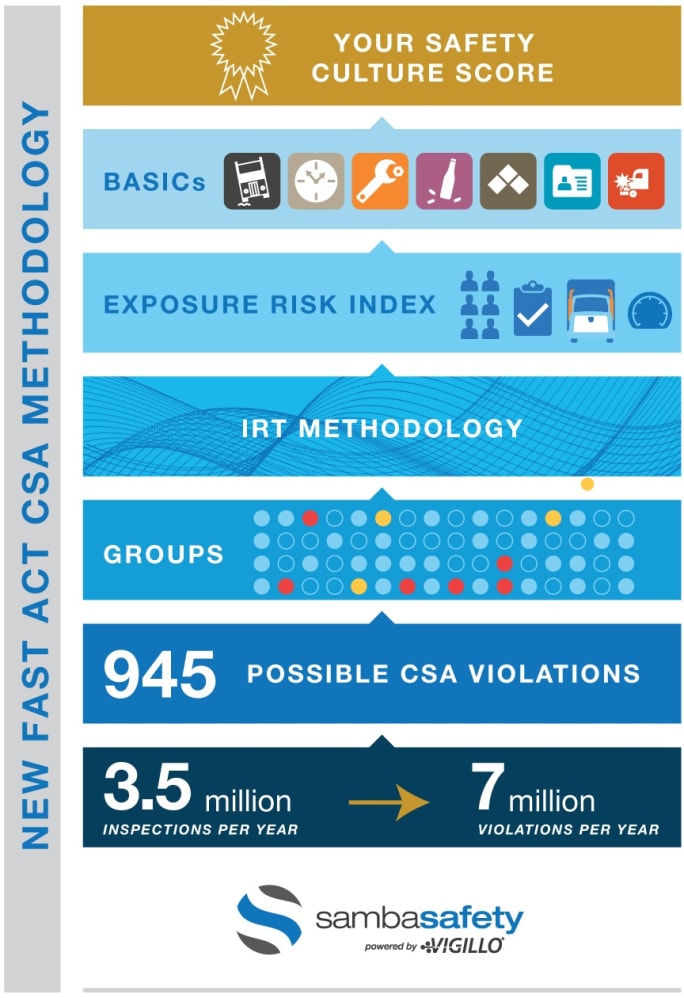
Source: SambaSafety
Bryan said that SambaSafety/Vigillo is finding that FMCSA’s use of Item Response Theory-based data analysis— as suggested to the agency by the National Academy of Sciences’ CSA review— is “moving in the right direction. Our analysis shows that the IRT model is an effective means of identifying a poor safety culture at a motor carrier” and will significantly improve the effectiveness of the CSA program.
More specifically, he said CSA scoring informed by IRT methodology would result “not in trying to predict future crash [risk], but would instead evaluate the existing ‘safety culture’ at a given fleet.”
He advised that “IRT is very complex and data-intensive, and almost completely changes the building blocks of CSA.” He said that once FMCSA enacts all the planned changes to CSA resulting from the NAS review, there will no longer be violation weights, CSA points, BASIC measures, or Safety Event Groups.
Instead, FMCSA will introduce a new, single CSA BASIC score that will be “a very different way of representing the safety culture of a motor carrier. By helping our customers manage that process in advance of the full [FMCSA] release, we are enabling them to look at the same data they will be seeing with the new scoring model."
Bryan said the company will be introducing its new model CSA scorecard to customers around Nov. 1. He told HDT that what SambaSafety customers will get is a combination educational and management tool they can start using right away to become familiar with the changes FMCSA will be implementing eventually.
Back in July, FMCSA said it would be develop and run a small scale IRT model by September of this year and, after evaluating the results, it would run a full scale IRT model by April 2019.
The NAS study and subsequent report was commissioned by FMCSA to comply with a provision of the FAST Act highway bill of 2015 that mandated a study be conducted of the agency’s CSA program and its Safety Measurement System component.
The hope of all this activity by the government is that an IRT-based analytical method will help develop “an estimate of the measure of ‘safety culture’ for each carrier and be used to monitor and identify carriers in need of intervention,” rather than just zero in on violations, said FMCSA Director of Compliance and Enforcement Joe DeLorenzo on Oct. 22, 2017, during an educational session at the American Trucking Associations’ annual Management Conference & Exhibition In Orlando, Florida.
More Safety & Compliance

FMCSA Pauses Biennial-Update Enforcement Amid Motus Transition
Carriers whose updates were due on or after June 1 have more time, while FMCSA works to stabilize its new registration system and warns of phishing sites impersonating its new carrier registration system, Motus.
Read More →
ZF Expands Commercial Vehicle Push in North America
ZF is expanding its North American commercial-vehicle presence with new transmission applications, electrification, trailer technology and autonomous-driving systems.
Read More →
Truck Drivers Need More Than Another Alert
Fleets have more visibility into truck health, safety events, and driver activity than ever. The next challenge is turning all that information into useful guidance for the person who has to decide what to do next.
Read More →
Tesla Wants a Self-Driving Semi. Are Cameras Enough?
Could Tesla’s camera-only autonomous driving technology work on an 80,000-pound Semi? In this commentary, HDT's Deborah Lockridge takes a look at Tesla, Cybercab, and how autonomous trucks see the road.
Read More →
What DOT’s Automated Vehicle Strategy Means for Trucking
The U.S. Department of Transportation issued a new automated-vehicle strategy that outlines plans for driverless-truck regulations, cross-state freight corridors, and federal safety standards.
Read More →
NYC Expands Speed, Pedestrian Safety Tech Across Fleet
New York City is expanding intelligent speed assistance and pedestrian-alert systems across its municipal fleet, moving the technologies from pilot programs into vehicle procurement and retrofit requirements.
Read More →
FMCSA Removes 110 Truck Driver Training Schools from Certified ELDT List
Federal regulators also are targeting more than 160 additional training providers and launching a nationwide audit of third-party CDL skills testers as part of a broader crackdown on trucking fraud.
Read More →
Beyond DOT Compliance: What Makes a Trucking Fleet Truly Safe?
A trucking fleet can follow every rule and still make unsafe decisions. The real test comes when safety conflicts with freight, productivity, or cost.
Read More →
Hours of Service Pilot Programs: FMCSA Readies for 2027 Rollout
Two pilot programs could eventually reshape hours-of-service rules, giving truck drivers options to pause their 14-hour clock or use longer split sleeper rest periods.
Read More →
New Guide Offers Pet Safety Tips for Truck Drivers
Hundreds of thousands of pets travel in truck cabs. A new safety guide from Volvo Trucks and the Center for Pet Safety offers practical advice for truck drivers who bring dogs and cats along for the ride.
Read More →