




Safety for the Long Haul Book Now Available
The American Trucking Associations (ATA) released Safety for the Long Haul, a comprehensive text on large truck safety
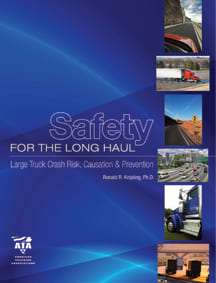
The American Trucking Associations (ATA) released Safety for the Long Haul, a comprehensive text on large truck safety.
The book, written by Dr. Ron Knipling, encompasses more than 100 specific topics relating to large truck crash risk, causation, countermeasures, safety management and safety policy.
"The trucking industry continues to advance an aggressive safety agenda and providing the most current information is key to that mission" said ATA president and CEO Bill Graves. "Safety for the Long Haul is the definitive source of the critical information needed to support the safety initiatives of our members and other transportation organizations."
Safety for the Long Haul: Large Truck Crash Risk, Causation & Prevention, by Ronald R. Knipling, Ph.D., published by American Trucking Associations is 619 pages. It's available to ATA members for $119, $159 for non-members. For a copy go to www.ATABusinessSolutions or call ATA Business Solutions at (866) 821-3458.
Following is a review of the book by Oliver B. Patton, Heavy Duty Trucking Washington editor, which appeared in the March issue of HDT.
Every truck safety professional in the country should read this book. And every trucking company owner or chief executive, upon whom the ultimate responsibility for safety lies, should be familiar with it. And so should the next chief of the Federal Motor Carrier Safety Administration.
What Ron Knipling, senior research scientist at the Virginia Tech Transportation Institute, has attempted here is to put forth in one document, for the first time, the current best understanding of the theory and practice of truck safety.
There aren't many who might be as qualified as he is to take on the subject. Knipling, who describes himself as an experimental psychologist, has been researching safety for 30 years. He began as a consultant to, and later was an employee of, the National Highway Traffic Safety Administration, where he did human factors and crash causation research. In 1995 he became the manager of the research program at the Office of Motor Carriers (predecessor to the Federal Motor Carrier Safety Administration). He left FMCSA for Virginia Tech in 2002.
This is a textbook, but it is not the practitioner's manual that trucking executives must master in order to obtain a safety manager or safety director certificate. Knipling said he hopes safety professionals will use the text to broaden and deepen their understanding of the work they do.
In 12 chapters, he covers the science of safety, driver risk, error and fatigue, the role of automobiles in truck safety, truck and roadway engineering, types of crashes, safety management including special topics such as driver retention and pay, and government regulation.
In the 13th and final chapter he proposes that it is time to change the way government approaches truck safety. "By and large, we already understand the elements of superior safety because they have been demonstrated," he writes. "We know what to do. We just haven't done it on a comprehensive scale."
Instead of "processed-based" regulation and enforcement, such as hours of service rules and roadside inspections, the emphasis should be on "active safety" - reduce driver errors and improve behavior in traffic by monitoring performance.
The current regulatory approach has worked - rules and enforcement are necessary - but it will not lead to maximum safety, he says.
For example, fatigue is an important cause of crashes and is fundamental to driver health,
Knipling said in an interview. "But it is not a major cause of crashes compared to speeding. Speeding is simpler and yet we're so obsessed with fatigue. We're obsessed with hours of service regulations, yet [they] only partially address the fatigue problem."
His thesis: "The foundation of truck safety is not the government, regulations and enforcement, industry officials or even the drivers themselves. It is carrier safety managers. All the players have critical roles, but the safety manager's role is pivotal."
Knipling says that the most innovative government and industry programs will be those that support carrier-based safety management. Key management concepts include proper driver selection and evaluation, a process that will greatly benefit from onboard safety management technologies that keep track of driver behavior - speeding or hard braking, for example.
He believes that onboard technologies will provide the biggest bang for the safety buck, partly by monitoring driver behavior and partly by reducing mistakes.
"Onboard safety monitoring captures behavior, which is at the core of risk," he writes. "Other methods [of driver evaluation] are necessary and helpful, but fall far short of OBSM in their effectiveness."
Knipling is not breaking new ground here. John Hill, the most recent chief of FMCSA, has said he believes that technologies such as collision and lane departure warning could lead to a 30 percent to 40 percent reduction in crashes and fatalities. FMCSA could spend a lot more money on staff and enforcement and not get those kinds of results, Hill said.
Much of the material in this book is technical, referencing dozens of scientific studies, as you would expect in an analysis of human behavior and performance. It is not a light read. But Knipling's style is straightforward and efficient, and he has a passion for the subject that carries him through.
Among the author's many collaborators was Dave Osiecki, vice president of safety, security and operations at the American Trucking Associations, who served as a primary editor. Osiecki said he is aware of no other text that pulls together the complex web of safety issues like this one does. His goal, he said, is to see every trucking company have it as a working reference.
Knipling wants that, and one more thing: "I hope it results in more respect for safety professionals."
More Safety & Compliance
PrePass, Kodiak Connect Driverless Trucks to Roadside Enforcement
The system will allow enforcement agencies to verify Enhanced Inspection information and decide whether Kodiak’s autonomous trucks can bypass roadside screening sites.
Read More →
From One Generation to the Next: How Mentorship Builds Safer Truck Drivers
After three decades in trucking, Harold Perry shares what he's learned about driver safety, mentorship, and helping the next generation build confidence behind the wheel.
Read More →
FMCSA Pauses Biennial-Update Enforcement Amid Motus Transition
Carriers whose updates were due on or after June 1 have more time, while FMCSA works to stabilize its new registration system and warns of phishing sites impersonating its new carrier registration system, Motus.
Read More →
ZF Expands Commercial Vehicle Push in North America
ZF is expanding its North American commercial-vehicle presence with new transmission applications, electrification, trailer technology and autonomous-driving systems.
Read More →
Truck Drivers Need More Than Another Alert
Fleets have more visibility into truck health, safety events, and driver activity than ever. The next challenge is turning all that information into useful guidance for the person who has to decide what to do next.
Read More →
Tesla Wants a Self-Driving Semi. Are Cameras Enough?
Could Tesla’s camera-only autonomous driving technology work on an 80,000-pound Semi? In this commentary, HDT's Deborah Lockridge takes a look at Tesla, Cybercab, and how autonomous trucks see the road.
Read More →
What DOT’s Automated Vehicle Strategy Means for Trucking
The U.S. Department of Transportation issued a new automated-vehicle strategy that outlines plans for driverless-truck regulations, cross-state freight corridors, and federal safety standards.
Read More →
NYC Expands Speed, Pedestrian Safety Tech Across Fleet
New York City is expanding intelligent speed assistance and pedestrian-alert systems across its municipal fleet, moving the technologies from pilot programs into vehicle procurement and retrofit requirements.
Read More →
FMCSA Removes 110 Truck Driver Training Schools from Certified ELDT List
Federal regulators also are targeting more than 160 additional training providers and launching a nationwide audit of third-party CDL skills testers as part of a broader crackdown on trucking fraud.
Read More →
Beyond DOT Compliance: What Makes a Trucking Fleet Truly Safe?
A trucking fleet can follow every rule and still make unsafe decisions. The real test comes when safety conflicts with freight, productivity, or cost.
Read More →