





Related: Getting Smart in the Warehouse
Ryder Rethinks Smart-Warehouse Concept
Ryder System has joined forces with new technology suppliers to showcase smart warehouse operations, such as robotics; autonomous vehicles and drones; sensors and automatic identification tools; and wearable technology.
January 17, 2019
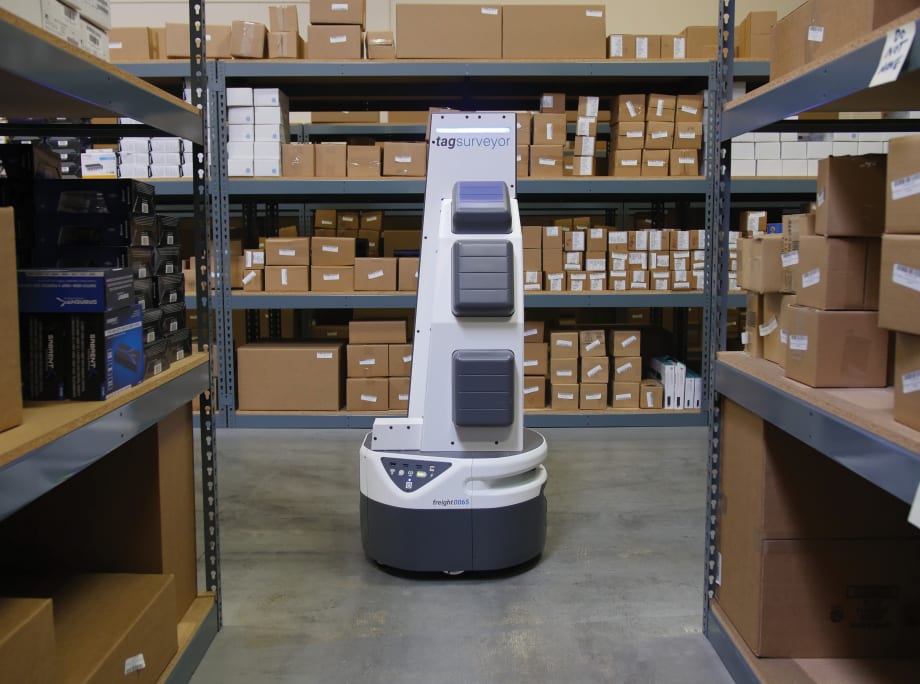
The Fetch Robotics TagSurveyor robots are performing automated cycle counting and reducing inventory loss in Ryder System warehouses by collecting, locating, and tracking RFID tags on products and bins.
Photo: Ryder System
3 min to read
Ryder System has announced what it calls a “successful transformation” of Ryder smart warehouses in the Miami, Dallas, and Chicago markets. Ryder officials say these transformed warehouses – or showcase sites – deliver advanced automation, flexible and instantly scalable operations, real-time visibility, and a customer-centric experience. The warehouses, established for three leading global consumer brands, bring together innovative startup technologies and smart capabilities customized to optimize operations and best serve customer needs.
The Ryder smart warehouse showcase sites feature advanced automation, such as state-of-the-art robotics; autonomous vehicles and drones; sensors and automatic identification tools; and wearable technology, like smart glasses and ring scanners.
Ryder says it has identified specific new and emerging technologies as new benchmarks of an effective smart warehouse, capable of delivering for its customers. Among them:
Robotics – The implementation of robotics throughout a Ryder-managed warehouse produced a 25% increase in productivity and 20% operating savings, simply by reducing travel time in the warehouse, which can account for 30% of an employee’s shift.
Drones – At a Ryder customer warehouse, drones successfully scanned pallets and locations in 20 minutes, compared to a manual scan, which took 90 minutes. Additionally, a cycle count on the entire warehouse took just three hours versus two days. The drone can also identify available pallet locations and verify product placement.
Sensors – Identification tools provide real-time asset location and enable performance management. When implemented throughout a Ryder facility, productivity and cost savings increased more than 25%.
Wearables – When Ryder deployed smart glasses at a customer warehouse to improve picking processes, the time it took to pick and scan inventory decreased by five to seven seconds per item and improved efficiency by 33%.
“We are evaluating advanced technology and automation solutions that require minimum investment but deliver maximum return,” said Steve Sensing, Ryder president of Global Supply Chain Solutions. “We focus on technologies that are mobile, flexible, and scalable, so they can flex with changing demands. As Ryder customers continue to face increasing omni-channel fulfillment demands, rising consumer expectations, and a nationwide warehouse labor shortage, we will continue to innovate and automate the parts of the process that make sense.”
Ryder has partnered with start-ups such as Fetch Robotics to provide the technologies that bring what was once considered the warehouse-of-the-future to life.
“Ryder – with its established network and broad bench of diverse customers – is the ideal partner for Fetch Robotics to implement our advanced robotics platform,” said Melonee Wise, CEO of Fetch Robotics. “Together, our companies can provide autonomous mobile robot solutions to serve both warehouse employees and Ryder’s customers; ultimately making supply chain and logistics safer and more efficient. Our top priority is to help our customers achieve on-demand automation with a fast, flexible and scalable cloud-based platform that minimizes strenuous manual labor and streamlines inventory processes. We’re seeing this come to life successfully through the smart warehouses Ryder has developed.”
More Fleet Management

Sponsored•September 16, 2026
Color Match Smarter: Tools That Restore & Perform
For fleet managers and collision repair professionals keeping heavy-duty trucks on the road, getting the color right the first time isn't just about appearance — it's about efficiency, turnaround time, and bottom-line results. Discover how today's digital color tools are transforming the repair process from guesswork to precision.
Read More →
FMCSA Pauses Biennial-Update Enforcement Amid Motus Transition
Carriers whose updates were due on or after June 1 have more time, while FMCSA works to stabilize its new registration system and warns of phishing sites impersonating its new carrier registration system, Motus.
Read More →
Sponsored•September 14, 2026
2026 Blueprint for Countering Smarter Supply Chain Theft
Cargo theft is no longer just the cost of doing business. It's a multi-billion-dollar criminal enterprise exploiting vulnerabilities across your fleet, drivers, and supply chain.
Read More →


Sponsored•September 1, 2026
How Telematics Improves Visibility, Control, and Performance in Refrigerated Fleets
Explore how telematics help refrigerated fleets improve visibility, uptime, efficiency, compliance, and cargo protection across connected cold chain operations.
Read More →
What the U.S.-Canada Trade War Means for Trucking
Escalating U.S.-Canada tariffs could disrupt cross-border freight, reduce truck volumes, raise costs, and create new uncertainty for carriers on both sides of the border.
Read More →
What Are Trucking’s Top Concerns for 2026?
The American Transportation Research Institute wants to know what's worrying trucking fleet managers, drivers, and other stakeholders in its annual Industry Issues survey.
Read More →
American Trucking Associations Looks for a New Leader
ATA President and CEO Chris Spear abruptly left his job at the association on August 21, at a pivotal time for the trucking industry.
Read More →
Public Wi-Fi Cybersecurity Risks: How Truck Drivers and Fleets Can Protect Their Data
Public Wi-Fi can expose truck drivers and fleets to credential theft, malware, and other cyber threats. Here’s how to reduce the risk on the road.
Read More →
For Nicky Cupp, Fleet Innovation Starts With Frustration
HDT Truck Fleet Innovator Nicky Cupp turns everyday pain points at Fraley & Schilling into opportunities for better technology and smarter processes.
Read More →
Adam Buttgenbach’s Approach to Electric Trucks: Start With Where They Fit
HDT Truck Fleet Innovator Adam Buttgenbach helped PepsiCo build one of North America’s largest EV fleets by focusing on where electric trucks make operational sense.
Read More →