





Related: HDT's New Podcast Debuts with Episodes on Safety, Electric Trucks
Roadcheck 2020 to Focus on Driver Inspections
The Commercial Vehicle Safety Alliance's International Roadcheck will take place May 5-7 and focus on truck driver violations.
January 27, 2020
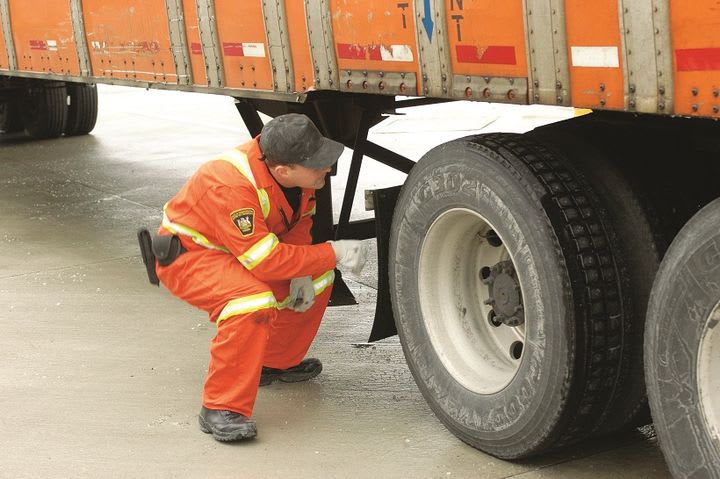
Each year, International Roadcheck places special emphasis on a category of violations. This year's focus is on the driver requirements category of a roadside inspection.
Photo: Jim Park
4 min to read
Even though it’s a little earlier this year, ‘tis the season for a Roadcheck inspection blitz. The Commercial Vehicle Safety Alliance announced that its annual International Roadcheck commercial vehicle inspection blitz week will take place across the United States May 5-7. Roadcheck has traditioinally been held the first week of June. However, this year, the date was moved up by one month, from June to May, when the weather may be more favorable for many jurisdictions, CVSA said.
International Roadcheck is a high-volume, high-visibility three-day enforcement initiative that highlights the importance of commercial motor vehicle safety through roadside inspections. Over that 72-hour period, commercial motor vehicle inspectors in jurisdictions throughout North America will conduct inspections on commercial motor vehicles and drivers.
Each year, International Roadcheck places special emphasis on a category of violations. This year's focus is on the driver requirements category of a roadside inspection.
According to the Federal Motor Carrier Safety Administration's fiscal 2019 data (as of Dec. 27, 2019), of the 3.36 million inspections conducted, 944,794 driver violations were discovered, of which 195,545 were out-of-service conditions.
"With last year's federal electronic logging device full-compliance mandate in the U.S., the alliance decided that this year's International Roadcheck would be the perfect opportunity to revisit all aspects of roadside inspection driver requirements," said CVSA President John Samis with the Delaware State Police.
About the inspections
During Roadcheck, CVSA-certified inspectors primarily conduct the North American Standard Level I Inspection, a 37-step procedure that includes two main inspection categories: an examination of driver operating requirements and vehicle mechanical fitness. A third category, hazardous materials/dangerous goods, may also be part of a Level I Inspection. Depending on weather conditions, available resources or other factors, inspectors may opt to conduct the Level II Walk-Around Driver/Vehicle Inspection, Level III Driver/Credential/Administrative Inspection or Level V Vehicle-Only Inspection.
An inspector will start each inspection procedure by greeting, interviewing and preparing the driver. The inspector will collect and verify the driver's documents, identify the motor carrier, examine the driver's license or commercial driver's license, check record of duty status and review periodic inspection report(s). If applicable, the inspector will check the Medical Examiner's Certificate, Skill Performance Evaluation Certificate, and the driver's daily vehicle inspection report. Inspectors will also check drivers for seat belt usage, illness, fatigue, and apparent alcohol and/or drug possession or impairment.
The vehicle inspection includes checking critical vehicle inspection items such as brake systems, cargo securement, coupling devices, driveline/driveshaft components, driver's seat (missing), exhaust systems, frames, fuel systems, lighting devices, steering mechanisms, suspensions, tires, van and open-top trailer bodies, wheels, rims and hubs, and windshield wipers.
If no critical vehicle inspection item violations are found during a Level I or Level V Inspection, a CVSA decal will be applied to the vehicle, indicating that the vehicle successfully passed a decal-eligible inspection conducted by a CVSA-certified inspector.
If an inspector does identify critical vehicle inspection item violations, he or she may render the vehicle out of service if the condition meets the North American Standard Out-of-Service Criteria. This means the vehicle cannot be operated until the vehicle violation(s) are corrected. A driver can also be placed out of service for driver credential-related issues or driver conditions, such as fatigue or impairment.
"Announcing the dates of International Roadcheck has always been a deliberate, thoughtful and purposeful decision by the Alliance," said Sgt. Samis. "By announcing the dates in advance, we hope to remind motor carriers of the importance of proactive vehicle maintenance and remind drivers to be prepared for inspections and to always conduct pre- and post-trip inspections. We want every vehicle and driver inspected during this initiative to pass inspection with no violations."
Samis added, "We're aware that some drivers opt to stay off roadways during the three days of International Roadcheck. Although there is certainly an increase in the number of inspections conducted during International Roadcheck, it's important to remember that inspections are conducted every day of the year. Inspectors will be inspecting commercial motor vehicles the day before International Roadcheck starts, the day after it ends, as well as any other day of the year."
International Roadcheck is the largest targeted enforcement program on commercial motor vehicles in the world, with approximately 17 trucks and buses inspected, on average, every minute in Canada, Mexico and the U.S. during a 72-hour period. Since its inception in 1988, more than 1.6 million roadside inspections have been conducted during International Roadcheck campaigns.
More Safety & Compliance

FMCSA Pauses Biennial-Update Enforcement Amid Motus Transition
Carriers whose updates were due on or after June 1 have more time, while FMCSA works to stabilize its new registration system and warns of phishing sites impersonating its new carrier registration system, Motus.
Read More →
ZF Expands Commercial Vehicle Push in North America
ZF is expanding its North American commercial-vehicle presence with new transmission applications, electrification, trailer technology and autonomous-driving systems.
Read More →
Truck Drivers Need More Than Another Alert
Fleets have more visibility into truck health, safety events, and driver activity than ever. The next challenge is turning all that information into useful guidance for the person who has to decide what to do next.
Read More →
Tesla Wants a Self-Driving Semi. Are Cameras Enough?
Could Tesla’s camera-only autonomous driving technology work on an 80,000-pound Semi? In this commentary, HDT's Deborah Lockridge takes a look at Tesla, Cybercab, and how autonomous trucks see the road.
Read More →
What DOT’s Automated Vehicle Strategy Means for Trucking
The U.S. Department of Transportation issued a new automated-vehicle strategy that outlines plans for driverless-truck regulations, cross-state freight corridors, and federal safety standards.
Read More →
NYC Expands Speed, Pedestrian Safety Tech Across Fleet
New York City is expanding intelligent speed assistance and pedestrian-alert systems across its municipal fleet, moving the technologies from pilot programs into vehicle procurement and retrofit requirements.
Read More →
FMCSA Removes 110 Truck Driver Training Schools from Certified ELDT List
Federal regulators also are targeting more than 160 additional training providers and launching a nationwide audit of third-party CDL skills testers as part of a broader crackdown on trucking fraud.
Read More →
Beyond DOT Compliance: What Makes a Trucking Fleet Truly Safe?
A trucking fleet can follow every rule and still make unsafe decisions. The real test comes when safety conflicts with freight, productivity, or cost.
Read More →
Hours of Service Pilot Programs: FMCSA Readies for 2027 Rollout
Two pilot programs could eventually reshape hours-of-service rules, giving truck drivers options to pause their 14-hour clock or use longer split sleeper rest periods.
Read More →
New Guide Offers Pet Safety Tips for Truck Drivers
Hundreds of thousands of pets travel in truck cabs. A new safety guide from Volvo Trucks and the Center for Pet Safety offers practical advice for truck drivers who bring dogs and cats along for the ride.
Read More →