




Report: Overall Freight Shipping Levels, Rates Better than They First Look
While a measure of total U.S. freight shipments in October broke a string of being in negative territory for 20 months, November fell back while separate reports for the month show an improvement in intermodal rates for the second consecutive month while truckload linehaul rates turned lower.
Graphic: Cass Information Systems
Graphic: Cass Information Systems
While a measure of total U.S. freight shipments in October broke a string of being in negative territory for 20 months, November fell back while separate reports for the month show an improvement in intermodal rates for the second consecutive month while truckload linehaul rates turned lower.
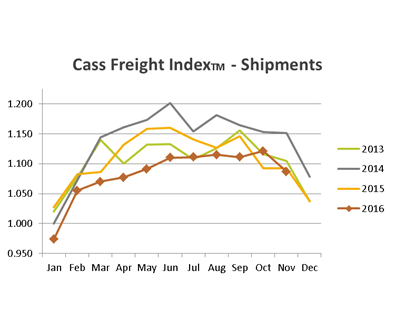
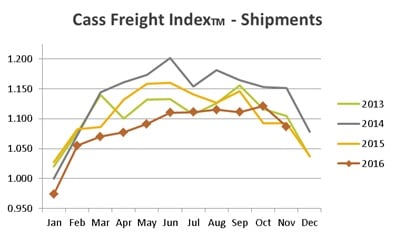
The Cass Freight Index, which measures the volume of shipments and expenditures for freight shipments across all transportation modes, showed in November that shipments declined 0.5% from November 2015 and posted a wider 3% drop from October.
Also, the index’s measure of freight expenditures fell a larger 4.5% in November from a year ago and is down 1.8% last month from October.
Despite these downturns, there is some good news, according to the report’s author, Donald Broughton, who is also managing director, chief market strategist and senior transportation analyst at investment firm Avondale Partners.
“We have seen a wide range of results in the different modes, from continued volume growth in parcel and airfreight driven by e-commerce, to a sequential improvement in truck tonnage, to less bad rail and barge volume overall,” he wrote.
“Although it is far too early to make a ‘change in trend’ call," he continued, "data is beginning to suggest that the consumer is finally starting to spend a little, and that with the recent surge in the price of crude the industrial economy’s rate of deceleration has eased. If the winter of the current year-and-a-half freight recession in the U.S. is not over, it is certainly showing increasing signs of thawing.”
He said when it comes to shipments, the month-over-month pattern looked a bit more ominous, but doesn’t give him great cause for concern.
“There is some degree of normal seasonality at work, and we are currently getting daily reports of stronger shipment volume in almost all modes from both hard data sources and industry anecdotes,” Broughton said.
Meantime, the Cass Intermodal Price Index, which measures all costs, including linehaul, fuel and accessorials, increased 0.3% in November from the same time a year ago following a 0.4% improvement in October. Despite this index reading of 125.7, it was pulled down from 130.4 in October due to a 3.6% drop in November from the month before.
"This marked the second consecutive month of increases with the data set being influenced by fuel [costs] up 4.2% year-over-year,” said Avondale Partners, which provides analysis of the report.
It was somewhat reserved about other near-term improvements in intermodal freight rates. "We concede that the extent to which loads can be shifted from domestic intermodal back to over-the-road truck is dependent on trucking capacity, which is currently available in most lanes.”
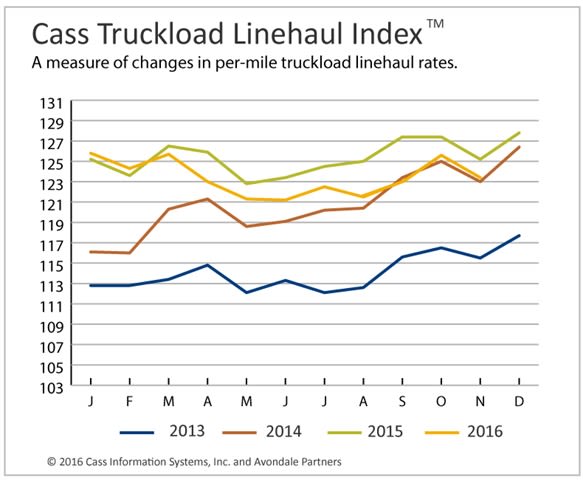
Finally, the Cass Truckload Linehaul Index, which gauges truckload pricing minus other components such as fuel and accessorials, fell 1.5% in November from a year earlier, the ninth straight such drop, and is down 1.8% last month from October. Despite this, the reading of 123.4 is still the second-best since March, leading to cautious optimism.
Graphic: Cass Information Systems
“The current strength being reported in spot rates is leading us to believe that our current 3% [decline] to a 1% [increase in our] truckload pricing forecast may need to be improved/moved to a slightly more positive outlook if the strength in spot rates continues long enough to move contract rates back into positive territory,” said Avondale Partners.
Data in both the Cass Intermodal Price Index and the Cass Truckload Linehaul Index is based on actual freight invoices paid on behalf of clients of freight payment processor Cass Information Systems, which totaled $25 billion in 2015.
More Fleet Management

Color Match Smarter: Tools That Restore & Perform
For fleet managers and collision repair professionals keeping heavy-duty trucks on the road, getting the color right the first time isn't just about appearance — it's about efficiency, turnaround time, and bottom-line results. Discover how today's digital color tools are transforming the repair process from guesswork to precision.
Read More →
FMCSA Pauses Biennial-Update Enforcement Amid Motus Transition
Carriers whose updates were due on or after June 1 have more time, while FMCSA works to stabilize its new registration system and warns of phishing sites impersonating its new carrier registration system, Motus.
Read More →
2026 Blueprint for Countering Smarter Supply Chain Theft
Cargo theft is no longer just the cost of doing business. It's a multi-billion-dollar criminal enterprise exploiting vulnerabilities across your fleet, drivers, and supply chain.
Read More →


How Telematics Improves Visibility, Control, and Performance in Refrigerated Fleets
Explore how telematics help refrigerated fleets improve visibility, uptime, efficiency, compliance, and cargo protection across connected cold chain operations.
Read More →
What the U.S.-Canada Trade War Means for Trucking
Escalating U.S.-Canada tariffs could disrupt cross-border freight, reduce truck volumes, raise costs, and create new uncertainty for carriers on both sides of the border.
Read More →
What Are Trucking’s Top Concerns for 2026?
The American Transportation Research Institute wants to know what's worrying trucking fleet managers, drivers, and other stakeholders in its annual Industry Issues survey.
Read More →
American Trucking Associations Looks for a New Leader
ATA President and CEO Chris Spear abruptly left his job at the association on August 21, at a pivotal time for the trucking industry.
Read More →
Public Wi-Fi Cybersecurity Risks: How Truck Drivers and Fleets Can Protect Their Data
Public Wi-Fi can expose truck drivers and fleets to credential theft, malware, and other cyber threats. Here’s how to reduce the risk on the road.
Read More →
For Nicky Cupp, Fleet Innovation Starts With Frustration
HDT Truck Fleet Innovator Nicky Cupp turns everyday pain points at Fraley & Schilling into opportunities for better technology and smarter processes.
Read More →
Adam Buttgenbach’s Approach to Electric Trucks: Start With Where They Fit
HDT Truck Fleet Innovator Adam Buttgenbach helped PepsiCo build one of North America’s largest EV fleets by focusing on where electric trucks make operational sense.
Read More →