




Related: Truck Cargo Thefts on The Rise
Report: Cargo Thieves 'Nuts' About Nuts
The upcoming harvest season for nuts is expected to get increased attention from cargo thieves in 2016, following big jumps in stealing the previous two years.

Evan Lockridge・Former Business Contributing Editor

Graph: FreightWatch International
2 min to read
Graph: FreightWatch International
The upcoming harvest season for one particular type of food is expected to get increased attention again from cargo thieves following big jumps in stealing the previous two years.
Nuts have become a sought after commodity for organized cargo thefts because of their high value density per truckload and typically low security protocols, according to a new report by the logistics security services provider FreightWatch International
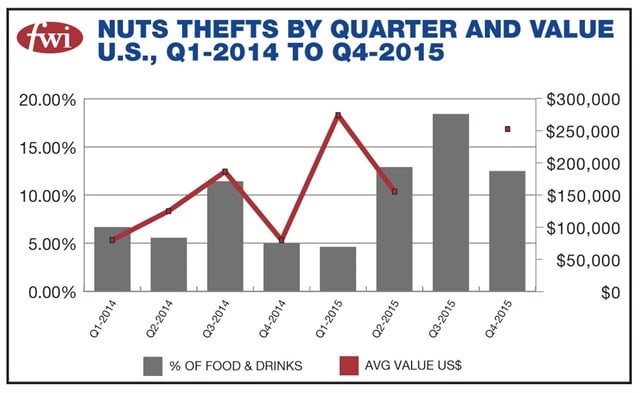
“Since the harvest season for most commercially grown nuts is from August to September, it stands to reason that the third quarter of each year tends to record the most nuts thefts, as was the case in 2014 and 2015,” the report says.
The third quarters of 2015 and 2014 each accounted for more than a third of all annual U.S. nuts thefts. The thefts carried an average value of $215,719 last year, 65% higher than the average value in 2014.
“Nuts will likely gain in popularity amongst cargo thieves due to their value and lack of serialization or refrigeration needs, unless steps are taken to secure the supply chain and increase security on these shipments,” says the Freightwatch report. “As of the publication of this report, measures are being taken in California to create a law enforcement task force specifically aimed at combating high value Nuts thefts.”
Geographically, California is the leader in nut theft, accounting for 81% nationwide. Also, because 99% of the country’s walnuts are grown in the state, three of the top 10 agricultural products of California are nuts. With foreign nuts also being imported through the Ports of Long Beach and Los Angeles, it’s clear why the Golden State is the nut theft capital of the country.
Fictitious pickup was by far the most common method of theft, accounting for nearly half of all nut thefts. By comparison, no other product has as high a share of thefts by ficticious pickup, according to the report.
“This fact is indicative of the interest already being shown by organized cargo criminals to obtain this product,” FreightWatch says. “Typical scouting techniques on internet load boards for fictitious pickups, such as high requirements for insurance or team drivers, can be coupled with the unique geography of nuts producers to identify with near certainty the contents of a shipment before the criminal bids on a load. As such, this atypical theft type is particularly well suited towards nuts.”
More Fleet Management

Sponsored•September 16, 2026
Color Match Smarter: Tools That Restore & Perform
For fleet managers and collision repair professionals keeping heavy-duty trucks on the road, getting the color right the first time isn't just about appearance — it's about efficiency, turnaround time, and bottom-line results. Discover how today's digital color tools are transforming the repair process from guesswork to precision.
Read More →
FMCSA Pauses Biennial-Update Enforcement Amid Motus Transition
Carriers whose updates were due on or after June 1 have more time, while FMCSA works to stabilize its new registration system and warns of phishing sites impersonating its new carrier registration system, Motus.
Read More →
Sponsored•September 14, 2026
2026 Blueprint for Countering Smarter Supply Chain Theft
Cargo theft is no longer just the cost of doing business. It's a multi-billion-dollar criminal enterprise exploiting vulnerabilities across your fleet, drivers, and supply chain.
Read More →


Sponsored•September 1, 2026
How Telematics Improves Visibility, Control, and Performance in Refrigerated Fleets
Explore how telematics help refrigerated fleets improve visibility, uptime, efficiency, compliance, and cargo protection across connected cold chain operations.
Read More →
What the U.S.-Canada Trade War Means for Trucking
Escalating U.S.-Canada tariffs could disrupt cross-border freight, reduce truck volumes, raise costs, and create new uncertainty for carriers on both sides of the border.
Read More →
What Are Trucking’s Top Concerns for 2026?
The American Transportation Research Institute wants to know what's worrying trucking fleet managers, drivers, and other stakeholders in its annual Industry Issues survey.
Read More →
American Trucking Associations Looks for a New Leader
ATA President and CEO Chris Spear abruptly left his job at the association on August 21, at a pivotal time for the trucking industry.
Read More →
Public Wi-Fi Cybersecurity Risks: How Truck Drivers and Fleets Can Protect Their Data
Public Wi-Fi can expose truck drivers and fleets to credential theft, malware, and other cyber threats. Here’s how to reduce the risk on the road.
Read More →
For Nicky Cupp, Fleet Innovation Starts With Frustration
HDT Truck Fleet Innovator Nicky Cupp turns everyday pain points at Fraley & Schilling into opportunities for better technology and smarter processes.
Read More →
Adam Buttgenbach’s Approach to Electric Trucks: Start With Where They Fit
HDT Truck Fleet Innovator Adam Buttgenbach helped PepsiCo build one of North America’s largest EV fleets by focusing on where electric trucks make operational sense.
Read More →