




Renewable Diesel Depot Opens in California
T Bros Oil and Gas said its new renewable diesel depot in Barstow, California features advanced infrastructure that positions it as a cornerstone for clean energy innovation.

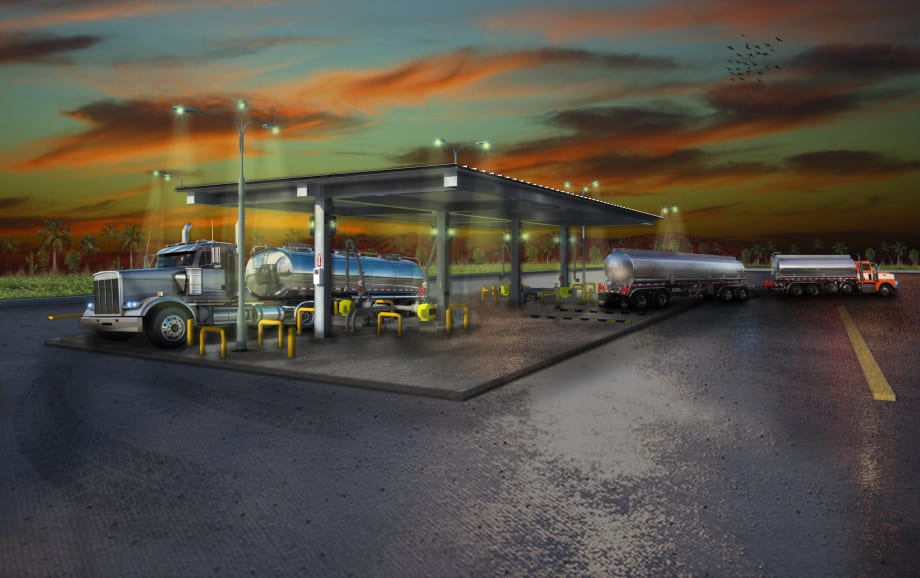
An artist's rendering of the new T Bros renewable diesel fuel depot near Barstow, California.
Image: T Bros Oil and Gas
T Bros Oil & Gas Co. announced the grand opening of its state-of-the-art bulk renewable diesel depot in Barstow, California, set for Summer 2025.
The company said this “cutting-edge” facility marks a transformative step for sustainable logistics and economic growth within the vital Southern California transportation corridor. It also reinforces Barstow's role in the region's supply chain.
According to the company, the depot's advanced infrastructure and strategic foresight position it as a cornerstone for clean energy innovation.
Complimenting the Region’s BIG Project
The new depot is located at 2957 Lenwood Road. It aligns with the transformative Barstow International Gateway (BIG) project.
The BIG project is $1.5 billion, 4,800-acre rail yard, intermodal facility, and logistics park set to begin construction in late 2026.
The BIG project is expected to create an estimated 20,000 direct and indirect jobs, including roles in rail operations, logistics, and supporting industries.
By launching ahead of BIG, the depot proactively addresses the anticipated surge in clean fuel demand driven by this development, the company said.
Its prime location near I-15 and Highway 58 integrates with Barstow's 2048 Growth Plan, which prioritizes industrial development in this corridor. The region is also a critical fuel distribution point via the Kinder Morgan CALNEV pipeline.
The depot is engineered for high-volume wholesale distribution, initially offering conventional Ultra-Low Sulfur Diesel (ULSD) through the Kinder Morgan pipeline in Summer 2025.
According to T Bros, the site is equipped with state-of-the-art systems for efficient rack loading, precise blending, secure storage, and high-capacity throughput. It opens with two loading racks. That capacity will expand to six by year’s end.
The modern infrastructure adheres to rigorous safety and environmental standards. It also minimizes downtime for customer fleets and aligns with industry best practices for automated fuel terminals, ensuring rapid turnarounds and reliable supply.
By late 2025, a "mini-refinery" will be added to the facility for the production of renewable diesel.
This is a new type of fuel refinery that T Bros said introduces a new paradigm to the fuel industry:
The equipment is safe to run without dangerous chemicals.
No pollution escapes the machine to air, water, or the ground.
The equipment scales to any desired throughput.
What is Renewable Diesel Fuel?
Renewable diesel is a premium "drop-in" biofuel, chemically identical to petroleum diesel by meeting ASTM D975 standards.
It requires no engine modifications or infrastructure upgrades, lowering barriers for logistics companies adopting sustainable fuels.
With enhanced fuel efficiency and reduced emissions, it supports improved vehicle performance and compliance with California's stringent environmental regulations, ensuring operational stability in a green economy. This compatibility accelerates the adoption of cleaner fuels across the transportation sector.
"This depot is a cornerstone of sustainable commerce," said Timothy Wetzel, chief technology officer, T Bros. "It supports the growth driven by the Barstow International Gateway while enabling businesses to achieve environmental and operational excellence, cementing Barstow's transformation into a premier green logistics hub for California and beyond."
More Fuel Smarts

How Volvo Updated Its D13 for EPA 2027 [Watch]
Volvo’s updated D13 promises lower emissions without sacrificing performance or fuel economy. Take a closer look at what changed inside the engine in this HDT Spotlight video.
Read More →
Diesel Price Spike Shortens Payback for Natural Gas Trucks, Report Says
Energy Vision estimates fleets could recover the higher purchase price of an RNG-fueled Class 8 tractor in 1.3 to 2.8 years under current fuel-price scenarios.
Read More →
Calstart Becomes Catalyst Mobility, Reflecting Broader Focus
Calstart is now Catalyst Mobility, reflecting the nonprofit’s growing national role in clean transportation, including zero-emission trucks, infrastructure and incentive programs.
Read More →

Record Diesel Prices Squeeze Trucking Fleets
Average U.S. diesel prices have climbed to nearly $6 a gallon, surpassing the 2022 record as tight refinery capacity and Middle East disruptions keep fuel costs elevated.
Read More →
How Fuel Delivery Shapes Engine Performance
Fuel delivery depends on more than what happens at the injector. For fleet, maintenance and technical professionals, looking at the full path from pump to injector can provide useful context for understanding engine performance.
Read More →
East Coast Port Launches $45M Electric Truck Push
The Port Authority of New York and New Jersey announced millions in incentives for zero-emission drayage trucks, yard tractors, and new charging hubs near the port.
Read More →
California Bill Could Shed Light on Electric Truck Prices
Why do battery-electric Class 8 trucks remain so expensive? A California bill headed to Gov. Gavin Newsom would give fleets and state agencies more visibility into what manufacturers charge.
Read More →
Detroit Opens Orders for EPA 2027 Engines
Detroit isn’t starting from scratch to meet EPA 2027 diesel emissions standards. Its Gen 6 DD13 and DD15 engines keep much of today’s platform while updating the fuel and aftertreatment systems.
Read More →
Zero-Emission Truck Corridor Planned for West Coast
California, Oregon, Washington, British Columbia and Baja California are coordinating plans for truck charging and hydrogen fueling from Canada to Mexico.
Read More →
A Closer Look at Kenworth’s Electric T880E Vocational Truck [Video]
Learn more about Kenworth's T880E battery-electric vocational truck at the Paccar Technical Center, including its range, applications, upfitting considerations, and PTO options, in this HDT Spotlight video.
Read More →