




Regulatory Climate Explored at Zonar Conference
The Federal Motor Carrier Safety Administration has a number of proposed rules scheduled for this summer, including establishing a drug and alcohol database, mandatory speed limiters and prohibiting driver coercion. However, proposals on electronic logs, entry-level driver training and safety fitness probably won't be unveiled as scheduled, according to a panel discussion May 15 during Zonar's inaugural user's conference.

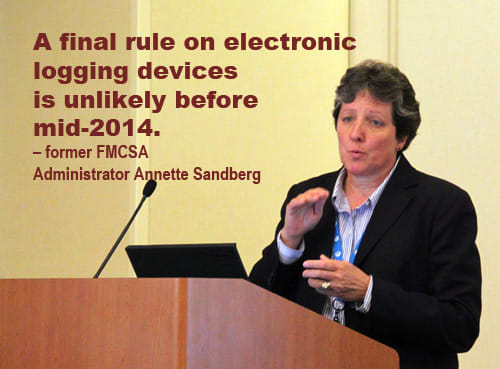
Annette Sandberg, CEO of TransSafe Consulting and former FMCSA administrator.
Annette Sandberg, CEO of TransSafe Consulting and former FMCSA administrator.
The Federal Motor Carrier Safety Administration has a number of proposed rules scheduled for this summer, including establishing a drug and alcohol database, mandatory speed limiters and prohibiting driver coercion. However, proposals on electronic logs, entry-level driver training and safety fitness probably won't be unveiled as scheduled, according to a panel discussion May 15 during Zonar's inaugural user's conference.
Upcoming FMCSA rulemakings were discussed from the regulatory, industry and enforcement perspectives during the session at the Zone 2013 event in San Diego, with a panel consisting of:
Annette Sandberg, CEO of TransSafe Consulting and former FMCSA administrator;
Rob Abbott, vice president of safety policy for the American Trucking Associations; and
Steve Keppler, executive director of the Commercial Vehicle Safety Alliance.
Among the upcoming rules discussed were:
drug and alcohol test database/clearinghouse,
speed limiters
electronic logging devices/supporting documents,
entry level driver training requirements,
prohibition on driver coercion,
safety fitness, and
a rule dealing with patterns of violations.
Drug and Alcohol Database
A rule establishing a drug and alcohol database is slated for a Notice of Proposed Rulemaking sometime this summer. The database/clearinghouse is something the industry has advocated for some time, as it allows carriers to know if potential drivers have tested positive for drugs or alcohol.
“It’s been a long road for this,” Abbott said, but there are a few concerns. For one, it’s unclear if third parties would have access to the database, and a number of fleets use third parties for driver qualification and drug testing administration. Another concern is that the database will take a long time to fully implement.
Speed Limiters
A proposed rule on speed limiters also is slated for this summer. The rule would require speed limiters on buses and trucks. Abbott said that rule is among the industry’s highest priorities for a number of reasons. Speed is the single most common reason for crashes.
Limiting speed, he said, would also reduce the severity of crashes and provide longer brake distances and extra room for evasive maneuvers when a truck comes upon an obstacle. The devices are relatively low cost and they would level the playing field between the fleets that monitor speed and those that don’t. Plus, it would reduce the black eye the industry gets from irresponsible operators.
Again, there are some concerns.
“Certainly speed kills, and that is something that is a top priority for enforcement agencies,” Keppler said. “But one of the challenges we are going to have is enforcement out in the field. What is a violation?” Would that be tampering with the device or tampering with the engine's electronic control module? “One of the things we are going to be watching for closely is that there are very strong tampering restrictions in the rule.”
Electronic Logs
A supplemental notice of proposed rulemaking on electronic logging devices is currently slated to be released in November of this year, but Sandberg said she expects it will be later than that.
“This rule has been kind of hanging out there,” she said. “We had a rule and it was thrown out by the court.” Two issues that have to be worked out in the rule are restrictions on driver harassment and certification for the devices -- formerly known as electronic onboard recorders, but the terminology has shifted to electronic logging devices, or ELDs.
Sandberg said there are likely to be additional delays, and a final rule is doubtful before mid-2014. Currently, ELD vendors are allowed to self-certify their devices. The new rule will require all vendors to undergo the same certification process.
[PAGEBREAK]

Rob Abbott, vice president of safety policy for the American Trucking Associations.
Despite the delay in the ELD rule, Sandberg noted that “more and more carriers all the time are adopting the technology now instead of waiting” for the rule.
Of course there is an issue of deploying devices that might not meet the new technical and certification standards. The rule that was thrown out by the court grandfathered devices fleets are currently using until they replace their equipment, at which time they would have been required to deploy devices meeting the new standards. While Sandberg said she anticipated FMCSA would adopt a similar tack in the revision, “we won’t know until we see it.”
Abbott said the industry supports the ELD rule because there seems to be a clear correlation between safety and use of the devices. It would also level the playing field between fleets that comply and those that don’t.
Again, ATA has some concerns about the technical specifications and data transfer requirements.
From the enforcement perspective, Keppler said there is support for ELDs, but “one of the things to keep in mind from the enforcement perspective is that agencies don’t have a lot of money around to buy the newest technologies” that would allow them to read or transfer data during a roadside inspection. The rule “needs to be able to account for the differing levels of technology in the field.”
The ELD rule would also contain language that would do away with much of the supporting documentation fleets are now required to retain.
Entry-Level Driver Training, Driver Coercion
An entry-level driver training rule was mandated by the MAP-21 transportation bill passed last year. It set a deadline of October 2013. While the rule is pending, FMCSA will not make the deadline, Sandberg said. There is currently no date for this rule until the agency “figures out what the standards should be,” she said.
MAP-21 also required the FMCSA to set a rule that prohibits driver coercion. A NPRM is slated to be released in August. The rule would apply to motor carriers, shippers and brokers and anyone coercing drivers to violate hours of service or other rules would be violating federal regulations. A key issue yet to be determined: the exact definition of coercion.
Safety Fitness/Entrance Exam
A NPRM on motor safety fitness is scheduled for January 2014, but that date will slide as the agency works through current CSA issues. Industry’s concern is “whether or not CSA is ready for that,” Abbott said.
Keppler said he felt a rule on safety fitness was needed. “Now, if you can pay your money, you can go into business.”
Another potential rule that goes along with safety fitness would be one requiring potential carriers to pass a new entrant proficiency exam. “We need to make sure potential carries understand the rules and regulations they need to comply with,” Keppler said.
Other Rules in the Works:
A rule establishing a Uniform Registration System that would combine all the agencies that carriers currently have to register with. That rule is currently at the White House Office of Management and Budget, with a final rule expected to be unveiled in 2013. The enforcement community supports this rule, Keppler said, because currently, enforcement personnel have to check various databases to verify a carrier’s registration.
A final rule on patterns of violations, which would disqualify drivers with repeated safety violations, is uncertain at this time, Sandberg said. Abbott said the industry's concern is that a fleet may unknowingly “hire a lemon. As an employer, how do you know if you are hiring someone with a pattern of violations?”
A NPRM on medical examiners certification is slated for July. That would require that medical examiners be certified and would also establish an electronic medical form that could be sent to a carrier as soon as the exam was completed, giving carries real-time notification if a driver fails a drug/alcohol screen.
A NPRM dealing with insulin-dependent drivers is slated for January. That rule would allow insulin-dependent drivers to drive without going through the exemption process they currently must go through.
A final rule on electronic stability is slated to be released by NHTSA next March. “There is plenty of research out there that shows the benefits of stability control systems,” Keppler said. “We think it would have a great impact on safety in the industry, especially in tank industry.”
A comprehensive truck size and weight study is scheduled to be delivered to Congress by November 2014.
More Drivers

EEOC Sues Texas Trucking Company Over Driver Age Limits
The agency says Trancasa USA rejected applicants over 65 and applied tougher driving-record standards to those over 60.
Read More →
Nussbaum, Roehl Announce Second Driver Pay Increase This Year
This year has seen a swath of major truck driver pay increases as freight capacity has tightened.
Read More →
From One Generation to the Next: How Mentorship Builds Safer Truck Drivers
After three decades in trucking, Harold Perry shares what he's learned about driver safety, mentorship, and helping the next generation build confidence behind the wheel.
Read More →
Truck Drivers Need More Than Another Alert
Fleets have more visibility into truck health, safety events, and driver activity than ever. The next challenge is turning all that information into useful guidance for the person who has to decide what to do next.
Read More →
FMCSA Removes 110 Truck Driver Training Schools from Certified ELDT List
Federal regulators also are targeting more than 160 additional training providers and launching a nationwide audit of third-party CDL skills testers as part of a broader crackdown on trucking fraud.
Read More →
Hours of Service Pilot Programs: FMCSA Readies for 2027 Rollout
Two pilot programs could eventually reshape hours-of-service rules, giving truck drivers options to pause their 14-hour clock or use longer split sleeper rest periods.
Read More →
Medical Cards, English Proficiency Reshape Roadcheck Violations
Medical-card violations jumped to the top of the driver out-of-service list during CVSA’s 2026 International Roadcheck, while English-language proficiency violations appeared among the leading violations for the first time.
Read More →
Driver Trust Can Make or Break the Success of Fleet Safety Technology
New Teletrac Navman research suggests that onboarding, transparency about driver data, and positive feedback can play a significant role in how commercial drivers respond to safety and coaching technology.
Read More →
EEOC Sues KLLM Over Alleged Sex Discrimination in Driver Training
KLLM is facing a federal sex-discrimination lawsuit over policies the EEOC alleges put female truck driver trainees at a disadvantage.
Read More →
FMCSA Moves to Codify English Language Requirements for Commercial Drivers
By changing regulations on English-language proficiency requirements for commercial drivers, rather than relying on a guidance memo, the FMCSA said future administrations won't be able to walk back the Trump administration's stricter enforcement with just a memo.
Read More →