




Related: FTR: Trucking Has Likely Bottomed, Recovery Will Be Slow
Predicting the Unpredictable: Plotting Out Economic Recovery
The sudden, devastating economic collapse caused by the COVID-19 pandemic was so unprecedented, that even seasoned economists admit it’s difficult to predict what the recovery will look like.
by James Menzies, Today’s Trucking
August 14, 2020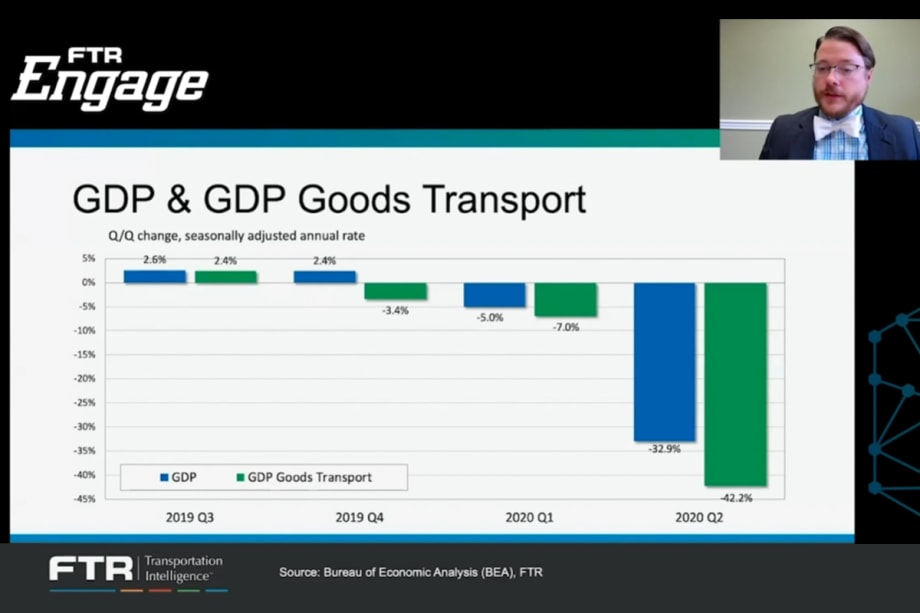
FTR’s Clay Slaughter shows the goods transport sector was hit worse than the overall economy.
Image: FTR Engage screenshot
5 min to read
The sudden, devastating economic collapse caused by the COVID-19 pandemic was so unprecedented, that even seasoned economists admit it’s difficult to predict what the recovery will look like.
But two such economists, Laura Speake, chief economist, energy and transportation, with Caterpillar, and Bill Witte, chief economist for industry forecaster FTR, both indicated it will be 2022 before the U.S. economy fully recovers to pre-pandemic levels. And many businesses will never recover at all.
“Coming out of the other end, whenever that is, I think there’s going to be some real permanent damage to the economy,” Witte said, noting employment may never equal pre-pandemic levels. “That’s not the most optimistic forecast I’ve ever made.”
But predicting the recovery isn’t easy, since there’s no historical recession that’s comparable. “There are no past patterns for an economy that just experienced a 30% drop,” Witte noted.
“The economy will be driven by how the virus behaves and policy response,” he added, noting neither factor is predictable.
COVID Recession Hit ‘Like a Natural Disaster’
“When we came into this year, we felt very differently about where we thought we were going to be, to what has occurred,” Speake said.
Early in 2020, GDP was expected to grow, U.S. employment was at record levels, a Phase 1 trade deal was reached with China, and oil prices were strong enough to support U.S. shale growth — a growing part of the U.S. economy.
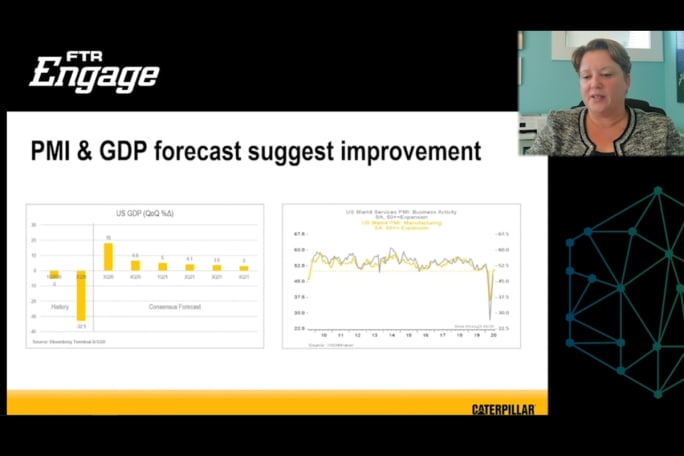
According to Caterpillar economist Laura Speake, 2020 had a lot positives going for it, but by March, "everything had changed, and changed quickly.”
Image: FTR Engage screenshot
“There were lots of positives coming into the year,” said Speake. “By March, everything had changed, and changed quickly.”
While the economy is in recession, it’s a different type of recession. Witte compared it to a natural disaster.
“This is non-economic,” he said. “It’s more like a natural disaster that comes out of the blue, hits the economy, and when you have an area that’s hit by a natural disaster, it’s really whacked.”
Trucking Feels the Pain
The trucking industry felt an impact even greater than the broader economy, pointed out Clay Slaughter, FTR’s chief strategy officer. When U.S. GDP plunged 32.9% in the second quarter, the goods transport sector dropped 42.2%.
“We have a bigger hole to dig out of,” Slaughter said.
But the good news is, trucking is digging out quite rapidly. FTR’s Truck Freight Recovery Index indicates trucking has already emerged from the full recovery phase, thanks to rising freight volumes and rates. The recovery hasn’t been evenly spread among segments, however, with dry van leading the way and refrigerated and flatbed following.
By contrast, the rail industry is still stuck in the restart phase. Intermodal is somewhere in between, about halfway through the full recovery phase.
Plotting the Economic Recovery
FTR’s Witte is projecting a 20% bounce in GDP in the third quarter, but that’s from Q2’s stunning 33% loss. While 20% growth “sounds pretty good,” Witte cautioned, “we shouldn’t get carried away,” as the economy will still be well off pre-pandemic levels.

Bill Witte outlines what the U.S. economic recovery will look like.
Image: FTR Engage screenshot
“By the end of this year, we will still be well below the peak we reached prior to the decline,” Witte warned. “At the end of next year, we will be 3% below the previous trend. It’s not until the beginning of 2022 that we get back to the previous peak. So, it takes us a full two years to get back to the peak and we will still be 3% below where we thought we would’ve been.”
Witte doesn’t expect another Q2-type dip, but expects the recovery to be slow, with periods of plateaus as the virus continues to rear its head.
Caterpillar’s Speake agreed another widespread economic shutdown is unlikely, even if the virus persists.
“I don’t think we will see widespread shutdowns like what we saw earlier this year,” Speake said. “That’s not the best way to go for the overall economy and people's general welfare. We will see areas that shut down again, maybe at the state or regional levels. And we will see tighter regulations, but not enough to force us into the kind of economic activity seen earlier in the year.”
Like Witte, Speake said it’ll be 2022 before the U.S. economy recovers to pre-pandemic levels. And she also warns of a second wave — not of COVID-19, but of job losses.
“We will see more people get laid off,” she acknowledged. “There is a second round of employment challenges that are coming.”
Payments from the U.S. Payroll Protection Act, implemented to save jobs, will stop coming and some businesses that have recalled workers will fold.
“There’s going to be a substantial number of people laid off as a result of that. There are going to be businesses that don’t recover because of this. There is another wave of this coming, but don’t take that as an overall indictment that the economy is getting worse. It’s part of what is built into this forecast — we know it’s going to happen.”
Lasting Impact
When the economy does recover from this unprecedented recession, there will be permanent changes to how we work and live. They will affect the trucking business. For instance, many employees will continue working from home. If this is true of even one in five employees, that represents a 20% drop in oil demand related to commuting, Speake noted.
“You start to think about those kinds of changes we know are going to happen,” she added. As an example, she said we may have reached peak oil, considering less commuting going forward and the retirement of many large, inefficient aircraft.
Working from home also means an effect on housing, with more families potentially moving further from city centers, but into larger homes to accommodate workspaces and more home time. Commercial real estate will also be affected, with businesses reducing their workplace footprints. Slaughter also noted there could be ongoing changes to how education is delivered, with more online learning.
The pandemic has also accelerated the adoption of e-commerce.
“This has caused the birth of a new consumer,” Slaughter said. “This has been a perfect storm to accelerate us from what might have taken several years to do, and we are going to do it in months.”
James Menzies is the editor of Today's Trucking, where this article originally appeared. This content was used with permission from Newcom Media as part of a cooperative editorial agreement.
More Fleet Management

Sponsored•September 16, 2026
Color Match Smarter: Tools That Restore & Perform
For fleet managers and collision repair professionals keeping heavy-duty trucks on the road, getting the color right the first time isn't just about appearance — it's about efficiency, turnaround time, and bottom-line results. Discover how today's digital color tools are transforming the repair process from guesswork to precision.
Read More →
FMCSA Pauses Biennial-Update Enforcement Amid Motus Transition
Carriers whose updates were due on or after June 1 have more time, while FMCSA works to stabilize its new registration system and warns of phishing sites impersonating its new carrier registration system, Motus.
Read More →
Sponsored•September 14, 2026
2026 Blueprint for Countering Smarter Supply Chain Theft
Cargo theft is no longer just the cost of doing business. It's a multi-billion-dollar criminal enterprise exploiting vulnerabilities across your fleet, drivers, and supply chain.
Read More →


Sponsored•September 1, 2026
How Telematics Improves Visibility, Control, and Performance in Refrigerated Fleets
Explore how telematics help refrigerated fleets improve visibility, uptime, efficiency, compliance, and cargo protection across connected cold chain operations.
Read More →
What the U.S.-Canada Trade War Means for Trucking
Escalating U.S.-Canada tariffs could disrupt cross-border freight, reduce truck volumes, raise costs, and create new uncertainty for carriers on both sides of the border.
Read More →
What Are Trucking’s Top Concerns for 2026?
The American Transportation Research Institute wants to know what's worrying trucking fleet managers, drivers, and other stakeholders in its annual Industry Issues survey.
Read More →
American Trucking Associations Looks for a New Leader
ATA President and CEO Chris Spear abruptly left his job at the association on August 21, at a pivotal time for the trucking industry.
Read More →
Public Wi-Fi Cybersecurity Risks: How Truck Drivers and Fleets Can Protect Their Data
Public Wi-Fi can expose truck drivers and fleets to credential theft, malware, and other cyber threats. Here’s how to reduce the risk on the road.
Read More →
For Nicky Cupp, Fleet Innovation Starts With Frustration
HDT Truck Fleet Innovator Nicky Cupp turns everyday pain points at Fraley & Schilling into opportunities for better technology and smarter processes.
Read More →
Adam Buttgenbach’s Approach to Electric Trucks: Start With Where They Fit
HDT Truck Fleet Innovator Adam Buttgenbach helped PepsiCo build one of North America’s largest EV fleets by focusing on where electric trucks make operational sense.
Read More →