





You also might like: CVSA Ponders Driverless-Truck Enforcement
Podcast: Is the Real World Ready for Driverless Trucks?
On the HDT Talks Trucking podcast, we talk to one safety expert who believes major challenges must be addressed before driverless trucks will be ready and accepted by the public for widespread use.
November 23, 2021
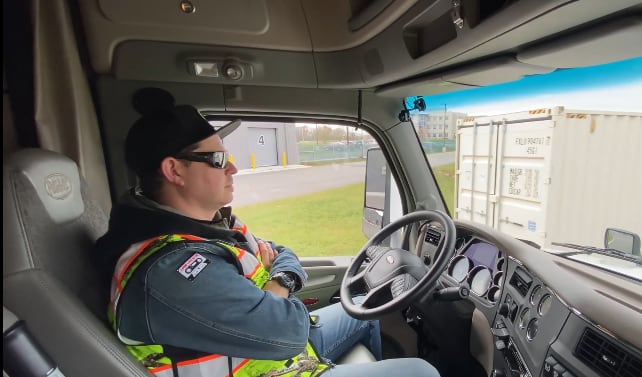
Autonomous technology undergoes testing at the Virginia Tech Transportation Institute.
Photo: Screen capture from VTTI video
2 min to read
According to safety experts, more than 90% of motor vehicle crashes involve driver error, and many believe that replacing drivers with automation could significantly reduce the number of crashes. But one safety expert believes major challenges must be addressed before driverless motor vehicles will be ready and accepted by the public for widespread use.
There are already dozens of driverless trucks operating on interstate highways (with safety drivers), in pilot programs, undergoing testing, and even hauling freight for customers. The technology certainly appears to work. Does that mean they are ready for prime time?
Christopher Hart doesn’t think so. He’s a former chairman of the National Transportation Safety Board, and he has been studying and observing automation in transportation for years. He’s still uneasy about sharing the road with driverless vehicles.
In a recent blog post for the National Academies of Science, Hart brought his knowledge of aviation automation to bear on the question. HDT Equipment Editor Jim Park talked to Hart for the HDT Talks Trucking podcast, “Is the Real World Ready for Driverless Trucks?”
It’s not that Hart is an automation naysayer. In fact, he calls himself a “gadget geek.”
“In the U.S. alone, we lose more than 100 people every day on the highways,” he says. “And I think that automation could significantly reduce that number… But the caution is we need to not do it until we're really ready to go.”
What will an autonomous car do, for instance, when encountering a double-parked delivery truck, he asks. Will it violate the law and cross the yellow line to go around the truck? Or what about a construction zone with a worker signaling drivers to stop or slow depending on the circumstances?
Hear more about Hart’s thoughts on topics such as how aviation automation compares to motor-vehicle automation, what the “Miracle on the Hudson” tells us about the challenges of autonomous technologies, training artificial intelligence, public acceptance of driverless vehicles, ethics, the federal government’s role, and more. Check out HDT Talks Trucking on your favorite podcast platform or listen below:
More Safety & Compliance

FMCSA Pauses Biennial-Update Enforcement Amid Motus Transition
Carriers whose updates were due on or after June 1 have more time, while FMCSA works to stabilize its new registration system and warns of phishing sites impersonating its new carrier registration system, Motus.
Read More →
ZF Expands Commercial Vehicle Push in North America
ZF is expanding its North American commercial-vehicle presence with new transmission applications, electrification, trailer technology and autonomous-driving systems.
Read More →
Truck Drivers Need More Than Another Alert
Fleets have more visibility into truck health, safety events, and driver activity than ever. The next challenge is turning all that information into useful guidance for the person who has to decide what to do next.
Read More →
Tesla Wants a Self-Driving Semi. Are Cameras Enough?
Could Tesla’s camera-only autonomous driving technology work on an 80,000-pound Semi? In this commentary, HDT's Deborah Lockridge takes a look at Tesla, Cybercab, and how autonomous trucks see the road.
Read More →
What DOT’s Automated Vehicle Strategy Means for Trucking
The U.S. Department of Transportation issued a new automated-vehicle strategy that outlines plans for driverless-truck regulations, cross-state freight corridors, and federal safety standards.
Read More →
NYC Expands Speed, Pedestrian Safety Tech Across Fleet
New York City is expanding intelligent speed assistance and pedestrian-alert systems across its municipal fleet, moving the technologies from pilot programs into vehicle procurement and retrofit requirements.
Read More →
FMCSA Removes 110 Truck Driver Training Schools from Certified ELDT List
Federal regulators also are targeting more than 160 additional training providers and launching a nationwide audit of third-party CDL skills testers as part of a broader crackdown on trucking fraud.
Read More →
Beyond DOT Compliance: What Makes a Trucking Fleet Truly Safe?
A trucking fleet can follow every rule and still make unsafe decisions. The real test comes when safety conflicts with freight, productivity, or cost.
Read More →
Hours of Service Pilot Programs: FMCSA Readies for 2027 Rollout
Two pilot programs could eventually reshape hours-of-service rules, giving truck drivers options to pause their 14-hour clock or use longer split sleeper rest periods.
Read More →
New Guide Offers Pet Safety Tips for Truck Drivers
Hundreds of thousands of pets travel in truck cabs. A new safety guide from Volvo Trucks and the Center for Pet Safety offers practical advice for truck drivers who bring dogs and cats along for the ride.
Read More →