




Phillips Announces Tractor-Trailer Connectivity Solution
Phillips Industries says it has a solution for the challenge of smart-trailer connectivity with the tractor.

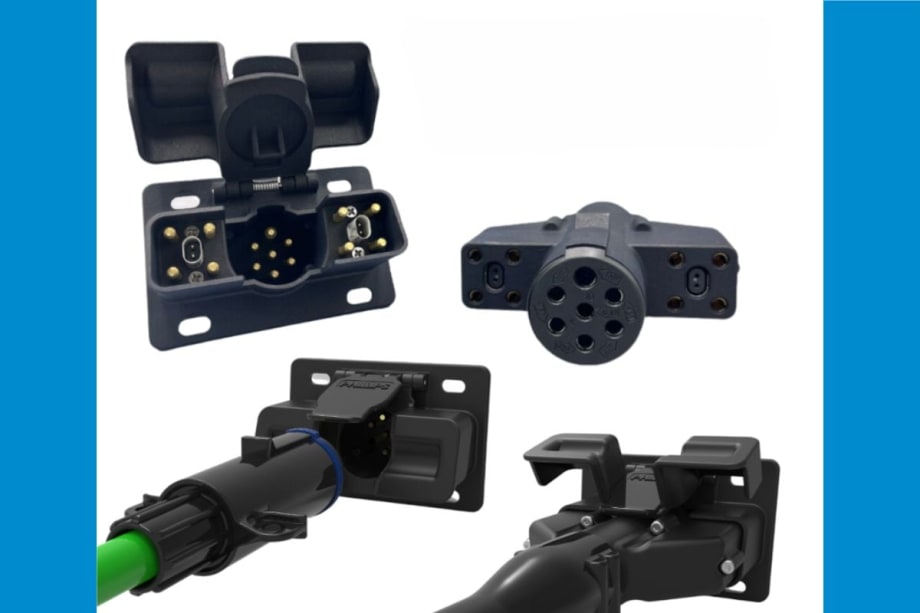
Phillips Industries’ EC47 provides two ethernet connectors, two CAN network connections, 4-AUX connections, and a 7-way J560 power connection.
Photo: Phillips Industries
Phillips Industries says it has a solution for the challenge of smart-trailer connectivity with the tractor.
As HDT's Jim Park explained in a 2020 article about the challenges of adopting smart trailers, we still rely on 60-year-old technology to manage communications between the tractor and trailer: the seven-pin J560 connector. Wireless connections and telematics are one way to bypass the constraints of the J560, but there are limits to how far that will take us. Conventional wireless communication is too slow for the demands of future connectedness.
Phillips has an answer with it new EC47. The name comes from what it offers: two ethernet connectors, two CAN network connections, 4 AUX connections, and a 7-way J560 power connection. It is cross-compatible, expands tractor-trailer communication, and allows fleets to upgrade their systems when they are ready, according to the company.
Phillips said this advancement aligns with the recommendations of the Technology & Maintenance Council Future Truck and Trailer Interface Task Force by addressing requirements anticipated to be essential as the transportation industry continues to evolve. No adapters are required, as the EC47 harmoniously interfaces with present-day J560 components used across fleets today.
The Phillips EC47 was developed in partnership with O’Neil Components. The design draws inspiration from the original O’Neil connector, made popular in the logging sector for its supplementary AUX pins and SAE J560 adaptability.
Flexible Integration
The EC47 connector and socket housings are fully compatible with current J560 components. Their cross-over ability allows them to work interchangeably, without additional adapters, Phillips said.
The design considers a fleet's ability to embrace new technology, Phillips said, safeguarding their equipment's future readiness without disrupting daily operations within their regular replacement cycles.
This avoids the necessity of a large-scale retrofit operation that takes equipment out of service and drains available resources, Phillips said.
Fleets can choose to retrofit current equipment with EC47 technology as their schedules and resources allow. They can also order new equipment with the EC47 with the peace of mind that the entire fleet will remain 100% cross compatible, according to Phillips.
ABS System Compatibility
A CAN-capable connection allows for future tractor-trailer communication expandability with a secondary network designed to work with ISO 11992 or SAE J1939 CAN protocol.
These protocols are currently on many new brake control modules to coordinate ABS and roll stability events between truck and trailer, add brake-related data sharing, and provide reduced stopping distances.
Other expanded capabilities of the Phillips EC47 technology include two 1000BASE-T1 capable ethernet connectors supporting 1G/sec speeds capable of streaming multiple video feeds and camera viewing. Four additional auxiliary pins accommodate added power and functionality between tractor and trailer, eliminating ABS voltage drop concerns on long road trains.
More Equipment

How Volvo Updated Its D13 for EPA 2027 [Watch]
Volvo’s updated D13 promises lower emissions without sacrificing performance or fuel economy. Take a closer look at what changed inside the engine in this HDT Spotlight video.
Read More →
Michelin Tire Improves Efficiency and Durability for Regional Fleets
The Michelin X Multi Energy D2 is a regional haul drive tire engineered to help fleets improve fuel efficiency, durability and traction in demanding stop-and-go operations.
Read More →
ZF Expands Commercial Vehicle Push in North America
ZF is expanding its North American commercial-vehicle presence with new transmission applications, electrification, trailer technology and autonomous-driving systems.
Read More →
Tesla Wants a Self-Driving Semi. Are Cameras Enough?
Could Tesla’s camera-only autonomous driving technology work on an 80,000-pound Semi? In this commentary, HDT's Deborah Lockridge takes a look at Tesla, Cybercab, and how autonomous trucks see the road.
Read More →
Kodiak: Driverless Long-Haul Truck Launch on Track for 2026
Kodiak AI says its driverless long-haul safety case is 93% complete and it remains on track to begin commercial operations by year-end 2026.
Read More →
What DOT’s Automated Vehicle Strategy Means for Trucking
The U.S. Department of Transportation issued a new automated-vehicle strategy that outlines plans for driverless-truck regulations, cross-state freight corridors, and federal safety standards.
Read More →
East Coast Port Launches $45M Electric Truck Push
The Port Authority of New York and New Jersey announced millions in incentives for zero-emission drayage trucks, yard tractors, and new charging hubs near the port.
Read More →
PlusAI Going Public to Fund Autonomous Truck Launch
A SPAC deal could provide PlusAI with up to $300 million as it works toward a 2027 commercial launch of factory-built autonomous trucks.
Read More →
NHTSA Moves to Rewrite Truck Fuel-Economy Rules
The National Highway Traffic Safety Administration says it lacks authority to regulate medium- and heavy-duty truck engines separately from complete vehicles, but the existing standards have not yet been eliminated.
Read More →
Detroit Opens Orders for EPA 2027 Engines
Detroit isn’t starting from scratch to meet EPA 2027 diesel emissions standards. Its Gen 6 DD13 and DD15 engines keep much of today’s platform while updating the fuel and aftertreatment systems.
Read More →