





Related -- Commentary: Self-Driving Trucks Sooner Than You Think
Peterbilt Shows off 'Cruise Control of the Future'
Peterbilt showed off its take on autonomous vehicle technologies to reporters Friday during a Technology Showcase at the Texas Motor Speedway.
May 31, 2015
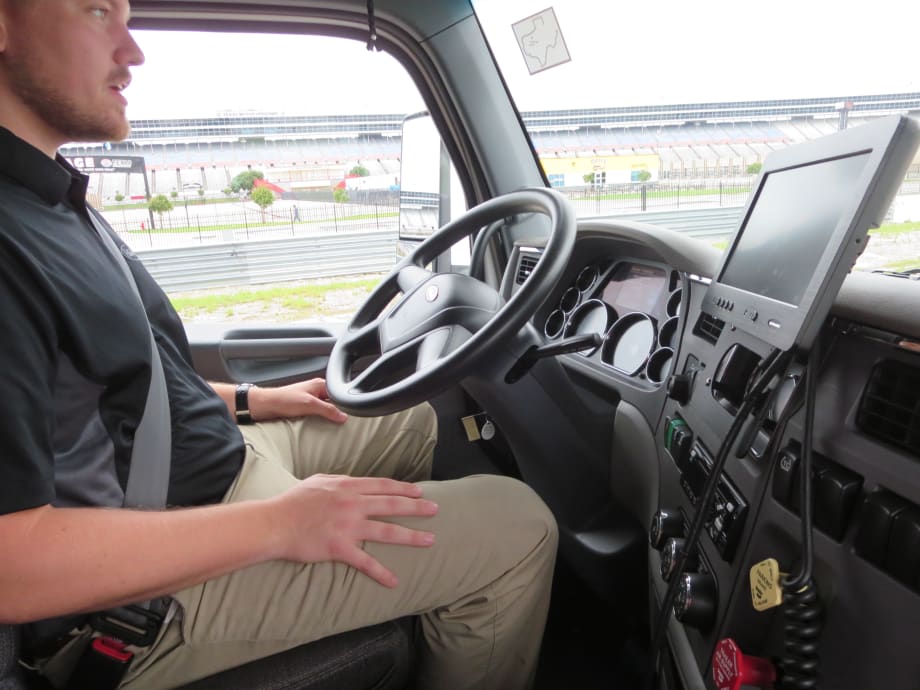
Brent Hankins with Peterbilt's Advanced Technology Group demonstrates the system at the Texas Motor Speeday. The screen mounted to the right shows the pre-programmed course the truck is taking. Photo: Deborah Lockridge
2 min to read
Peterbilt showed off its take on autonomous vehicle technologies to reporters Friday during a Technology Showcase at the Texas Motor Speedway.
Bill Kahn, manager of advanced concepts at Peterbilt, doesn't really like to call the two demonstration vehicles "autonomous," although they would qualify as a Level 3 autonomous vehicle under National Highway Traffic Safety Administration classifications. He characterizes the technology more as the "cruise control of the future" and a "stepping stone to autonomous vehicles." Peterbilt engineers have dubbed it "advanced driver assist systems."
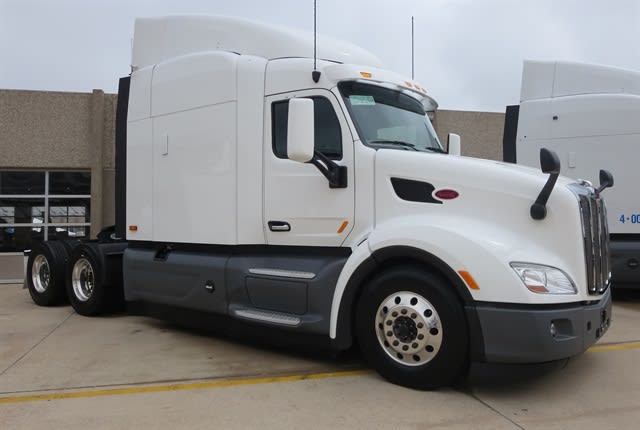
One of Peterbilt's two demonstration trucks testing autonomous technologies.Photo: Deborah Lockridge
A bumper-mounted radar system, on one of the trucks, and a lidar camera on the other, are used to determine the distance from the truck to the vehicle or obstacle ahead of it. The lidar has the added advantage of not only being able to determine an obstacle ahead, but also a wider field of "view" and the ability to provide some data on the size and shape of whatever's there. For on-highway situations, these and a windshield-mounted camera provide data to keep the truck in the lane as the truck steers itself. Kahn said this lanekeeping technology is capable of taking 85% of the active steering out of the driver's hands, leaving him much more refreshed.
Kahn characterized lanekeeping as a form of advanced cruise control, and noted that just as any cruise control, you wouldn't use it in bad weather or congested traffic.
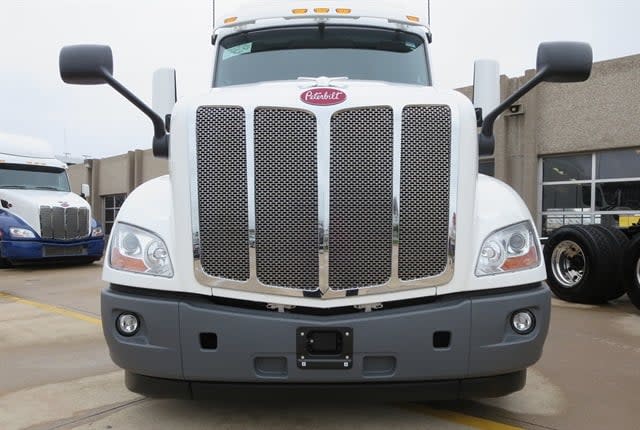
Note the bumper-mounted radar system. Photo: Deborah Lockridge
The radar/lidar is also used for adaptive cruise, which can keep the truck the right distance from the vehicle in front of it and bring it to a complete stop if necessary.
In addition, the concept trucks featured a GPS-based autopilot system that would allow the truck to operate autonomously in urban environments – but only if the route was preprogrammed.
The GPS system is accurate up to 5 centimeters. One truck can drive the route (with a human driver) and "map" it, then transfer that data to other trucks in the fleet. The other trucks then follow that preprogrammed course; driver intervention would be needed in some situations.
In the case of platooning, that information transfer between the front truck and the ones behind would happen in real time.
So far, testing of the GPS system has all been done on non-public courses set up to mimic city streets.
The trucks have Dedicated Short Range Communications, or DSRC, radio antennas, a vehicle-to-vehicle communication system. DRSC is similar to Wi-Fi, but is not likely to be vulnerable to interference, and is an important part of the federal government's plans for "connected vehicles."
More Safety & Compliance

FMCSA Pauses Biennial-Update Enforcement Amid Motus Transition
Carriers whose updates were due on or after June 1 have more time, while FMCSA works to stabilize its new registration system and warns of phishing sites impersonating its new carrier registration system, Motus.
Read More →
ZF Expands Commercial Vehicle Push in North America
ZF is expanding its North American commercial-vehicle presence with new transmission applications, electrification, trailer technology and autonomous-driving systems.
Read More →
Truck Drivers Need More Than Another Alert
Fleets have more visibility into truck health, safety events, and driver activity than ever. The next challenge is turning all that information into useful guidance for the person who has to decide what to do next.
Read More →
Tesla Wants a Self-Driving Semi. Are Cameras Enough?
Could Tesla’s camera-only autonomous driving technology work on an 80,000-pound Semi? In this commentary, HDT's Deborah Lockridge takes a look at Tesla, Cybercab, and how autonomous trucks see the road.
Read More →
What DOT’s Automated Vehicle Strategy Means for Trucking
The U.S. Department of Transportation issued a new automated-vehicle strategy that outlines plans for driverless-truck regulations, cross-state freight corridors, and federal safety standards.
Read More →
NYC Expands Speed, Pedestrian Safety Tech Across Fleet
New York City is expanding intelligent speed assistance and pedestrian-alert systems across its municipal fleet, moving the technologies from pilot programs into vehicle procurement and retrofit requirements.
Read More →
FMCSA Removes 110 Truck Driver Training Schools from Certified ELDT List
Federal regulators also are targeting more than 160 additional training providers and launching a nationwide audit of third-party CDL skills testers as part of a broader crackdown on trucking fraud.
Read More →
Beyond DOT Compliance: What Makes a Trucking Fleet Truly Safe?
A trucking fleet can follow every rule and still make unsafe decisions. The real test comes when safety conflicts with freight, productivity, or cost.
Read More →
Hours of Service Pilot Programs: FMCSA Readies for 2027 Rollout
Two pilot programs could eventually reshape hours-of-service rules, giving truck drivers options to pause their 14-hour clock or use longer split sleeper rest periods.
Read More →
New Guide Offers Pet Safety Tips for Truck Drivers
Hundreds of thousands of pets travel in truck cabs. A new safety guide from Volvo Trucks and the Center for Pet Safety offers practical advice for truck drivers who bring dogs and cats along for the ride.
Read More →