





Related: Driving a SuperTruck
Peterbilt Highlights Technology Transformation
Two decades ago, Peterbilt was primarily known for its classic truck designs that appealed to owner-operators and small fleets. But as it showed reporters during its Technology Showcase at its plant in Denton, Texas, it has reinvented itself as a company on top of the latest technology and fuel economy.
May 28, 2015
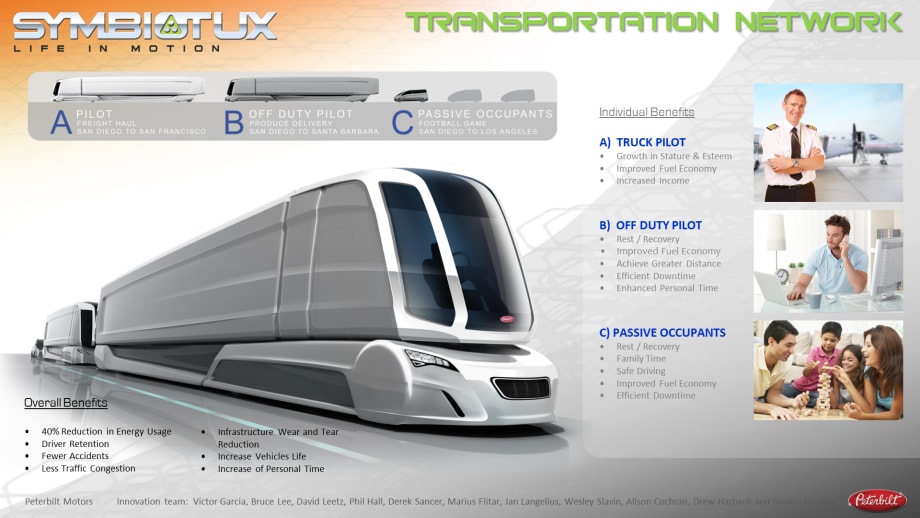
A far-out future truck project for the LA Auto Show
4 min to read
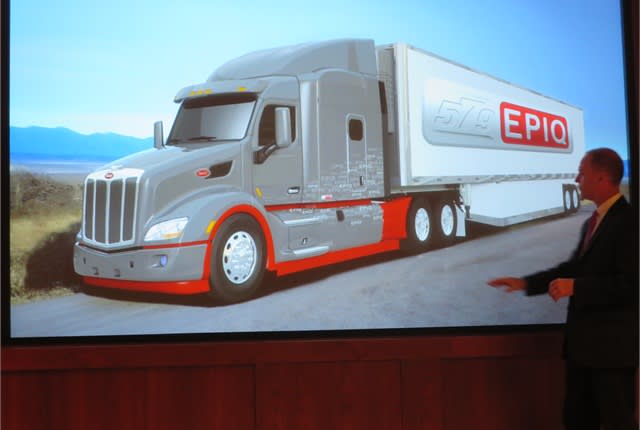
Chief Engineer Scott Newhouse explains how the aerodynamics used on the SuperTruck were improved for the Model 579 Epiq in order to make them more easily serviceable.
Two decades ago, Peterbilt was primarily known for its classic truck designs that appealed to owner-operators and small fleets. But as it showed reporters during its Technology Showcase May 28 at its plant in Denton, Texas, it has reinvented itself as a company on top of the latest technology and fuel economy.
About 10 years ago, the Model 386 was Peterbilt's first ground up design of an aero product, said Robert Woodall, assistant GM, sales and marketing.
"In 2013 we introduced the Model 579, helping redefine our company," he said. Of course, the company still has a tried and true offering for customers who prefer that traditional look, with the Model 389.
With the Model 579 Epiq, Peterbilt took the truck to an even greater level of fuel efficiency, Woodall said, noting later that it "has opened a whole new customer for us. We're the most competitive we've ever been with the big on-highway fleet business." Large fleets already buying the Epiq include Walmart, Love's, TMC, Freymiller and Celadon.
On top of that, he said, "we've got a new 58-inch [sleeper] box coming out in November for regional hauls, so that's going to open up another group of customers."
Many of the technologies used on that truck came through the Cummins-Peterbilt SuperTruck project, a joint effort with the EPA to demonstrate freight efficiency possibilities.
Some of the aerodynamic fairings were adapted from the SuperTruck and actually tweaked to offer the same performance with easier maintainability, explained Chief Engineer Scott Newhouse.
New Predictive Cruise technology, which will be available on the Model 579 and 567 this summer, also made its debut on the SuperTruck. It uses GPS data to ensure the engine and transmission are operating in the most efficient mode, working in tandem with neutral coast technology that allows trucks to coast downhills at idle.
Under the hood, he said, Peterbilt's work on integrating the engine and transmission on the Super Truck taught them things they were able to apply to the new Apex package.
"Also not directly related, we learned things such as driver impact, which really led into a lot of the Driver Performance Assistant technology," he said. "You have to be able to manage the impact the driver may have on fuel efficiency."
Woodall noted that just as important as new high-tech products is the growth of high-tech systems and tools to support those products once vehicles are in operation. New vehicle technology such as the 579 Epiq, the Apex powertrain and the Driver Performance Assistant are complemented by back-end and diagnostic tools such as in-cab diagnostics that alerts drivers whether fault codes need immediate attention or not, as well as SmartLinq remote diagnostics.
The technology extends to the plant itself, which has higher levels of automation and robotics than ever before, according to Ron Augustyn, manager of the Denton plant. The plant's undergoing an expansion that will add a new high-tech parts storage and retrieval system in addition to more docks.
"The launch of the 579 and 567 was the most significant product launch in our history," he said, and the plant underwent a major transformation in order to produce the trucks, completely rearranging 55,000 square feet of floor space. Part of that transformation is an automated cab build station, a critical element in the overall build quality of the product, he said.
Another significant investment was a non-contacting laser alignment system. Augustyn said this is the first truck plant in North America to use this state of the art technology, which uses a drive through laser scanning system that integrates steering wheel alignment as well. The system, he said, has improved accuracy 10-fold and efficiency by 40%.
"Total truck alignment has been a challenge for the entire industry," he said, noting the accuracy of this system can provide improved fuel efficiency and reduced tire wear for customers.
And looking to the future, Peterbilt is continuing to work on development of technologies that could move to autonomous vehicles. It has worked with Walmart to design a working autonomous truck that it will show to reporters Friday.
"We're always looking ahead to new opportunities," said Newhouse. Autonomous technologies such as lane keeping, GPS navigation and platooning "are all technologies we continue to advance."
Looking even further out, Newhouse highlighted Peterbilt's entry in the LA Auto Show design challenge last year, taking on the theme, "Sensing the Future" to look at how vehicles and people will interact in 2029. Peterbilt's concept entry, called Symbiotux, featured the concept of platooning. The interior would use nanotechnology and biomonitoring to adapt the environment to the driver's needs. For instance, a smart seat could sense a tight muscle in a driver's leg or back and adjust the ergonomics of the seat to compensate.
More Equipment

How Volvo Updated Its D13 for EPA 2027 [Watch]
Volvo’s updated D13 promises lower emissions without sacrificing performance or fuel economy. Take a closer look at what changed inside the engine in this HDT Spotlight video.
Read More →
Michelin Tire Improves Efficiency and Durability for Regional Fleets
The Michelin X Multi Energy D2 is a regional haul drive tire engineered to help fleets improve fuel efficiency, durability and traction in demanding stop-and-go operations.
Read More →
ZF Expands Commercial Vehicle Push in North America
ZF is expanding its North American commercial-vehicle presence with new transmission applications, electrification, trailer technology and autonomous-driving systems.
Read More →
Tesla Wants a Self-Driving Semi. Are Cameras Enough?
Could Tesla’s camera-only autonomous driving technology work on an 80,000-pound Semi? In this commentary, HDT's Deborah Lockridge takes a look at Tesla, Cybercab, and how autonomous trucks see the road.
Read More →
Kodiak: Driverless Long-Haul Truck Launch on Track for 2026
Kodiak AI says its driverless long-haul safety case is 93% complete and it remains on track to begin commercial operations by year-end 2026.
Read More →
What DOT’s Automated Vehicle Strategy Means for Trucking
The U.S. Department of Transportation issued a new automated-vehicle strategy that outlines plans for driverless-truck regulations, cross-state freight corridors, and federal safety standards.
Read More →
East Coast Port Launches $45M Electric Truck Push
The Port Authority of New York and New Jersey announced millions in incentives for zero-emission drayage trucks, yard tractors, and new charging hubs near the port.
Read More →
PlusAI Going Public to Fund Autonomous Truck Launch
A SPAC deal could provide PlusAI with up to $300 million as it works toward a 2027 commercial launch of factory-built autonomous trucks.
Read More →
NHTSA Moves to Rewrite Truck Fuel-Economy Rules
The National Highway Traffic Safety Administration says it lacks authority to regulate medium- and heavy-duty truck engines separately from complete vehicles, but the existing standards have not yet been eliminated.
Read More →
Detroit Opens Orders for EPA 2027 Engines
Detroit isn’t starting from scratch to meet EPA 2027 diesel emissions standards. Its Gen 6 DD13 and DD15 engines keep much of today’s platform while updating the fuel and aftertreatment systems.
Read More →