




Related: Daycabs, Vocational Trucks Are Priorities for Nikola
Nikola Vehicles to Replace Cat Trucks for Thompson Machinery
Investment to support Cat's discontinued on/off-road trucks can be shifted to Nikola's hydrogen-electric vehicles when they become available.
by Staff
December 5, 2016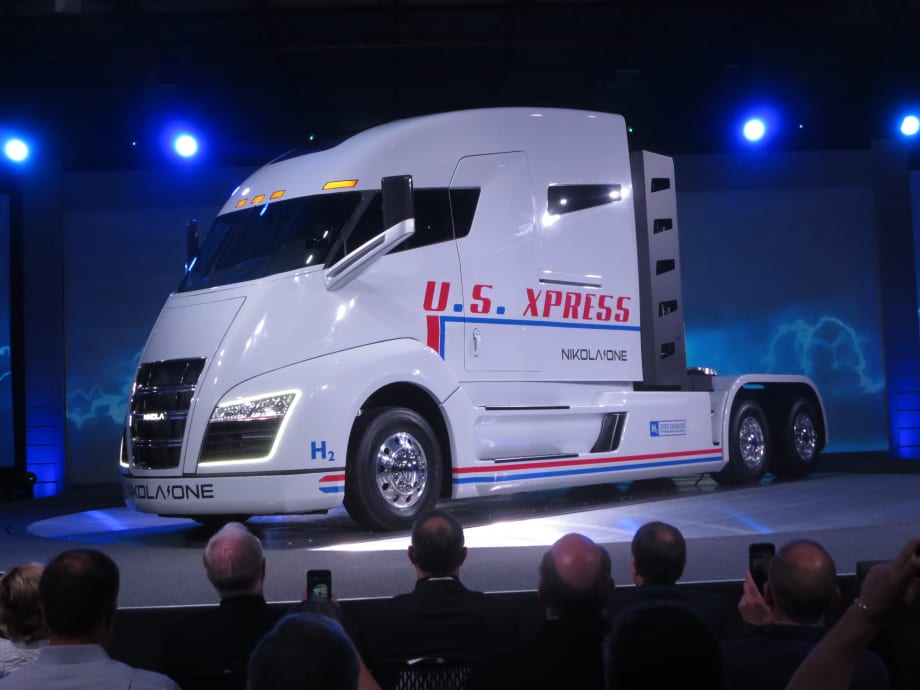
During the Nikola One unveiling last week, Trevor Milton, Nikola Motor's founder and CEO, announced that Thompson Machinery would be a distributor for the hydrogen-electric tractor. Photo: Tom Berg
3 min to read
During the Nikola One unveiling last week, Trevor Milton, Nikola Motor's founder and CEO, announced that Thompson Machinery would be a distributor for the hydrogen-electric tractor. Photo: Tom Berg
Nikola Motor’s upcoming hydrogen-electric vehicles will eventually replace the discontinued Cat Truck products for Thompson Machinery, says the Caterpillar dealer for Tennessee and Mississippi, which will handle Nikola sales and service in those states.
In February of this year, Caterpillar announced its departure from the on-highway vocational truck market as part of the company's ongoing restructuring, the dealer noted. Like other Cat outlets that had invested heavily in capital assets and personnel to service the on/off-highway truck, Thompson searched for new product ideas.
"Within a few months, our team had identified a new partner in Trevor Milton, the CEO of Nikola Motor Co.,” said De Thompson V, the dealer’s president and CEO. “As an entrepreneur and leader, Trevor has an unmatched passion and work ethic to create change."
Thompson therefore invested in Nikola Motor, and on December 1st, when Milton unveiled his Nikola One hydrogen-electric sleeper-cab tractor, he announced that Thompson would have distribution rights in its home states. Ryder System will otherwise be the main dealer and service provider for Nikola vehicles. The Nikola range will also include daycab tractors and trucks, to include vocational vehicles.
"We are excited to announce Thompson Machinery as our only other authorized sales, service and warranty dealer, along with Ryder System, Inc. Given Thompson Machinery's impeccable reputation in Tennessee and Mississippi, we were happy to have them as an early investor,” Milton said.
“Thompson Machinery has committed a tremendous amount of capital on the infrastructure needed to service Class 8 trucks and we are excited to have a partner that understands the benefits of clean technology and is ready to serve Nikola drivers," he added.
Thompson Machinery will also distribute Nikola Motor’s Power Sport battery-electric all-terrain vehicle, called the Nikola Zero. It has over 500 hp and 476 lb-ft of torque and is anticipated to hit Thompson Machinery's showrooms in December of 2017. The Class 8 Nikola One and Two are three years away from production, Milton has said.
“Even with a change in administration and possible adjustment to EPA's transportation regulation, we think the growing acceptability and popularity of all electric cars suggest that the market wants cleaner, more environmentally friendly transportation options,” said Steve Lainhart, Thompson’s vice president of energy and transportation.
"We believe the on-highway truck industry will follow suit as soon as a truck manufacturer can bring an affordable solution to the heavy haul market," he said. "We feel Nikola is going to provide that solution and remain the innovation leader in this industry, and we are very excited to be a dealer for the Nikola Motor Co."
Nikola One and Two vehicles will use hydrogen fuel cells to generate electricity that's sent to advanced lithium-ion batteries, which then supply power to chassis motors. Regenerative braking captures kinetic energy that also goes to batteries.
Each truck or tractor will have four or six electric motors generating as much as 1,000 hp, which will be modulated to balance propulsion needs against tire conservation, Milton explained during technical briefings that followed the unveiling.
The Nikola One truck is expected to attract drivers who are interested in using its new technology, and thus reduce the problem of the ongoing driver shortage, said both companies.
Other advantages include exceeding EPA standards, complying with the new brake stopping distance regulations, satisfying fuel economy needs and providing increased horsepower and torque for heavier loads and multiple trailers.
More Equipment

How Volvo Updated Its D13 for EPA 2027 [Watch]
Volvo’s updated D13 promises lower emissions without sacrificing performance or fuel economy. Take a closer look at what changed inside the engine in this HDT Spotlight video.
Read More →
Michelin Tire Improves Efficiency and Durability for Regional Fleets
The Michelin X Multi Energy D2 is a regional haul drive tire engineered to help fleets improve fuel efficiency, durability and traction in demanding stop-and-go operations.
Read More →
ZF Expands Commercial Vehicle Push in North America
ZF is expanding its North American commercial-vehicle presence with new transmission applications, electrification, trailer technology and autonomous-driving systems.
Read More →
Tesla Wants a Self-Driving Semi. Are Cameras Enough?
Could Tesla’s camera-only autonomous driving technology work on an 80,000-pound Semi? In this commentary, HDT's Deborah Lockridge takes a look at Tesla, Cybercab, and how autonomous trucks see the road.
Read More →
Kodiak: Driverless Long-Haul Truck Launch on Track for 2026
Kodiak AI says its driverless long-haul safety case is 93% complete and it remains on track to begin commercial operations by year-end 2026.
Read More →
What DOT’s Automated Vehicle Strategy Means for Trucking
The U.S. Department of Transportation issued a new automated-vehicle strategy that outlines plans for driverless-truck regulations, cross-state freight corridors, and federal safety standards.
Read More →
East Coast Port Launches $45M Electric Truck Push
The Port Authority of New York and New Jersey announced millions in incentives for zero-emission drayage trucks, yard tractors, and new charging hubs near the port.
Read More →
PlusAI Going Public to Fund Autonomous Truck Launch
A SPAC deal could provide PlusAI with up to $300 million as it works toward a 2027 commercial launch of factory-built autonomous trucks.
Read More →
NHTSA Moves to Rewrite Truck Fuel-Economy Rules
The National Highway Traffic Safety Administration says it lacks authority to regulate medium- and heavy-duty truck engines separately from complete vehicles, but the existing standards have not yet been eliminated.
Read More →
Detroit Opens Orders for EPA 2027 Engines
Detroit isn’t starting from scratch to meet EPA 2027 diesel emissions standards. Its Gen 6 DD13 and DD15 engines keep much of today’s platform while updating the fuel and aftertreatment systems.
Read More →