





Related: Nikola One Fuel Cell Electric Truck Promises High Fuel Economy, Low Maintenance
Daycabs, Vocational Trucks Are Priorities for Nikola
A daycab version of Nikola Motor Co.’s hydrogen-electric heavy-duty tractor will probably be the first one to enter production, said the firm’s founder and CEO, Trevor Milton.
December 2, 2016
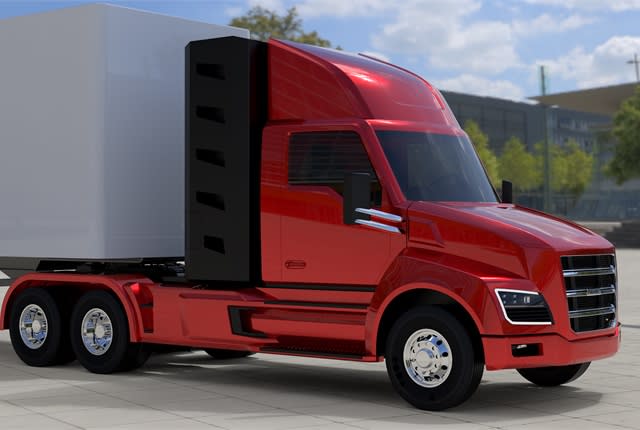
Photo: Nikola Motor
2 min to read

Photo: Nikola Motor
A daycab version of Nikola Motor Co.’s hydrogen-electric heavy-duty tractor will probably be the first one to enter production, said the firm’s founder and CEO, Trevor Milton, at the conclusion of a series of technical briefings on the products on Friday morning. And vocational straight trucks might be close behind.
An unveiling of a Nikola One, a streamlined sleeper-cab tractor, the previous evening put nearly all emphasis on the long-haul model. But short and regional hauling is as important and the daycab Nikola Two is simpler, he told HDT at the event’s conclusion. Daycab tractor versions would share most operational benefits – low maintenance and operating costs along with zero emissions – with the over-the-road sleeper model.
Vocational markets will include refuse, and Milton said he and his engineers are already planning a chassis for trash collection. Dump and mixer trucks are likewise probable, and all-wheel drive would make them valuable in some on/off-road duties.
An earlier discussion of a Nikola’s likely lifespan included observations that the electric motors and battery “don’t need air to operate,” and the motors, anyway, could be driven into water and emerge undamaged.
Milton said he’s planning 6x6 and 6x4 versions of the fuel cell electric drive chassis; without front-driving gear, steer-axle wheels could cut sharper, aiding maneuverability in a number of applications.
Engineers initially designed the Nikola with a gas-fueled turbine-electric powertrain, but decided to go to hydrogen fuel cells because they’re much quieter and cleaner, and require no emissions certification. A turbine version is still possible “for sale into markets where we can’t get hydrogen to,” he said.
The company’s plans to build hundreds of hydrogen fueling stations will include parking and shopping areas, and facilities will be “awesome -- they will be destinations,” Milton said. Existing truck stops were considered to be part of the network, but his team didn’t think their facilities were of the quality that Nikola wants for its customers and their drivers.
Production is three years away because durability testing must go through three winter seasons, and safety-related testing of braking systems and other components will also take time. As announced the night before, Fitzgerald Gliders will build the first 5,000 units and Nikola Motor will erect a factory to assemble subsequent vehicles.
Ryder System will handle sales and service for most Nikolas at its 800-plus facilities in the United States and Canada. Thompson Machinery, a Caterpillar dealer in Kentucky and Tennessee and an early investor in Nikola Motor, will have rights to handle Nikolas in those states.
More Fuel Smarts

How Volvo Updated Its D13 for EPA 2027 [Watch]
Volvo’s updated D13 promises lower emissions without sacrificing performance or fuel economy. Take a closer look at what changed inside the engine in this HDT Spotlight video.
Read More →
Diesel Price Spike Shortens Payback for Natural Gas Trucks, Report Says
Energy Vision estimates fleets could recover the higher purchase price of an RNG-fueled Class 8 tractor in 1.3 to 2.8 years under current fuel-price scenarios.
Read More →
Calstart Becomes Catalyst Mobility, Reflecting Broader Focus
Calstart is now Catalyst Mobility, reflecting the nonprofit’s growing national role in clean transportation, including zero-emission trucks, infrastructure and incentive programs.
Read More →

Record Diesel Prices Squeeze Trucking Fleets
Average U.S. diesel prices have climbed to nearly $6 a gallon, surpassing the 2022 record as tight refinery capacity and Middle East disruptions keep fuel costs elevated.
Read More →
Sponsored•September 9, 2026
How Fuel Delivery Shapes Engine Performance
Fuel delivery depends on more than what happens at the injector. For fleet, maintenance and technical professionals, looking at the full path from pump to injector can provide useful context for understanding engine performance.
Read More →
East Coast Port Launches $45M Electric Truck Push
The Port Authority of New York and New Jersey announced millions in incentives for zero-emission drayage trucks, yard tractors, and new charging hubs near the port.
Read More →
California Bill Could Shed Light on Electric Truck Prices
Why do battery-electric Class 8 trucks remain so expensive? A California bill headed to Gov. Gavin Newsom would give fleets and state agencies more visibility into what manufacturers charge.
Read More →
Detroit Opens Orders for EPA 2027 Engines
Detroit isn’t starting from scratch to meet EPA 2027 diesel emissions standards. Its Gen 6 DD13 and DD15 engines keep much of today’s platform while updating the fuel and aftertreatment systems.
Read More →
Zero-Emission Truck Corridor Planned for West Coast
California, Oregon, Washington, British Columbia and Baja California are coordinating plans for truck charging and hydrogen fueling from Canada to Mexico.
Read More →
A Closer Look at Kenworth’s Electric T880E Vocational Truck [Video]
Learn more about Kenworth's T880E battery-electric vocational truck at the Paccar Technical Center, including its range, applications, upfitting considerations, and PTO options, in this HDT Spotlight video.
Read More →