




Nikola Touts Battery-Electric, Fuel-Cell Truck Progress
The first Nikola Tre battery-electric trucks are due to be in customers' hands by the end of the year. What about the fuel-cell versions?

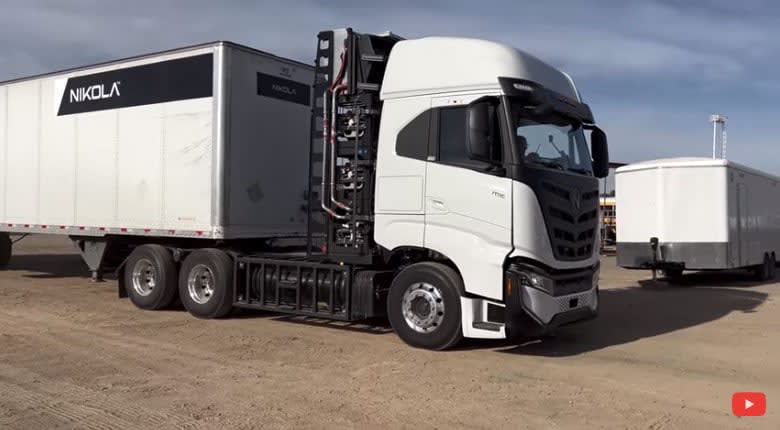
One of seven Nikola fuel-cell-electric "alpha" test trucks.
Screen capture from Munro Live video
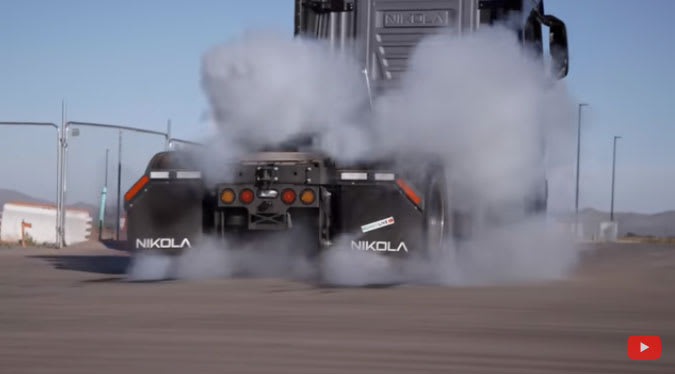
Consultant Sandy Munro challenged Nikola skeptics to behold the peel-out in the BEV Tre.
Screen capture from Munro Live video
The first pre-series Nikola Tre battery-electric Class 8 trucks have come off the line at the company’s Coolidge, Arizona, facility and will soon be delivered to customers, while its first fuel-cell-electric test trucks are shortly due to hit the streets.
Nikola touted the completed BEV Tre trucks in a Dec. 14 tweet.
Celebrating another step toward a sustainable future where what once seemed impossible is becoming possible. #TeamNikola cheered on as the pre-series BEV trucks came off-the-line at the #NikolaCoolidgeFacility. Next stop, customer deliveries. pic.twitter.com/750gJoSDBi
— Nikola Motor Company (@nikolamotor) December 14, 2021
The company's third-quarter financial report last month said as many as 25 Tre BEV trucks should be delivered to dealers and customers by the end of 2021. It also said progress had been made in building the sales and service network, with dealers in 28 states spread across more than 130 locations.
“The trucks will haul customer loads, gain real-world mileage accumulation, and in turn we expect to secure additional orders for 2022 volume and beyond,” the company said.
Nikola also said testing has begun on its fuel-cell-electric Nikola Tre. Seven “alpha” vehicles have been built, five in Coolidge and two in Ulm, Germany. Track testing has begun in both Ulm, Germany, and Phoenix, Arizona, and the company said it will continue to progress toward road release by the end of 2021.
Ulm, Germany Update: How we love seeing the Tre FCEV alpha in action! Here it is taking some laps while fully loaded at 82k lbs gross combined weight. #NikolaTreFCEV#DrivingChangepic.twitter.com/i0MwkHhEdt
— Nikola Motor Company (@nikolamotor) October 20, 2021
In a series of recent YouTube videos, Sandy Munro of Munro & Associates visited the Coolidge facility. The former Ford engineer founded consulting firm Munro & Associates in 1988 to focus on profit improvement through design innovation.
Munro’s video of the BEV Tre highlighted the tremendous torque of the truck. “Behold the burnout,” Munro says. In his own drive, he said, it accelerated well, and he praised the regen brakes, the quiet cab with just the whine of the electric motors, and the lack of vibration in the seat.
Nikola's FCEV Alpha
Much of the Munro video series was devoted to Nikola’s fuel-cell-electric alpha vehicle. The company has built seven of them, leveraging a lot of work already done on the battery-electric version, leading Munro to say the truck looked a lot further along than a typical “alpha.”
The Nikola Tre FCEV uses the same Euro-style cabover cab from Nikola’s partner Iveco as the BEV trucks that just came off the line. Munro noted that the cabover design allows easy access to all the equipment, as the entire cab tilts forward. Nikola officials explained that changes in the works for future models will be a chassis lengthened in the front to provide more space for the cooling package and give it a more aerodynamic shape. Engineers are working to reduce weight on future production vehicles. And they’re hoping to get NHTSA to allow camera systems instead of rear-view mirrors.
The FCEV also has basically the same chassis structure as the BEV. Instead of the rows of batteries, it has two hydrogen tanks in the saddle locations, and three more tanks in the “backpack” behind the cab. Each tank holds about 12 kg of hydrogen, but in production models, Nikola expects them to be able to store about 14 kg, which it projects will provide 500-plus miles of range for regional applications.
Munro asked about the expected life of the trucks, which Nikola projects at 700,000 to 1 million miles, depending on application. Engineers said one advantage of fuel cells over batteries is that they age differently. Batteries eventually will degrade and the truck’s range will decrease, said Nikola engineers. While fuel cells will see some degradation, they said, it’s much less than seen in batteries.
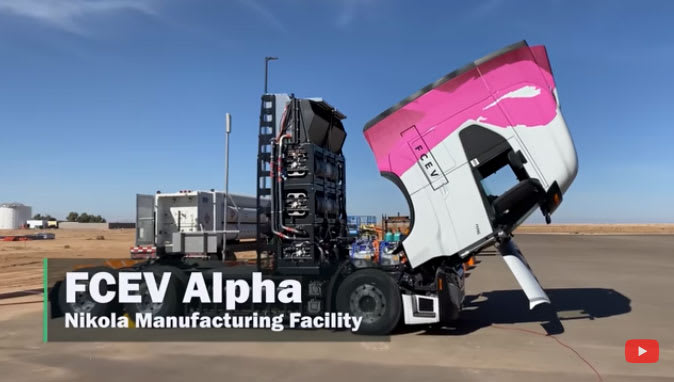
The Euro-style cab on the BEV and FCEV Nikola Tre models tilts forward for easy acess.
Screen capture from Munro Live video
The video also outlines safety measures and testing to protect the hydrogen tanks.
Nikola is working with an industry consortium to establish new hardware and a new standard for faster heavy-duty fueling. Currently, using the portable hydrogen fueling unit at the Nikola facility, it takes about an hour to fuel the truck. But the consortium is targeting a fueling time of around 10 minutes using new equipment and protocols for communication between the vehicle and the fueling station.
In a ride-and-drive video in a FCEV, Munro reported no difference between it and the BEV drive in the way it handled. He did point out the water dripping from the fuel cell after the drive, explaining, “that’s the exhaust…. This is going to be an absolutely brilliant way of making the world a cleaner place and probably saving the trucking companies a tremendous amount of money.”
Inside Nikola's Coolidge, Arizona, Facility
In its third-quarter earnings report, Nikola reported that while building the pre-series trucks, it is concurrently expanding the Phase 1 assembly expansion area to enable a total production capacity in 2022 of 2,400 trucks per year on two shifts. The expansion is expected to be completed in January, and the construction of Phase 2 will begin immediately after that, expected to be completed in early 2023 for a total capacity of 20,000 units per year. The facility will be capable of building the Nikola Tre BEV and FCEV trucks on the same line, and also assembling the Bosch fuel-cell modules.
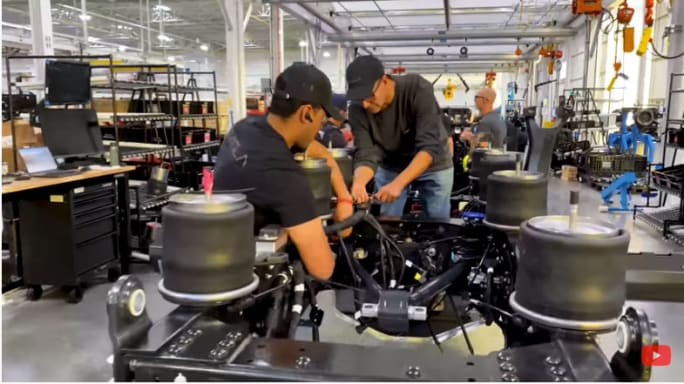
Nikola's Coolidge, Arizona, assembly facility is about to expand.
Screen capture from Munro Live video
In the Munro video, factory officials explain that the current facility, which has a lot of empty space, was designed to be modular to accommodate that growth. There’s no conveyor belt as you often see in a traditional truck factory; instead, Nikola uses automatic guided vehicles. The company is still learning the best method to put these trucks together, according to the video, and eventually it will be able to do it with fewer people than are currently involved.
The Challenge Ahead
Munro’s final video focused on two of the Nikola execs behind the trucks. Jason Roycht, global head, fuel cell electric vehicles, has been with Nikola for two years after 23 years at Bosch; and Christian Appel, global chief engineer, Tre FCEV and propulsion engineering, also worked with Bosch.
When asked what the company’s biggest challenge is, Roycht said, it is “bringing both the energy and the hydrogen and the truck to the level they need to be at to make the business case work.”
Not that there aren’t still technical issues to solve, he said. Roycht noted that “back in 2016 it was the dream of basically 25 people who had … no bloody clue how difficult this was.”
If you don’t have the time to spend on all five Munro videos, Nikola has edited together a highlights reel.
More Fuel Smarts

Trucking’s Diesel Squeeze Isn’t Letting Up
With diesel topping $6 a gallon nationally, ATA's Bob Costello explains why fleets should prepare for continued pressure at the pump.
Read More →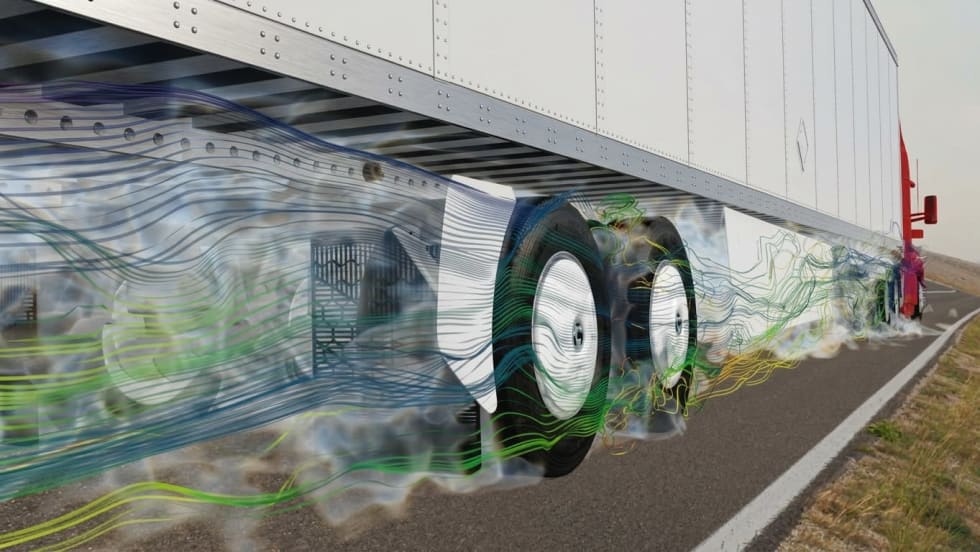
FlowBelow Redesigns Trailer AeroSlider to Cut Fuel Use
The lighter trailer aerodynamic system installs in less than 45 minutes, according to the company, with potential payback in under a year depending on fuel prices and trailer mileage.
Read More →
Why Diesel Price Relief Efforts May Fall Short
Diesel prices have eased from September’s record high, but doubts about additional Russian supply and limits on dyed-diesel tax relief mean trucking fleets still face expensive fuel. And prices could go higher.
Read More →
Why Small Fuel Savings Matter in Trucking
Can better fuel economy help pay for driver raises? In this podcast, GP Transco explains how small efficiency gains create room to reinvest in its people.
Read More →
How GP Transco Cuts Trucking Fuel Costs, a Tenth of a Gallon at a Time
What’s another tenth of a mile per gallon worth? GP Transco shares how equipment upgrades and driver coaching turn small gains into meaningful fuel savings.
Read More →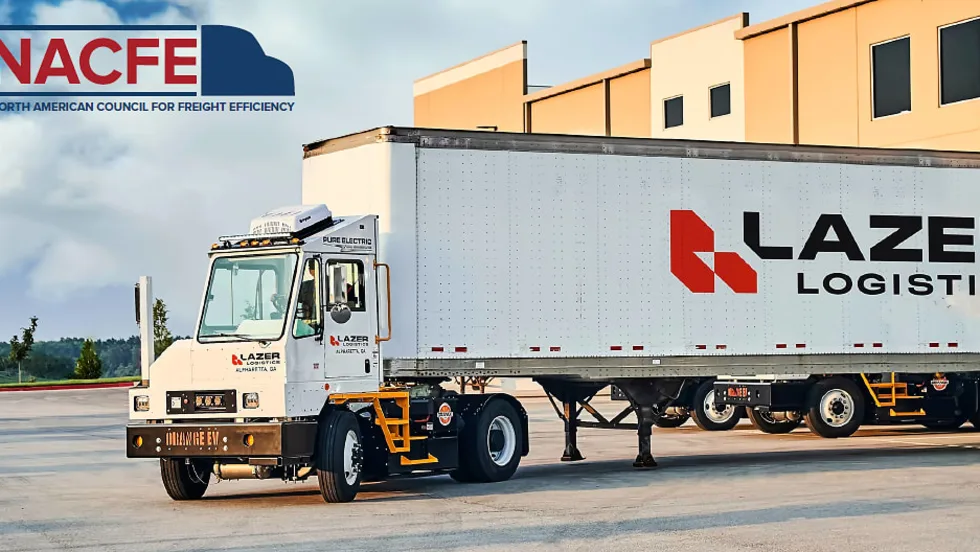
Electric Yard Tractors Move Beyond Pilots
Operating-cost savings have overtaken sustainability goals as the leading reason surveyed fleets are adopting battery-electric terminal tractors, according to new NACFE research.
Read More →
Geotab Links Fleet Card to Vehicle Data
The new card combines fuel discounts with telematics-based purchase controls. Geotab’s analysis also points to potential savings from choosing lower-priced fuel stops.
Read More →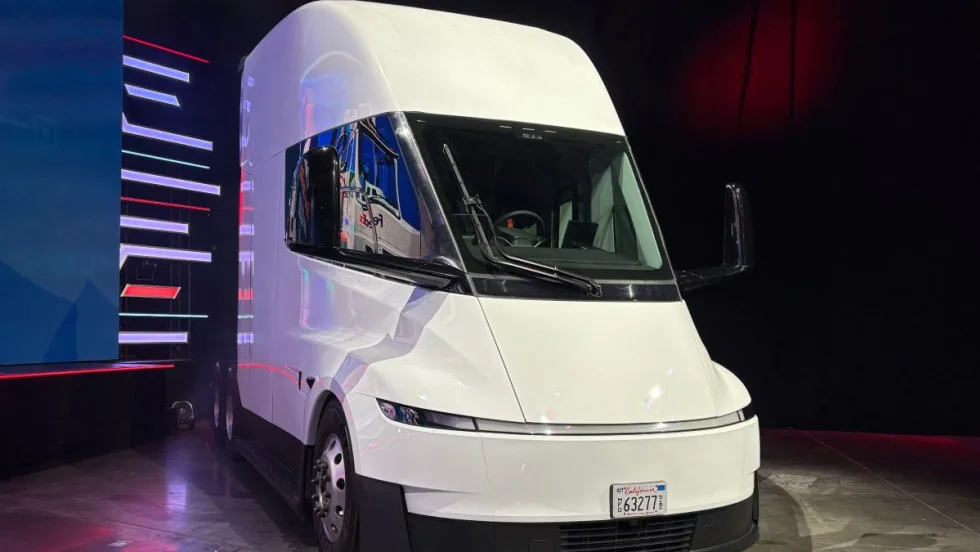
Fleet Economics Shape Electric Truck Outlook
ACT Research expects costs, charging infrastructure, and technology improvements to drive zero-emission commercial vehicle adoption as federal regulations and incentives retreat.
Read More →
Wex Adds Cardless Fuel Payments for Over-the-Road Customers
A new fuel card feature for Wex customers offers convenience and security.
Read More →
New California Law Could Shed Light on Electric Truck Prices
Why do battery-electric Class 8 trucks remain so expensive? A California bill signed by Gov. Gavin Newsom would give fleets and state agencies more visibility into what manufacturers charge.
Read More →