Nikola is upping the bar on hydrogen-powered zero-emissions trucks, unveiling the production version of the fuel-cell-electric Nikola Tre and declaring it has solved the “chicken and egg” problem of fueling infrastructure.
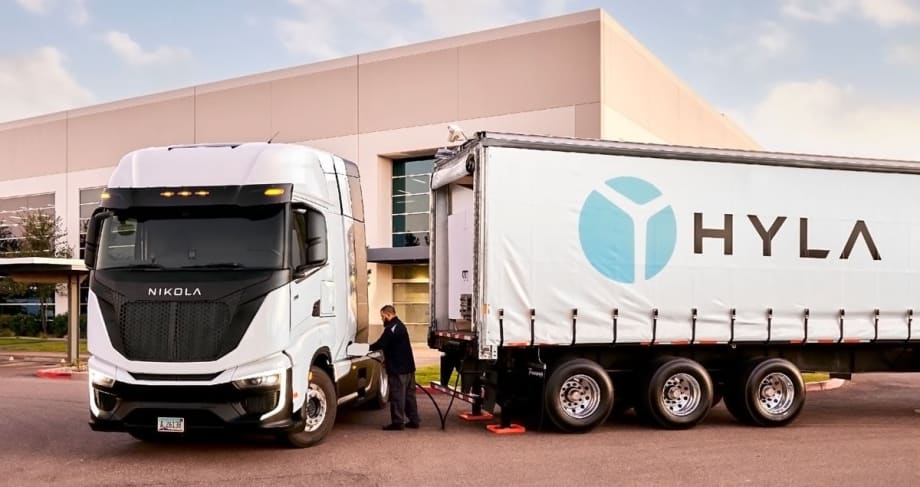
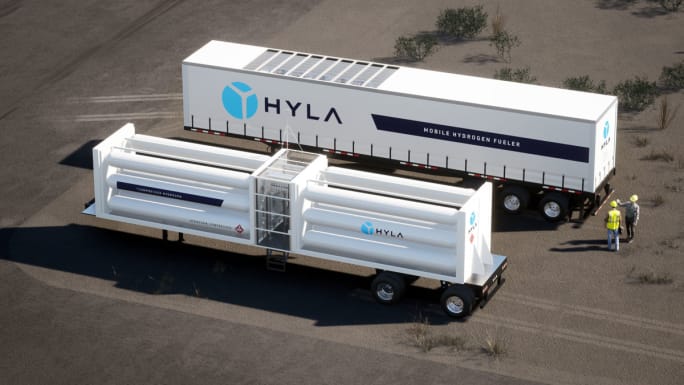
Nikola showed off the production version of its hydrogen-fuel-cell Tre and a new mobile hydrogen fueling trailer.
Photo: Nikola
7 min to read
Nikola is upping the bar on hydrogen-powered zero-emissions trucks, unveiling the production version of the fuel-cell-electric Nikola Tre and declaring it has solved the “chicken and egg” problem of fueling infrastructure.
“We believe here at Nikola that the time for hydrogen is right now,” said Carey Mendes, president of energy. “It’s a game-changing energy source we know is going to be the cornerstone of helping decarbonize the transportation sector.”
More than 300 fleet, government, supplier, energy and media representatives were on site for an event late Jan. 25 at Nikola’s U.S. headquarters in Phoenix, highlighting the progress made by Nikola’s energy and truck businesses.
Nikola announced the creation of a new global brand, Hyla, devoted to procuring, producing, distributing and dispensing hydrogen to fuel its zero-emissions trucks — and those of other OEMs. It plans to break ground this year on its first hydrogen hub, west of Phoenix in Buckeye, Arizona.
“Nikola is the only company that is successfully integrating a revolutionary new product, the hydrogen fuel cell truck, and the full hydrogen energy infrastructure supply chain under one roof,” said Nikola CEO and President Michael Lohscheller.
Officially unveiling the Nikola Tre fuel cell truck, Hyla, and its new mobile fueling trailer at the event “demonstrates a real and sustainable competitive advantage for our customers and are significant proof points that we are accomplishing what we set out to achieve,” he added.
Meet the Nikola Tre Fuel Cell Electric Vehicle (FCEV)
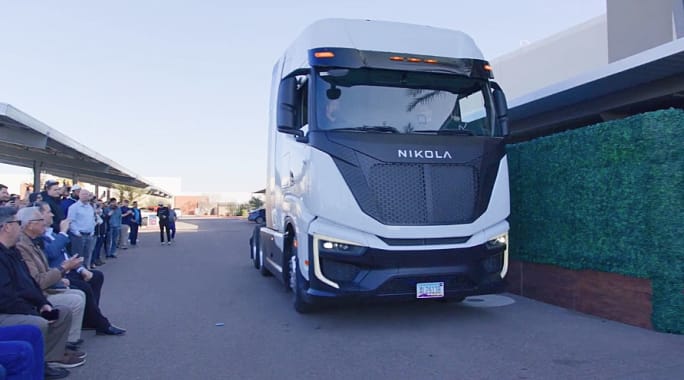
Lohscheller introduced the final production model of the Nikola Tre FCEV, which will be hitting the market later this year.
“You are not looking at the future. You are looking at the present here today,” he said.
With a range of up to 500 miles, the Nikola Tre FCEV is expected to have among the longest ranges of all commercially available zero-tailpipe-emission Class 8 tractors, according to Nikola, while realizing weight savings compared to battery-electric Class 8 trucks with similar range. This makes it suited for applications such as drayage, intermodal, metro-regional truckload, and less-than-truckload; even certain specialized hauling use cases.
Lohscheller said the truck has an estimated fueling time of 20 minutes. It produces 536 hp and 12,500 lb-ft of torque and features an advanced, multi stage regenerative braking system.
Nikola showed off its production-ready version of its FCEV Tre at a Jan. 25 event at its Phoenix headquarters.
Photo: Screen capture of Nikola event broadcast
Inside, the digital cockpit has two high-resolution screens: a 13-inch instrument cluster in front of the driver and a 17-inch infotainment screen to the driver’s right, which he said is the largest of its kind.
The Nikola Tre FCEV also features the company’s own, “from-the ground-up software architecture that is functional and intuitive.” Fleets can remotely program things such as speed limiting and driver assignments. “It can determine appropriate routes based on load, weight, height and class of materials on board,” he said. Onboard and remote diagnostics come standard.
In addition, a mobile app allows the driver to do things such as remotely lock and unlock the truck, do pretrip safety checks, and monitor the state of charge. The driver can even remotely have the truck flash its lights to easily locate the truck in a yard or parking lot.
The alpha version of the Tre FCEV has been in testing for a year in the real world by customers such as Anheuser Busch, Walmart, Biagi Bros. and TTSI at the Port of Long Beach in California. In a video shown at the event, someone from Biagi said even though they are alpha trucks, not production models, he’s had “less downtime with those two trucks than we’ve had with any new diesel truck we’ve purchased in the last 24 months."
Biagi Bros. plans to take delivery in the fourth quarter of 2023 of 15 Nikola Tre FCEVs in Ontario, California. The FCEV trucks are expected to put in over 100,000 miles per year, to support the round-the-clock operations.
Bruce Kurtt, senior vice president, sales and commercial operations, briefly addressed the questions his sales team gets about acquiring a Nikola FCEV but didn’t offer a lot of details in his answers:
Cost? “It’s going to cost a little more than a diesel truck.”
Fuel prices? Kurtt noted that with hydrogen, fleets will have a guaranteed price they can plan on for an extended period of time, rather than the rapid fluctuations of diesel prices.
Maintenance? An electric truck means less maintenance.
Warranty? The warranty covers all those new components and systems that fleets are concerned about, such as the fuel cell, the electric power plant, and the electric e-axle
Safety? “We did far more testing than what you need to do,” he said, showing videos of heavy sledges slamming into the front and sides of the truck to test the toughness of hydrogen tanks and other systems.
Financing? If you want to finance it, we can do that. If you want to lease it, we can do that. Incentives, we can do that.”
Hydrogen Production
But a hydrogen fuel cell truck is useless without a supply of hydrogen fuel.
Under the Hyla brand, Nikola is developing access of up to 300 metric-tons per day (TPD) of hydrogen. This supply is expected to be supported by the previously announced projects referenced below, which are being developed with Nikola partners:
Buckeye, Arizona: Hydrogen Production Hub will see phased development of up to 150 metric-TPD.
Plug Power: multi-region offtake agreement of up to 125 metric-TPD
Crossfield, Alberta, Canada: TC Energy – 60 metric-TPD
Clinton County, Pennsylvania: KeyState – 100 metric-TPD
The Phoenix Hydrogen Hub is expected to be built in phases to provide more hydrogen supply as demand created from Nikola’s zero-emission trucks in the Southwest region. It will start with 30 metric-tons in the first phase. Groundbreaking will take place this year, and construction of the first phase is anticipated to be completed in the second half of 2024, once final investment decisions and customary regulatory approvals are finalized.
Mendes explained that in the first stage, 30 metric tons, or 30,000 kilograms, of hydrogen can fuel up to 750 trucks every day. At its full projected capacity, it will produce up to 150,000 kilograms, or enough to fuel 3,500 trucks per day.
“If a small fleet of 15 trucks utilized 1.5 tons of hydrogen per day, it would replace an estimated 700 gallons of diesel fuel and cut 2.4 metric ton of carbon emissions,” he said.
Hyla Hydrogen Fueling
Hyla’s mission, said Mendes, is “to secure supplies of clean hydrogen and distribute to our customers at very competitive prices.
“As we set out to build the world’s first Class 8 hydrogen truck, we realized that wasn’t good enough. We had to consider both the chicken and the egg. In order to fuel that truck, we also need to find a way to develop the hydrogen supplies and the infrastructure required to support the demand for this truck.”
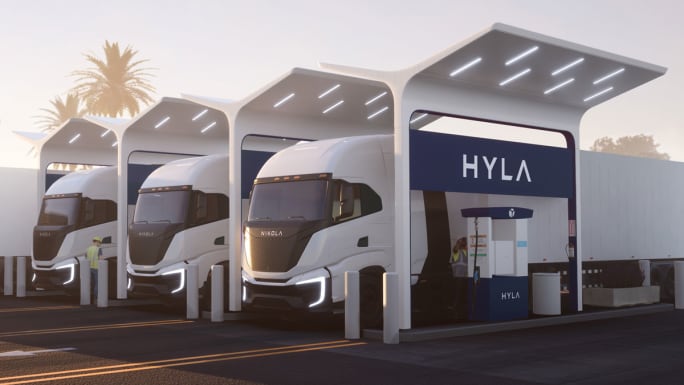
Nikola's new brand, Hyla, has a goal of opening 60 hydrogen fueling stations for Nikola FCEV customers — and other FCEV truck operators.
Photo: Nikola
Hyla’s goal is to have 60 hydrogen stations in place by 2026. The company already has announced the locations of three stations, all in California:
“It helps us get hydrogen and these trucks on the road not five years from now, but in 2023,” Mendes said. “We can deliver hydrogen to customers anytime, anywhere. Quickly establish refueling sites anywhere you imagine,” such as at a customer distribution center.
A new mobile fueling trailer will make it easier for customers to adopt hydrogen-fuel-cell vehicles now.
Photo: Nikola
“We believe this is the first of its kind,” Mendes said.
Nikola has spent the greater part of two years developing the mobile fueling solution, which cools and compresses hydrogen to rapidly fill 700-bar (10,000 psi) FCEV heavy-duty trucks.
“it allows us to fuel our customers fast,” Mendes said, “20 to 50 vehicles a day, right now. This is a game changer … that allows us to make the hydrogen dream a reality.”
The mobile fueler program includes its own mobile fuelers as well as a number of third-party mobile fuelers, which will provide Nikola customers with a variety of flexible fueling options.
The first mobile fueler has completed commissioning and testing and has been released for market operation. Nikola has additional hydrogen mobile fuelers being commissioned in the first quarter.
Lohscheller compared Nikola’s progress to his own passion for long-distance running. “Many running coaches will tell you, visualize your race before it happens,” he said. “We have done exactly that. They also say know what pace you can sustain. We all know this is not a sprint… but there are surges along the way and you will witness several of those today and in the coming months.
“The reality is, we are hitting our stride and the results are tangible products that will transform our entire world.”
Electric-Truck Startups Met With Skepticism
"Traditional truck companies were giving lip service to zero-emissions transportation."
Nikola Chairman of the Board Steve Girsky opened the event with a story:
"When I joined GM in 2009 as vice chairman, I asked the GM team about Tesla. Their response was, 'It’s a bunch of laptop batteries, don’t worry about it.' And that was the conventional wisdom of the auto industry at the time. And that gave Tesla a 10-year head start on everyone else. A head start on building scale, a head start on battery technology, and a head start on creating infrastructure.
"When I came to Nikola a few years ago, I saw a similar situation. Traditional truck companies were giving lip service to zero-emissions transportation. They thought electric and hydrogen were interesting, 'very nice, but that’s late decade stuff.' While others thought zero emissions trucking was 10 years out, we saw an opportunity. While others were doing it for the credit, we were doing it to change the world. While others were talking, we were doing."
Volvo’s updated D13 promises lower emissions without sacrificing performance or fuel economy. Take a closer look at what changed inside the engine in this HDT Spotlight video.
The Michelin X Multi Energy D2 is a regional haul drive tire engineered to help fleets improve fuel efficiency, durability and traction in demanding stop-and-go operations.
ZF is expanding its North American commercial-vehicle presence with new transmission applications, electrification, trailer technology and autonomous-driving systems.
Could Tesla’s camera-only autonomous driving technology work on an 80,000-pound Semi? In this commentary, HDT's Deborah Lockridge takes a look at Tesla, Cybercab, and how autonomous trucks see the road.
The U.S. Department of Transportation issued a new automated-vehicle strategy that outlines plans for driverless-truck regulations, cross-state freight corridors, and federal safety standards.
The Port Authority of New York and New Jersey announced millions in incentives for zero-emission drayage trucks, yard tractors, and new charging hubs near the port.
The National Highway Traffic Safety Administration says it lacks authority to regulate medium- and heavy-duty truck engines separately from complete vehicles, but the existing standards have not yet been eliminated.