




NHTSA Preparing to Require Stability Control Systems on Tractors
A pending federal proposal to require stability control systems on truck tractors is getting a mixed reaction from the trucking industry. The proposal, scheduled to be published by the National Highway Traffic Safety Administration at the end of the year, would specify the details of a technology standard that that a growing number of fleets already have adopted voluntarily because they see safety benefits
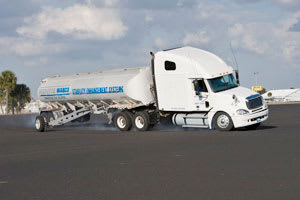
A pending federal proposal to require stability control systems on truck tractors is getting a mixed reaction from the trucking industry.
The proposal, scheduled to be published by the National Highway Traffic Safety Administration at the end of the year, would specify the details of a technology standard that that a growing number of fleets already have adopted voluntarily because they see safety benefits.
The agency has not said how it intends to handle the distinction between the two types of stability systems on the market, Roll Stability Control and Electronic Stability Control. But it has made clear that the proposal will cover only tractors, which according to experts indicates there is not likely to be a retrofit requirement.
The agency sees ample safety justification for the proposal. It says that rollover and loss-of-control crashes are responsible for 304 deaths and 2,738 injuries a year. And stability control systems are effective in up to 56% of single-vehicle tractor trailer rollover crashes, and up to 14% in crashes from skidding. From this, the agency estimates that the systems will save as many as 66 lives a year and prevent almost 1,000 injuries.
The systems would cost the industry up to $107 million a year, but that cost would be outweighed by up to $372 million in savings from preventing property damage and travel delays, the agency said.
Growing Support
Stability control systems, which were introduced starting in 2002, get positive reviews from a growing number of carriers.
"(They are) the biggest winner in safety technology as far as I am concerned," says C.R. England President Chad England. The company credits the Meritor Wabco stability control system with providing a 50% improvement in its rollover accident rate.
"In some respects, the (tank) industry has already gone beyond a rule," said John Conley, president of National Tank Truck Carriers, the trade association representing the tanker industry. "Just about any new tractor you buy today has a system on it, and any major manufacturer of cargo tanks will have roll stability systems as a standard item."
And the major suppliers of the systems report growing sales.
Fred Andersky, director of government affairs for Bendix Commercial Vehicle Systems, said his company has about 130,000 systems on the road. Last year about 14% of new trucks had stability systems. Market penetration among Class 6 through Class 8 air-braked trucks is now approaching 23%, he said.
Mark Melletat, director of field operations for Meritor Wabco Vehicle Control Systems, put market penetration for the systems as high as 25%. "I would expect the use of the systems to grow with or without a mandate," he said.
Safety Benefits
The growth is being driven by safety benefits shown in federally sponsored studies and fleet experience, but both Andersky and Melletat cited the Federal Motor Carrier Safety Administration's new CSA safety enforcement program as an additional factor. Carriers are looking for anything that can reduce the chances an accident that would raise their CSA score.
American Trucking Associations, which represents the interests of the large and small carriers in all segments of the business, supports the technology but is not ready to say that it will support a federal requirement.
ATA Engineering Director Ted Scott said the association would like to see some sort of incentive for the use of the systems, perhaps a tax break or a non-monetary incentive. Congress has in the past considered legislation that would create a tax credit on the cost of a number of safety systems, including stability control, but given the current political climate, such a bill is not likely to pass.
Scott said ATA will reserve judgment on the agency's proposal until it sees the details.
NTTC's Conley said that the tank carriers support the idea of a rule for new equipment. In fact, in 2008 the association's executive committee voted to petition NHTSA to require Electronic Stability Control on any new tractor used with cargo tank, he said. Like ATA, though, he wants to see the details.
The Owner Operator Independent Drivers Association opposes a mandate. Joe Rajkovacz, director of regulatory affairs, said he believes the technology works, but a mandate would force independents to pay for a device even if they have never had an accident.
He fears that this expense, on top of other regulatory expenses such as emission controls and electronic onboard recorders, will drive the cost of a truck beyond the reach of small businesses.
Another major player in the issue is the National Transportation Safety Board, an independent investigative agency that has no regulatory power but whose recommendations carry a great deal of weight with the public and on Capitol Hill.
In a recent examination of a 2009 crash in which a tank truck carrying liquefied petroleum gas overturned and exploded, the Board recommended that all tank trailers be retrofitted with a rollover stability control system, and that NHTSA require stability control systems on all new heavy commercial vehicles.
ESC versus RSC
Where NHTSA will come down on Electronic Stability Control versus Roll Stability Control is likely to affect industry reaction to the proposal.
Both systems perform a similar function: If sensors detect the risk of rollover or instability, the control module slows the vehicle by cutting back the throttle and applying the brakes automatically.
The difference is that RSC is triggered only when the system detects roll instability, such as might occur when a tank truck is too fast going into a turn or maneuvers too quickly. ESC reacts to both roll instability and yaw instability, such as a skid that could lead to a jackknife. In addition to slowing the vehicle to prevent a rollover, it applies the brakes on the wheel that needs to be slowed to counteract the skid.
Studies have demonstrated that both systems are effective, but not equally so. A 2009 study by the University of Michigan Transportation Institute concluded that if all 5-axle tractor-trailers had RSC, there would be 3,489 fewer crashes and 106 fewer deaths each year. If all of these trucks had ESC, there would be 4,659 fewer crashes and 126 fewer deaths.
The other difference is cost. ESC, having more capability, is more expensive. Andersky of Bendix said the retail list price for an RSC system is $1,600, while an ESC system ranges from $2,000 to $2,300. Melletat of Meritor Wabco put the RSC system at $800 and the ESC system at $1,800.
Discounts are common and prices should go down due to economies of scale if NHTSA mandates the systems, they both said.
Both manufacturers offer both systems, but they differ in their approach to the technical specifications that NHTSA should require.
Andersky said Bendix believes strongly that the agency should mandate ESC. "We see ESC as the foundation for a lot of future technology, such as collision mitigation and even more advanced systems," he said. Plus, he said, ESC is the only technology that will work on a straight chassis - and buses are included with truck tractors in the pending proposed rule.
Melletat said Meritor Wabco does not care which technology the agency requires. "We would support either platform," he said. "We see a place in market for both, and have seen success with both products."
Meritor Wabco is able to offer more advanced systems on either platform, he added.
Trucking interests typically worry about the possibility of a retrofit requirement in such rules, but both suppliers said the agency is not likely to go that route with respect to tractors, at least.
"Retrofit won't work on tractors," Melletat said, noting the difficulty of moving wiring harnesses and installing electronic control units. "It's very expensive."
On t
More Safety & Compliance
A Camera Isn't a Safety Program. Here's What Brokers Are Screening for Now
Footage alone may not be enough to pass broker vetting processes. Here's what counts as a defensible safety program now.
Read More →
Marijuana and Trucking’s Drug-Testing Dilemma
Marijuana is getting stronger, laws are changing, and drug tests still can’t reliably establish impairment. What does that mean for truck drivers and the fleets that employ them?
Read More →
PrePass, Kodiak Connect Driverless Trucks to Roadside Enforcement
The system will allow enforcement agencies to verify Enhanced Inspection information and decide whether Kodiak’s autonomous trucks can bypass roadside screening sites.
Read More →

From One Generation to the Next: How Mentorship Builds Safer Truck Drivers
After three decades in trucking, Harold Perry shares what he's learned about driver safety, mentorship, and helping the next generation build confidence behind the wheel.
Read More →
FMCSA Pauses Biennial-Update Enforcement Amid Motus Transition
Carriers whose updates were due on or after June 1 have more time, while FMCSA works to stabilize its new registration system and warns of phishing sites impersonating its new carrier registration system, Motus.
Read More →
ZF Expands Commercial Vehicle Push in North America
ZF is expanding its North American commercial-vehicle presence with new transmission applications, electrification, trailer technology and autonomous-driving systems.
Read More →
Truck Drivers Need More Than Another Alert
Fleets have more visibility into truck health, safety events, and driver activity than ever. The next challenge is turning all that information into useful guidance for the person who has to decide what to do next.
Read More →
Tesla Wants a Self-Driving Semi. Are Cameras Enough?
Could Tesla’s camera-only autonomous driving technology work on an 80,000-pound Semi? In this commentary, HDT's Deborah Lockridge takes a look at Tesla, Cybercab, and how autonomous trucks see the road.
Read More →
What DOT’s Automated Vehicle Strategy Means for Trucking
The U.S. Department of Transportation issued a new automated-vehicle strategy that outlines plans for driverless-truck regulations, cross-state freight corridors, and federal safety standards.
Read More →
NYC Expands Speed, Pedestrian Safety Tech Across Fleet
New York City is expanding intelligent speed assistance and pedestrian-alert systems across its municipal fleet, moving the technologies from pilot programs into vehicle procurement and retrofit requirements.
Read More →