




New York to Automate Tolling to Cut Congestion
New York Governor Andrew Cuomo has unveiled a plan to reduce traffic congestion in the New York City are by automating tolling of eight bridges and two tunnels.
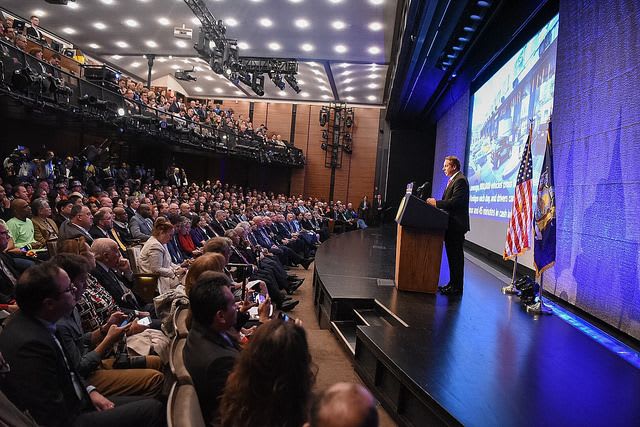
Governor Cuomo announced a transformational plan to reimagine New York City-area crossings for the 21st century. Photo via office of Gov. Andrew Cuomo
Governor Cuomo announced a transformational plan to reimagine New York City-area crossings for the 21st century.Photo via office of Gov. Andrew Cuomo
New York Governor Andrew Cuomo (D) has unveiled a plan to reduce traffic congestion by automating tolling of all bridges and tunnels operated by the state's Metropolitan Transportation Authority, which is repsonsible for unified mass transportation in the New YorK City metro area,
The New York Crossings Project will encompass all seven bridges and the two tunnels operated by MTA: Brooklyn-Battery Tunnel, Queens-Midtown Tunnel, Henry Hudson Bridge, Whitestone Bridge, Throgs Neck Bridge, RFK Triborough Bridge, Verrazano-Narrows Bridge, Marine Parkway-Gil Hodges Memorial Bridge, and Cross Bay Veterans Memorial Bridge. The coordinated tolling plan will also take in the George Washington Bridge, which is operated separatley by the Port Authority of New York and New Jersey.
The State of New York said it will implement automatic tolling to improve the flow of traffic by using sensors and cameras to automate the tolling process and thereby not require vehicles to come to a stop to pay. The sensors and cameras will be suspended overhead on structures known as gantries.
“This transformational project will revolutionize transportation in New York and ensure that our state is built to lead for generations to come,” said Cuomo. “By investing in New York's transportation network today and equipping it to meet the challenges of tomorrow, we are cementing our state's position as a national leader in 21st century infrastructure and cutting-edge innovation."
A vehicle with an electronic E-ZPass will be charged immediately while a non E-ZPass vehicle will have its license plate recorded and a toll bill will be mailed to the registered owner.
Asked by HDT to comment on the plan, Kendra Hems, President of the Trucking Association of New York, said that TANY supports “removing the toll booths and installing automated tolling to help reduce congestion and potentially reduce accidents.”
However, Hems said TANY has “some questions about the $500-million cost to the plan and we are currently working on getting more information related to that. Additionally, given the sheer volume of traffic that cross the bridges and tunnels every day, we have some concerns about the ability of the MTA to collect tolls from those vehicles that do not currently have E-ZPass.”
New York drivers currently spend more than 6,400 hours per day waiting to pay tolls and the state estimates that automatic tolling will save commuters up to 21 hours of drive time every year.
By eliminating the need to come to a stop, the state estimates that fuel consumption and emissions will also decrease. Putting the measure in place could conserve around 1 million gallons of fuel and save $2.3 million each year.
Automatic tolling will begin on both MTA tunnels in January and is slated to be completed on all MTA-operated bridges by the end of next year.
More Fleet Management

Color Match Smarter: Tools That Restore & Perform
For fleet managers and collision repair professionals keeping heavy-duty trucks on the road, getting the color right the first time isn't just about appearance — it's about efficiency, turnaround time, and bottom-line results. Discover how today's digital color tools are transforming the repair process from guesswork to precision.
Read More →
FMCSA Pauses Biennial-Update Enforcement Amid Motus Transition
Carriers whose updates were due on or after June 1 have more time, while FMCSA works to stabilize its new registration system and warns of phishing sites impersonating its new carrier registration system, Motus.
Read More →
2026 Blueprint for Countering Smarter Supply Chain Theft
Cargo theft is no longer just the cost of doing business. It's a multi-billion-dollar criminal enterprise exploiting vulnerabilities across your fleet, drivers, and supply chain.
Read More →


How Telematics Improves Visibility, Control, and Performance in Refrigerated Fleets
Explore how telematics help refrigerated fleets improve visibility, uptime, efficiency, compliance, and cargo protection across connected cold chain operations.
Read More →
What the U.S.-Canada Trade War Means for Trucking
Escalating U.S.-Canada tariffs could disrupt cross-border freight, reduce truck volumes, raise costs, and create new uncertainty for carriers on both sides of the border.
Read More →
What Are Trucking’s Top Concerns for 2026?
The American Transportation Research Institute wants to know what's worrying trucking fleet managers, drivers, and other stakeholders in its annual Industry Issues survey.
Read More →
American Trucking Associations Looks for a New Leader
ATA President and CEO Chris Spear abruptly left his job at the association on August 21, at a pivotal time for the trucking industry.
Read More →
Public Wi-Fi Cybersecurity Risks: How Truck Drivers and Fleets Can Protect Their Data
Public Wi-Fi can expose truck drivers and fleets to credential theft, malware, and other cyber threats. Here’s how to reduce the risk on the road.
Read More →
For Nicky Cupp, Fleet Innovation Starts With Frustration
HDT Truck Fleet Innovator Nicky Cupp turns everyday pain points at Fraley & Schilling into opportunities for better technology and smarter processes.
Read More →
Adam Buttgenbach’s Approach to Electric Trucks: Start With Where They Fit
HDT Truck Fleet Innovator Adam Buttgenbach helped PepsiCo build one of North America’s largest EV fleets by focusing on where electric trucks make operational sense.
Read More →