




New Proposal Would Greatly Expand EOBR Use
The new proposal on electronic onboard reporters vastly expands the rule the Federal Motor Carrier Safety Administration put out less than a year ago

The proposed rule would require electronic onboard recorders for all of the approximately 500,000 carriers now required to maintain driver logbooks.
The new proposal on electronic onboard reporters vastly expands the rule the Federal Motor Carrier Safety Administration put out less than a year ago.
The current rule, which will go into effect June 4, 2012, says that carriers that violate hours of service rules 10 percent of the time, based on single compliance review, must use electronic onboard recorders to track driver hours. It will affect only 5,700 interstate carriers.
The rule the agency is now proposing, which will go into effect three years after it is made final, will cover all of the approximately 500,000 carriers now required to maintain driver logs. It will not apply to short-haul interstate carriers that use timecards to document hours of service.
The proposal also covers requirements for documentation to prove compliance with the hours of service rule, and it would require carriers to monitor driver compliance with the rule.
In cases where drivers mainly use timecards but occasionally drive beyond the limits of their normal operations, the agency said it would permit continued use of timecards. The agency considered extending the recorder requirement to short-haul drivers of bulk hazmats, but decided to study the issue further and is looking for comments.
The agency said it considered requiring recorders just for long-haul operations outside the 150 air-mile radius, but decided that would not address safety concerns associated with short-haul carriers that use driver logs. It is asking for comments on whether a long-haul option is feasible, however.
Another possibility the agency looked at was the universal approach recommended by the National Transportation Safety Board - all motor carriers. But the cost of such a requirement would have exceeded the benefits for most short-haul carriers, the agency found.
The cost of a life
On this point, the agency was working with a crucial new piece of information. In drafting its rules, the agency is required to balance costs and benefits. A key data point in that equation is Economic Value of a Statistical Life. In 2008 the Department of Transportation raised that figure - doubled it, in fact - from $3 million to $6 million.
This change gave the agency more leeway to expand the recorder rule. The agency also noted in yesterday's proposal that the broader mandate is more cost-effective because the industry is making more use of onboard communications and management systems.
FMCSA said it does not expect to change the 2012 compliance date for the current rule, even though the final rule arising from this proposal should be done before then. It will enforce the current rule during the period between the 2012 compliance date and the compliance date of the new rule, the agency said.
The agency said it was considering the costs of recorders when it came up with the three-year grace period for compliance.
It estimates that the annualized cost for a carrier that does not already use a fleet management or other EOBR-ready system ranges from $525 to $785 per tractor. For a carrier with an EOBR-ready system in place, the cost would be $92.
But the aggregate impact of the mandate will be significant, considering the large number of small carriers, the agency said. Hence the three-year window.
The agency asks for comments on this point, and indicated it will consider adjustments to the compliance date. It also is asking for comments on the idea of staggering the adoption schedule by requiring larger carriers to make the move first.
Supporting documents
With respect to supporting documents, the proposal includes a requirement that carriers maintain an hours of service management system - controls, policies, programs, practices and procedures that systematically monitor a driver's compliance with the rules, and verify the accuracy of the logs. Failure to maintain such a system would be listed as an acute and critical citation.
Here's a rundown on other aspects of the supporting documents proposal:
* The driver's name or identification number. A vehicle number could be used as long as it can be associated with a driver at a specific date, time and location.
* The date of an event, and the time the event began and ended.
* The location must be precise enough for enforcement personnel to quickly find it on a map. If the location, which can be the nearest city or town, comes from an electronic document, it must derive from a source that no one can alter. The agency is proposing to prohibit electronic jamming devices that interfere with EOBRs.
* The number of documents that carriers will need to maintain will vary according to the operational circumstances, the agency said.
* Regarding the type of documents, the agency said it will require four categories: payroll, trip-related expense records and receipts, communications logs from fleet management systems, and a bill of lading or its equivalent.
* The agency is proposing to allow carriers to provide just one supporting document for the beginning and end of each on-duty not-driving period, provided the document contains all the data elements. If it does not, the carrier would have to keep enough documents to show collectively the required information.
In addition the agency is proposing a provision that would allow a carrier to certify that none of the required supporting documents are available. This should not be seen as a loophole, the agency cautioned: "Motor carriers that falsely certify the absence of supporting documents would be subject to the maximum penalty authorized by law."
The retention period for supporting documents would be six months.
Industry reaction
David Osiecki, senior vice president for policy and regulatory affairs at American Trucking Associations, said he was not surprised by the scope of the agency's proposal. "It is what we expected," he said.
The Owner-Operator Independent Drivers Association said in a statement that EOBRs cannot accurately record driver hours and duty status. The association also warned that recorders can be used to harass drivers.
The proposal can be found at http://www.ofr.gov/OFRUpload/OFRData/2011-02093_PI.pdf. The agency will be accepting comments as soon as the proposal is published in the Federal Register.
More Drivers
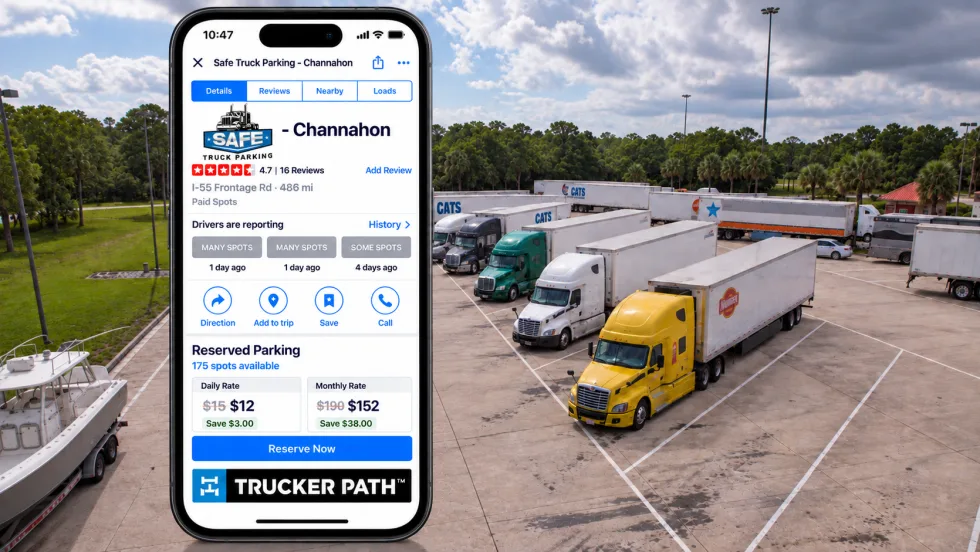
Trucker Path Expands Reserved Parking Network
Trucker Path has added close to 6,000 more truck parking spaces to its Trucker Path Reserved Parking Network with the addition of Safe Truck Parking.
Read More →
EEOC Sues Texas Trucking Company Over Driver Age Limits
The agency says Trancasa USA rejected applicants over 65 and applied tougher driving-record standards to those over 60.
Read More →
Nussbaum, Roehl Announce Second Driver Pay Increase This Year
This year has seen a swath of major truck driver pay increases as freight capacity has tightened.
Read More →
From One Generation to the Next: How Mentorship Builds Safer Truck Drivers
After three decades in trucking, Harold Perry shares what he's learned about driver safety, mentorship, and helping the next generation build confidence behind the wheel.
Read More →
Truck Drivers Need More Than Another Alert
Fleets have more visibility into truck health, safety events, and driver activity than ever. The next challenge is turning all that information into useful guidance for the person who has to decide what to do next.
Read More →
FMCSA Removes 110 Truck Driver Training Schools from Certified ELDT List
Federal regulators also are targeting more than 160 additional training providers and launching a nationwide audit of third-party CDL skills testers as part of a broader crackdown on trucking fraud.
Read More →
Hours of Service Pilot Programs: FMCSA Readies for 2027 Rollout
Two pilot programs could eventually reshape hours-of-service rules, giving truck drivers options to pause their 14-hour clock or use longer split sleeper rest periods.
Read More →
Medical Cards, English Proficiency Reshape Roadcheck Violations
Medical-card violations jumped to the top of the driver out-of-service list during CVSA’s 2026 International Roadcheck, while English-language proficiency violations appeared among the leading violations for the first time.
Read More →
Driver Trust Can Make or Break the Success of Fleet Safety Technology
New Teletrac Navman research suggests that onboarding, transparency about driver data, and positive feedback can play a significant role in how commercial drivers respond to safety and coaching technology.
Read More →
EEOC Sues KLLM Over Alleged Sex Discrimination in Driver Training
KLLM is facing a federal sex-discrimination lawsuit over policies the EEOC alleges put female truck driver trainees at a disadvantage.
Read More →