




Nevada Senators Decry Nuclear Transport
Nevada's U.S. Senators want closer scrutiny of hazardous materials shipping after a damaged nuclear waste container was found on a truck bound for the Nevada Test Site
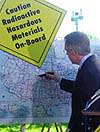
Nevada's U.S. Senators want closer scrutiny of hazardous materials shipping after a damaged nuclear waste container was found on a truck bound for the Nevada Test Site.
Democrat Harry Reid and Republican John Ensign held a press conference last week, where they showed the route taken by the truck on its way from New York to Nevada. The senators called for this incident, combined with the recent hazmat train accident in Baltimore, to serve as a wake-up call to the nation about the dangers of transporting dangerous materials.
"A cracked container carrying radioactive waste was transported through large cities in the East, small communities in America's heartland, and over the Rocky Mountains in the West," Reid said. "Millions of people live along the route taken by this truck…. Accidents happen, and it's time we understand the very real and immediate danger of transporting radioactive waste."
Ensign echoed Reid's remarks about Americans having "the right to know" when nuclear waste is being transported nearby. "I want to make sure that when an accident happens … the first responders to the scene … are equipped to effectively handle the situation," he said.
Two weeks ago, a truck was transporting seven containers holding low-level nuclear waste from the U.S. Department of Energy's West Valley, N.Y., reprocessing plant to the Nevada Test Site when the driver of the truck discovered white foam on the truck bed and called authorities. The foam was packing material from the thick-walled metal box, which foams when it gets wet.
After inspectors found an inch-long crack in one of the containers, the DOE suspended shipments from the New York site for two weeks to conduct a review. DOE reports that a preliminary test showed no radiation was detected around the truck.
The two senators head a Nevada congressional delegation fighting a proposal to transport high-level commercial and military nuclear waste to the Nevada Test Site, where it would be buried in Yucca Mountain, about 90 miles northwest of Las Vegas.
Nevada Gov. Kenny Guinn called the incident a "near catastrophe" and said it illustrated the problems with transporting nuclear waste.
More Safety & Compliance

When Language Stops the Truck: The Return of ELP Out-of-Service Orders
English language proficiency rules for commercial drivers aren’t new, but renewed out-of-service enforcement has raised the stakes. Here’s what carriers need to know before a driver reaches a roadside inspection.
Read More →
A Camera Isn't a Safety Program. Here's What Brokers Are Screening for Now
Footage alone may not be enough to pass broker vetting processes. Here's what counts as a defensible safety program now.
Read More →
Marijuana and Trucking’s Drug-Testing Dilemma
Marijuana is getting stronger, laws are changing, and drug tests still can’t reliably establish impairment. What does that mean for truck drivers and the fleets that employ them?
Read More →

PrePass, Kodiak Connect Driverless Trucks to Roadside Enforcement
The system will allow enforcement agencies to verify Enhanced Inspection information and decide whether Kodiak’s autonomous trucks can bypass roadside screening sites.
Read More →
From One Generation to the Next: How Mentorship Builds Safer Truck Drivers
After three decades in trucking, Harold Perry shares what he's learned about driver safety, mentorship, and helping the next generation build confidence behind the wheel.
Read More →
FMCSA Pauses Biennial-Update Enforcement Amid Motus Transition
Carriers whose updates were due on or after June 1 have more time, while FMCSA works to stabilize its new registration system and warns of phishing sites impersonating its new carrier registration system, Motus.
Read More →
ZF Expands Commercial Vehicle Push in North America
ZF is expanding its North American commercial-vehicle presence with new transmission applications, electrification, trailer technology and autonomous-driving systems.
Read More →
Truck Drivers Need More Than Another Alert
Fleets have more visibility into truck health, safety events, and driver activity than ever. The next challenge is turning all that information into useful guidance for the person who has to decide what to do next.
Read More →
Tesla Wants a Self-Driving Semi. Are Cameras Enough?
Could Tesla’s camera-only autonomous driving technology work on an 80,000-pound Semi? In this commentary, HDT's Deborah Lockridge takes a look at Tesla, Cybercab, and how autonomous trucks see the road.
Read More →
What DOT’s Automated Vehicle Strategy Means for Trucking
The U.S. Department of Transportation issued a new automated-vehicle strategy that outlines plans for driverless-truck regulations, cross-state freight corridors, and federal safety standards.
Read More →