



4 Questions About Brake Violations
Why was your truck put out of service? Answers to common questions about brake inspections.
 MENU
MENU SEARCH
Results from an unannounced brake inspection blitz by the Commercial Vehicle Safety Alliance show an improvement over 2019, but reinforce the need for ongoing brake inspections and improved brake maintenance.

Inspection results from this year's CVSA unannounced Brake Safety Day show improvements over 2019, but inspectors noted a troubling number of brake hose and tubing violations.
The out-of-service rate for this year's unannounced Brake Safety Day, conducted July 19 across North America, showed a nearly 4% improvement over 2019 (the last year there was a inspection blitz). The Commercial Vehicle Safety Alliance reports 1,273 trucks were sidelined because of brake-related critical vehicle inspection items this year compared to 1,667 trucks in 2019.
This year, CVSA conducted 10,091 inspections across Canada (946, 11.4% out-of-service), Mexico (487, 2.9% OOS) and the U.S (8,658, 13.3% OOS), resulting in a North American out-of-service rate of 12.6%. Last year's overall OOS rate was 16.1%.
Fourteen vehicles were removed from roadways in Mexico for brake violations. In Canada, 108 vehicles were placed out-of-service for brake violations, and in the U.S., 1,151 vehicles were sidelined due to brake violations.
“Inspectors conducted their usual inspections and reported brake-related data to CVSA for Brake Safety Day,” said CVSA President and Delware State Police Sgt. John Samis in a press release. “We are sharing the results to call attention to the importance of commercial motor vehicle brake safety.”
CVSA places a high priority on brake system function and condition because they are critical to vehicle safety. Despite that focus, brake-related violations continue to dominate vehicle out-of-service conditions. Brake system violations was the top vehicle out-of-service category during last year’s three-day International Roadcheck commercial motor vehicle and driver inspection and enforcement safety initiative.
Brake system violations at Roadcheck 2020 were 3,163 vehicles out of 12,254 inspections, or 25.8%.
Inspectors compiled and reported data specifically on chaffed or damaged brake hoses and tubing this year. Broken out by country: Canada reported 251 chafing violations, Mexico reported 186 and the U.S. reported 1,288 -- with is roughly proportionate to each jurisdiction's overall number of inspections and overall vehicle populations.
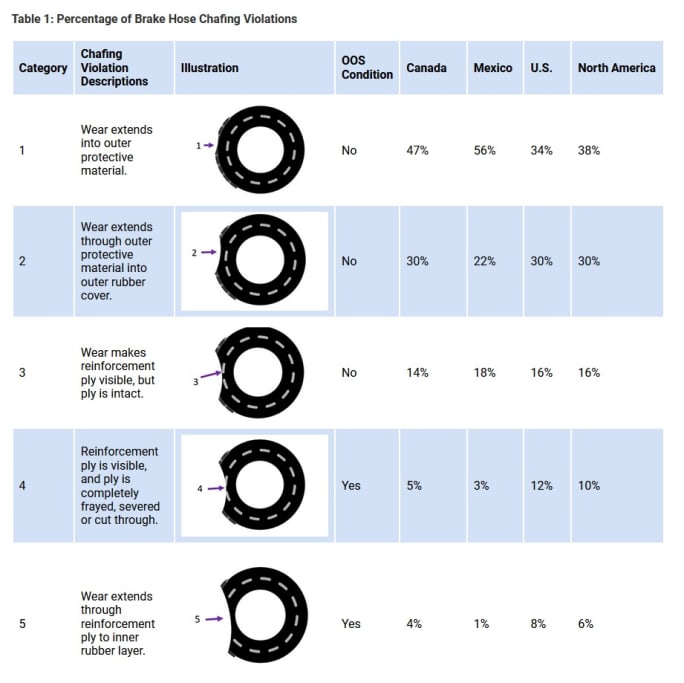
Graph: CVSA
“Brake hoses and tubing are essential brake system components and must be properly attached, undamaged, without leaks and flexible,” Samis said. “We chose to focus on brake hoses/tubing this year in an effort to reduce deaths and injuries as a result of commercial motor vehicle brake-system failures from pressure or vacuum loss due to brake hose/tubing deficiencies.”
Some jurisdictions in the U.S. use performance-based brake testers (PBBT) as part of their vehicle inspection process. A PBBT is a machine that assesses the braking performance of a vehicle. On Brake Safety Day, 68 PBBT tests were conducted. Four percent (about three vehicles) of PBBT-tested commercial motor vehicles were placed out of service for insufficient brake performance.
Brake Safety Day is the Alliance’s unannounced brake safety initiative; however, CVSA also holds Brake Safety Week each year and announces those dates publicly well in advance. This year’s Brake Safety Week is scheduled for Aug. 22-28.

Used-truck value is no longer just a concern at trade-in. Decisions made throughout a truck’s first life can influence what it’s worth years later.
Read More →
Volvo’s updated D13 promises lower emissions without sacrificing performance or fuel economy. Take a closer look at what changed inside the engine in this HDT Spotlight video.
Read More →
The Michelin X Multi Energy D2 is a regional haul drive tire engineered to help fleets improve fuel efficiency, durability and traction in demanding stop-and-go operations.
Read More →
ZF is expanding its North American commercial-vehicle presence with new transmission applications, electrification, trailer technology and autonomous-driving systems.
Read More →
Could Tesla’s camera-only autonomous driving technology work on an 80,000-pound Semi? In this commentary, HDT's Deborah Lockridge takes a look at Tesla, Cybercab, and how autonomous trucks see the road.
Read More →
Kodiak AI says its driverless long-haul safety case is 93% complete and it remains on track to begin commercial operations by year-end 2026.
Read More →
The U.S. Department of Transportation issued a new automated-vehicle strategy that outlines plans for driverless-truck regulations, cross-state freight corridors, and federal safety standards.
Read More →
The Port Authority of New York and New Jersey announced millions in incentives for zero-emission drayage trucks, yard tractors, and new charging hubs near the port.
Read More →
A SPAC deal could provide PlusAI with up to $300 million as it works toward a 2027 commercial launch of factory-built autonomous trucks.
Read More →
The National Highway Traffic Safety Administration says it lacks authority to regulate medium- and heavy-duty truck engines separately from complete vehicles, but the existing standards have not yet been eliminated.
Read More →