





Navistar: Electric Truck Will be First Off the Line of New Facility
Navistar Launches Electric International eMV Medium-Duty Truck
Navistar's fully electric medium-duty International eMV Series trucks are in production and ready to order.
August 31, 2021

Navistar's fully-electric, medium-duty International eMV Series trucks are in production and ready to order.
Photo: Navistar
3 min to read
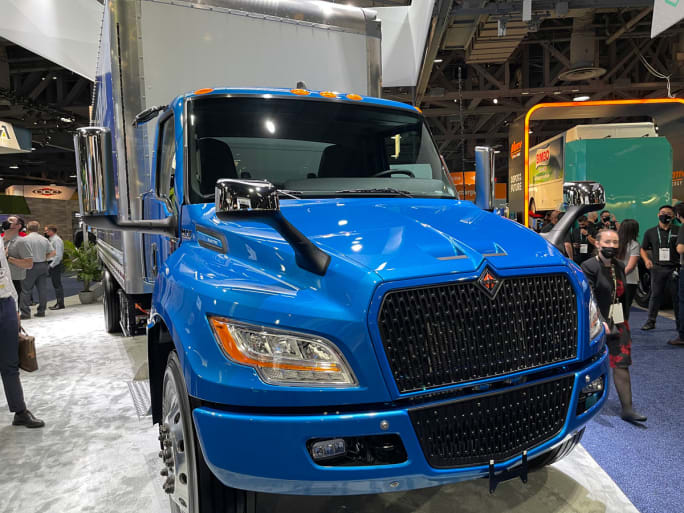
The International eMV on the ACT Expo show floor.
Photo: Jack Roberts
Navistar's fully electric, medium-duty International eMV Series trucks, which it sais is ideal for straight truck applications, is now in production and available to order.
The eMV was built to have the same standards as the diesel International MV Series and is designed with improved visibility and maneuverability. It is available in four different wheelbase options – 217", 236", 254" and 272" – and features the Diamond Logic electrical system as standard equipment. The battery provides a 135-mile range when fully charged.
"Our team has worked tirelessly to build an all-electric medium-duty vehicle solution that offers our customers all the environmental benefits of a zero-emissions vehicle, while delivering the capabilities of a traditional medium-duty truck to help you take care of business," said Debbie Shust, vice president of medium-duty trucks at Navistar.
She said the truck comes with consultation services provided by Navistar's Next eMobility Solutions team to ensure seamless integration of electric vehicles into customer fleets.
The truck is on display at ACT Expo in Long Beach, California. The International eMV was first unveiled in a concept version during the 2019 North American Commercial Vehicle Show.
Integrated Electric Charging and Battery Life
The eMV's battery electric motor provides peak power of over 335 hp or 250 kilowatts, with continuous power of 215 HP or 160 kW. The eMV has a 210-kW-capacity high-voltage battery that provides a 135-mile range when fully charged.
Batteries are packaged between the frame rails for additional protection and are under warranty for five years or 100,000 miles. The eMV is also equipped with three levels of regenerative braking, allowing the vehicle to collect kinetic energy from braking and store it in the battery for use. To ensure the driver has complete awareness of the eMV's operational status, a digital instrument cluster includes information on propulsion and regenerative load, state of charge indicator and regenerative braking indicator.
The International eMV also offers both AC and DC charging capabilities as standard equipment to allow customers to choose the best option for their fleets. The recommended Level 2 AC charging station is suitable for overnight charging and provides roughly 19.2 kW of power. The DC fast charge station option provides up to 125 kilowatt hours of power. The fast charge station also can provide multiple power options. At its highest kWh input, it can provide a full charge to the eMV in under two hours.
Education and Support
In addition to the International dealer network, Navistar’s Next eMobility Solutions acts as a resource for customers, providing all-inclusive zero-emissions education and assistance, beginning at buyer consultation and continuing through vehicle end of life. Next provides support throughout the entire fleet electrification process, including vehicle charging complexities such as requirements for proper charging, suitable infrastructure partners, charging installations, and collaborations with local power companies to ensure adequate power is available for vehicle charging.
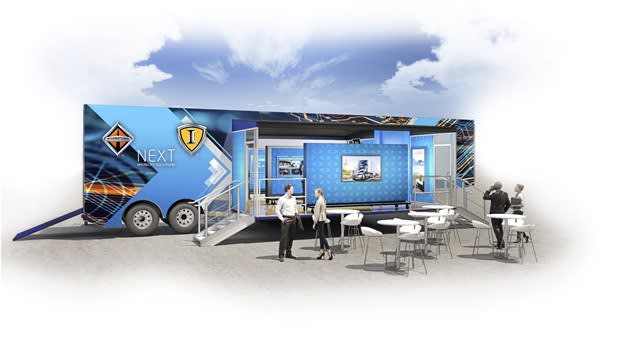
The mobile trailer will be used for sales, service and training events to create a cross-functional experience and provide end-to-end solutions. The NEXTperience trailer is expected to launch early 2022.
Photo: Navistar
Navistar also introduced its concept for the Nextperience trailer, a mobile unit that will offer specific e-mobility training sessions to dealers and customers hosted by the Next eMobility Solutions team.
The mobile trailer will be used for sales, service and training events and is expected to launch early 2022.
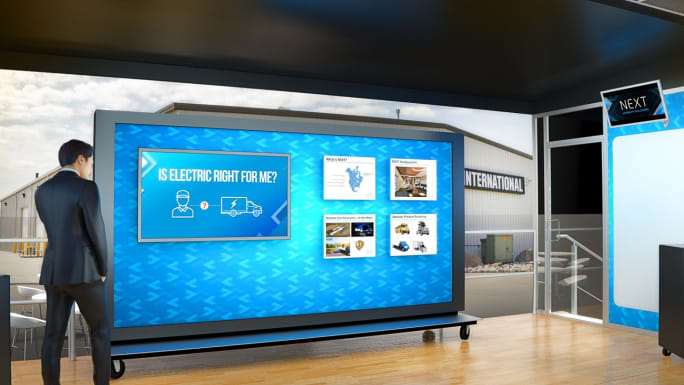
The goal of the mobile trailer is to enable Navistar to connect dealers and customers on educational topics necessary to advance the adoption of electrification within the trucking industry, Navistar officials said in a press release.
Photo: Navistar
The goal of the mobile trailer is to enable Navistar to connect dealers and customers on educational topics necessary to advance the adoption of electrification within the trucking industry, Navistar officials said in a press release.
More Fuel Smarts

How Volvo Updated Its D13 for EPA 2027 [Watch]
Volvo’s updated D13 promises lower emissions without sacrificing performance or fuel economy. Take a closer look at what changed inside the engine in this HDT Spotlight video.
Read More →
Diesel Price Spike Shortens Payback for Natural Gas Trucks, Report Says
Energy Vision estimates fleets could recover the higher purchase price of an RNG-fueled Class 8 tractor in 1.3 to 2.8 years under current fuel-price scenarios.
Read More →
Calstart Becomes Catalyst Mobility, Reflecting Broader Focus
Calstart is now Catalyst Mobility, reflecting the nonprofit’s growing national role in clean transportation, including zero-emission trucks, infrastructure and incentive programs.
Read More →

Record Diesel Prices Squeeze Trucking Fleets
Average U.S. diesel prices have climbed to nearly $6 a gallon, surpassing the 2022 record as tight refinery capacity and Middle East disruptions keep fuel costs elevated.
Read More →
Sponsored•September 9, 2026
How Fuel Delivery Shapes Engine Performance
Fuel delivery depends on more than what happens at the injector. For fleet, maintenance and technical professionals, looking at the full path from pump to injector can provide useful context for understanding engine performance.
Read More →
East Coast Port Launches $45M Electric Truck Push
The Port Authority of New York and New Jersey announced millions in incentives for zero-emission drayage trucks, yard tractors, and new charging hubs near the port.
Read More →
California Bill Could Shed Light on Electric Truck Prices
Why do battery-electric Class 8 trucks remain so expensive? A California bill headed to Gov. Gavin Newsom would give fleets and state agencies more visibility into what manufacturers charge.
Read More →
Detroit Opens Orders for EPA 2027 Engines
Detroit isn’t starting from scratch to meet EPA 2027 diesel emissions standards. Its Gen 6 DD13 and DD15 engines keep much of today’s platform while updating the fuel and aftertreatment systems.
Read More →
Zero-Emission Truck Corridor Planned for West Coast
California, Oregon, Washington, British Columbia and Baja California are coordinating plans for truck charging and hydrogen fueling from Canada to Mexico.
Read More →
A Closer Look at Kenworth’s Electric T880E Vocational Truck [Video]
Learn more about Kenworth's T880E battery-electric vocational truck at the Paccar Technical Center, including its range, applications, upfitting considerations, and PTO options, in this HDT Spotlight video.
Read More →