




Navistar Announces 100 EV-Ready Dealerships
More than 30% of Navistar dealers are now certified to support battery-electric trucks, the OEM has announced.

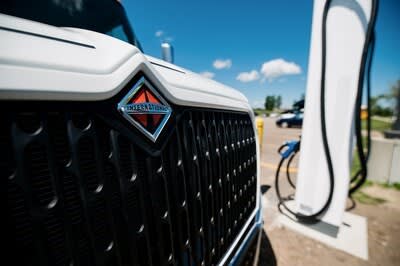
Navistar has developed a three-step consultative approach to help its customers more easily transition to EVs.
Photo: Navistar
More than 100 Navistar dealer locations are ready to guide fleets through their electric vehicle (EV) journey, the truck and bus OEM has announced.
With more than 100 EV authorized dealers now, and many more in process, Navistar said it will soon have more than 30% of its dealer locations ready to support the sale and service of both International and IC Bus EVs. These dealers cover 41 states and seven of 10 Canadian Provinces.
To be EV authorized, Navistar dealers must:
Provide a sales plan and resources to support the customer through the planning and delivery phases of their EV journey.
Invest in technician training to provide timely maintenance and repairs.
Invest in service equipment including lifts, tools and chargers to ensure dealers are fully prepared to diagnose all aspects of EVs and keep customer vehicles on the road.
Collectively, this represents a significant investment for dealers and is a testament to their commitment to a seamless customer experience, according to Navistar.
"The International and IC Bus dealer network live our customer-first value and that is no different in the transition to EVs," said Debbie Shust, VP, work truck business, Navistar. "A zero-emissions future requires collaboration from all stakeholders. For our customers to have a positive experience with EVs, our dealers must be appropriately prepared to sell and service them."
Helping Customers Deal with Unknowns
Navistar said its EV authorized dealers understand that the journey to electric vehicles is filled with uncertainty. They are focused on the entire experience from the sales process through maintenance and operation.
"We see the future of commercial transportation being more and more battery electric in certain applications," said Rick Otten, president of Cumberland, an International and IC Bus dealer with nine locations across Tennessee and Florida. "We want to be ahead of the curve to best serve our customers and provide a flawless customer service experience for all the vehicles we offer, either diesel, electric or other fuel options by application as a bridge to potentially electric as a solution. We are future proofing our business and educating ourselves so that we can be trusted advisors to our truck and bus customers in their journeys to sustainable operations, regardless of where they are in that journey now."
Navistar supports dealers and customers with a dedicated Zero Emissions team, following a three-step consultative approach to help customers more easily transition to EVs. These efforts include:
Consulting. Understanding concerns, motivations to adopt EVs, and discuss short- and long-term plans. This allows Navistar to help craft an adoption roadmap for the customer which can include route and range analysis, grant funding and charging and infrastructure planning.
Charging & Infrastructure. Understanding power needs, assisting the customer in making the appropriate charging hardware decisions based on their specific routes and application, and future-proofing operations by looking at the customer's long term EV goals. Navistar and its partners can support customers in the design and build out of infrastructure and charging.
Customer Onboarding. Coordination of truck and body build timing, charging and infrastructure build as well as customer, driver and other training to ensure that when the vehicle arrives, it can be woven into customers' operations with minimal disruption.
For more information about how Navistar supports customers through the consulting process listen to the EV Road Map Podcast.
More Fuel Smarts

How Volvo Updated Its D13 for EPA 2027 [Watch]
Volvo’s updated D13 promises lower emissions without sacrificing performance or fuel economy. Take a closer look at what changed inside the engine in this HDT Spotlight video.
Read More →
Diesel Price Spike Shortens Payback for Natural Gas Trucks, Report Says
Energy Vision estimates fleets could recover the higher purchase price of an RNG-fueled Class 8 tractor in 1.3 to 2.8 years under current fuel-price scenarios.
Read More →
Calstart Becomes Catalyst Mobility, Reflecting Broader Focus
Calstart is now Catalyst Mobility, reflecting the nonprofit’s growing national role in clean transportation, including zero-emission trucks, infrastructure and incentive programs.
Read More →

Record Diesel Prices Squeeze Trucking Fleets
Average U.S. diesel prices have climbed to nearly $6 a gallon, surpassing the 2022 record as tight refinery capacity and Middle East disruptions keep fuel costs elevated.
Read More →
How Fuel Delivery Shapes Engine Performance
Fuel delivery depends on more than what happens at the injector. For fleet, maintenance and technical professionals, looking at the full path from pump to injector can provide useful context for understanding engine performance.
Read More →
East Coast Port Launches $45M Electric Truck Push
The Port Authority of New York and New Jersey announced millions in incentives for zero-emission drayage trucks, yard tractors, and new charging hubs near the port.
Read More →
California Bill Could Shed Light on Electric Truck Prices
Why do battery-electric Class 8 trucks remain so expensive? A California bill headed to Gov. Gavin Newsom would give fleets and state agencies more visibility into what manufacturers charge.
Read More →
Detroit Opens Orders for EPA 2027 Engines
Detroit isn’t starting from scratch to meet EPA 2027 diesel emissions standards. Its Gen 6 DD13 and DD15 engines keep much of today’s platform while updating the fuel and aftertreatment systems.
Read More →
Zero-Emission Truck Corridor Planned for West Coast
California, Oregon, Washington, British Columbia and Baja California are coordinating plans for truck charging and hydrogen fueling from Canada to Mexico.
Read More →
A Closer Look at Kenworth’s Electric T880E Vocational Truck [Video]
Learn more about Kenworth's T880E battery-electric vocational truck at the Paccar Technical Center, including its range, applications, upfitting considerations, and PTO options, in this HDT Spotlight video.
Read More →