




NACFE: Increased Intermodal Transport Will Reduce Emissions
The North American Council for Freight Efficiency found that intermodal rail combined with zero-emission drayage vehicles are capable in combination of reducing freight emissions.

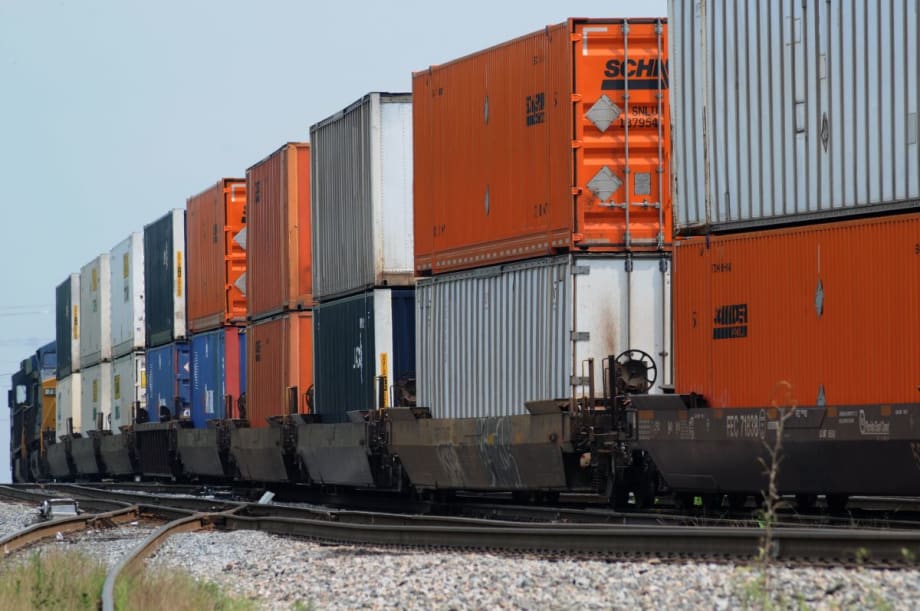
Shifting more freight from regional and long-haul trucking to intermodal rail could help reduce diesel exhaust emissions, a report by the North American Council for Freight Efficiency has found.
Photo: Jim Park
.
There are opportunities to reduce freight-related emissions in intermodal, according to a new report from the North American Council for Freight Efficiency.
While intermodal carriers such as J.B. Hunt and Schneider promote how moving freight from road to rail can cut carbon emissions, NACFE said the combination could become even more climate-friendly.
The NACFE study team that worked on the report, Intermodal & Drayage: An Opportunity To Reduce Freight Emissions, identified three key ways intermodal shipping could become a cleaner mode of transportation.
Shift more market share from regional and long-haul trucking to intermodal rail.
Replace traditional diesel drayage tractors with zero-emission and near-zero emission tractors.
Replace traditional diesel terminal tractors with zero-emission and near-zero emission tractors.
The report concluded that as new technologies enter production, such as battery-electric and fuel cell electric powertrains, there is a significant potential to improve the environmental impact of both rail and truck transport.
Interim energy solutions, such as renewable natural gas, renewable diesel, and green hydrogen, may also keep vehicles moving on internal combustion engines while reducing the impact of their emissions as technologies and regulations evolve, NAFCE analysts found.
Trucking and Rail Are Intertwined Industries
Trucks are faster than locomotives to transition to new technologies because the useful asset life of a truck may be less than 15 years, whereas locomotives may have asset lives of 50 years. However, the aging North American locomotive fleet offers opportunity to make significant steps in new zero-emission locomotive technology once it becomes available.
NACFE found that increasing intermodal rail freight from long-haul on-highway operations on select routes can reduce net emissions, but the opportunity may be tempered if the required drayage trucking demands at both ends of the rail line have significant mileage requirements. In order to achieve these goals, the rail industry must improve its customer service focus, refining on-time reliability and shortening time in transit to better compete with trucking, the report added.
“Intermodal involves using a combination of transportation methods to get goods delivered,” said Rick Mihelic, NACFE’s director of emerging technologies and the lead author of the report. “However, a partnership between truck and rail is necessary to improve and optimize freight movement and to make use of zero-emission technology.”
The report explains the intermodal freight system, including the complications of various container sizes by the different shipping modes. It also looks at the history of trains and trucks, including rail’s love-hate relationship with trucking.
“This is an early market segment for electrification,” says Mike Roeth, NACFE’s executive director, “but it is more complicated and complex than it seems at first glance.”
The report concludes that rail and trucking are intertwined freight segments that compete and complement each other, and that intermodal rail combined with zero-emission drayage vehicles are capable in combination of reducing freight emissions versus traditional diesel long-haul trucking on specific shipping lanes.
More Fuel Smarts

How Volvo Updated Its D13 for EPA 2027 [Watch]
Volvo’s updated D13 promises lower emissions without sacrificing performance or fuel economy. Take a closer look at what changed inside the engine in this HDT Spotlight video.
Read More →
Diesel Price Spike Shortens Payback for Natural Gas Trucks, Report Says
Energy Vision estimates fleets could recover the higher purchase price of an RNG-fueled Class 8 tractor in 1.3 to 2.8 years under current fuel-price scenarios.
Read More →
Calstart Becomes Catalyst Mobility, Reflecting Broader Focus
Calstart is now Catalyst Mobility, reflecting the nonprofit’s growing national role in clean transportation, including zero-emission trucks, infrastructure and incentive programs.
Read More →

Record Diesel Prices Squeeze Trucking Fleets
Average U.S. diesel prices have climbed to nearly $6 a gallon, surpassing the 2022 record as tight refinery capacity and Middle East disruptions keep fuel costs elevated.
Read More →
How Fuel Delivery Shapes Engine Performance
Fuel delivery depends on more than what happens at the injector. For fleet, maintenance and technical professionals, looking at the full path from pump to injector can provide useful context for understanding engine performance.
Read More →
East Coast Port Launches $45M Electric Truck Push
The Port Authority of New York and New Jersey announced millions in incentives for zero-emission drayage trucks, yard tractors, and new charging hubs near the port.
Read More →
California Bill Could Shed Light on Electric Truck Prices
Why do battery-electric Class 8 trucks remain so expensive? A California bill headed to Gov. Gavin Newsom would give fleets and state agencies more visibility into what manufacturers charge.
Read More →
Detroit Opens Orders for EPA 2027 Engines
Detroit isn’t starting from scratch to meet EPA 2027 diesel emissions standards. Its Gen 6 DD13 and DD15 engines keep much of today’s platform while updating the fuel and aftertreatment systems.
Read More →
Zero-Emission Truck Corridor Planned for West Coast
California, Oregon, Washington, British Columbia and Baja California are coordinating plans for truck charging and hydrogen fueling from Canada to Mexico.
Read More →
A Closer Look at Kenworth’s Electric T880E Vocational Truck [Video]
Learn more about Kenworth's T880E battery-electric vocational truck at the Paccar Technical Center, including its range, applications, upfitting considerations, and PTO options, in this HDT Spotlight video.
Read More →