




Mercedes-Benz eActros Sets Guinness World Record
A Mercedes-Benz eActros electric truck has set a new world record for the longest distance driven backwards by a tractor-trailer.

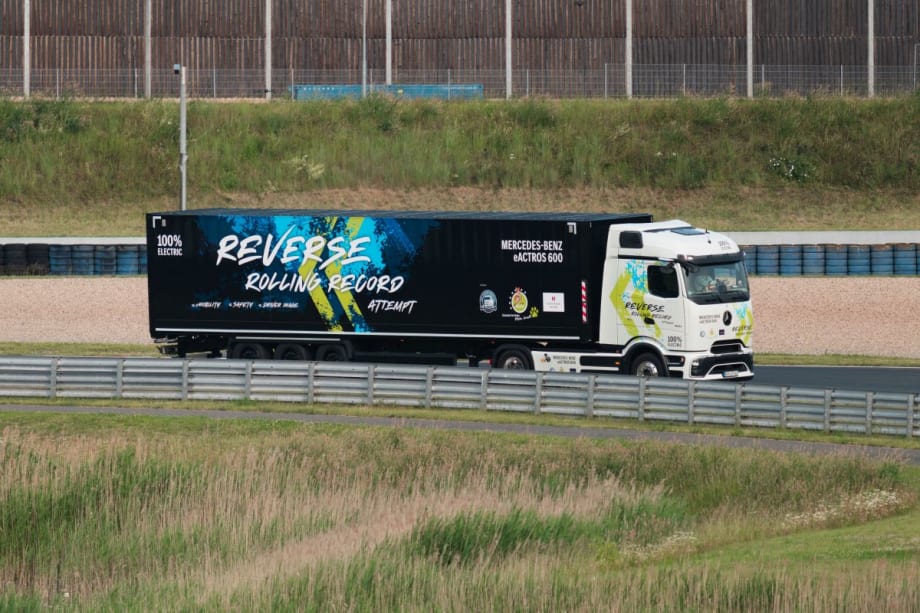
Photo: Mercedes-Benz Truck.
Mercedes-Benz has found an unusual way to demonstrate both the range and safety systems on its eActros electric semi-truck. At a track in Germany, the OEM set a new Guinness World Record for driving a Class 8 tractor-trailer in reverse.
During the run, the eActros logged 124.7 kilometers while running continuously in reverse gear.
The former world record of 89 kilometers was set in the U.S.A. in 2020 in a diesel truck.
14 Turns on the Track
The record-breaking trip in reverse was held on the Motorsport Arena Oschersleben racetrack in Saxony-Anhalt, Germany.
It took around 6 hours and 22 minutes to set the new world record. That translates into an average speed of 20 kilometers per hour.
With its 14 tight bends designed for cars, the circuit is extremely demanding. But the track fewer unpredictable risks of having to stop and thus interrupt the record attempt than an attempt on public roads.
Following the world record run, the eActros was slated to run another 30 kilometers in reverse on public roads.
The finish line for that run is the Daimler Truck Global Parts Center in Halberstadt, also in Saxony-Anhalt.
The new location will officially open on July 10th. Starting this year, it will gradually take on worldwide deliveries of spare parts for Mercedes-Benz Trucks.
Mercedes-Benz Trucks wants to use the journeys in reverse to draw attention to topics of relevance to the transportation sector and society at large: Electrification, road safety and truck driver image.
A German Military Officer Behind the Wheel
The driver of the truck was Marco Hellgrewe from near Berlin, Germany.
Hellgrewe is an in the German Armed Forces and a truck enthusiast and a previous holder of this world record.

Marco Hellgrewe (center) and Werner Kempfle, development engineer and co-project manager of the eActros 600, receive the award from Seyda Subasi-Gemici, Adjudicator, Guinness World Records Limited.
Photo: Mercedes-Benz Truck
Hellgrewe set his first backwards record in 2008.
Back then, he covered a distance of 64 kilometers in a diesel truck.
“I’m incredibly proud to have brought back the record to Germany together with Mercedes-Benz Trucks – especially as it was a world first with an all-electric drive,” Hellgrewe said. “By doing so, we have sent out a powerful message for the future of alternative drivetrains. I am convinced that we have also drawn broad attention to the topics of road safety and driver image that are particularly important to me as an examiner of new truck drivers, who tend to be younger.”
Hellgrewe also credited the driver assistance systems on the eActros for helping him set the new world record.
“It was a great help that the eActros 600 and its assistance systems make driving so much easier,” Hellgrewe said.
Rainer Müller-Finkeldei, head of product engineering, Mercedes-Benz Trucks, said that innovative technologies, such as the MirrorCam rear-view camera system played a major role in setting the new world record.
A Production Electric Truck
Mercedes-Benz Trucks launched the eActros 600 at the end of November last year at the Mercedes-Benz plant in Wörth.
Deliveries to customers began in December 2024.
The electric flagship from Mercedes-Benz Trucks has already proven its capabilities several times under real-life conditions.
In customer use and as part of the “eActros 600 European Testing Tour 2024”, a 15,000-kilometer all-electric development trip through a total of 22 countries and the “European Testing Tour Winter 2025” on around 6,500 kilometers through Northern Europe, each with a gross combination mass of 40 tons.
In addition, the e-truck was voted “International Truck of the Year 2025”.
According to Mercedes, the eActros has high battery capacity of over 600 kilowatt hours. It also features a new, electric drive axle developed in-house, that enables the truck to achieve a range of 500 kilometers without intermediate charging.
Mercedes said this range is accomplished under very realistic and practical conditions with a gross combination mass of 40 tons, which can also be significantly exceeded depending on the driving style and the route.
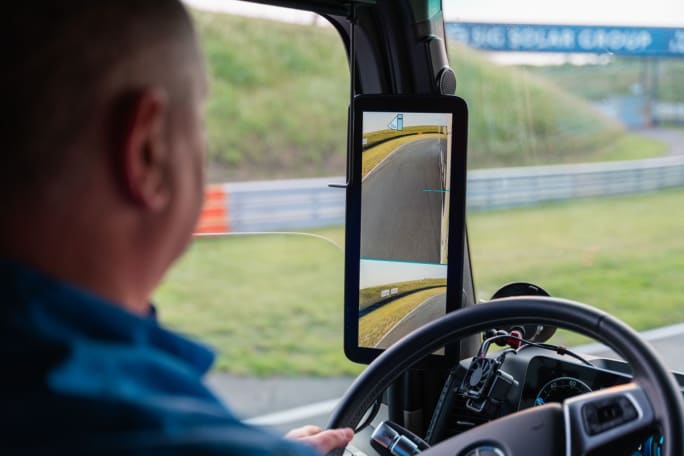
Hellegrewe credited the MirrorEye camera system for helping him set the new world record.
Photo: Mercedes-Benz Truck
The eActros 600 is also able to cover over 1,000 kilometers per day with the use of intermediate charging during statutory driver breaks, the OEM added.
The truck has three battery packs, each with 207 kWh. These offer an installed total capacity of 621 kWh.
The batteries are based on lithium iron phosphate cell technology (LFP) and are characterized by a long service life.
The development engineers at Mercedes-Benz Trucks designed the eActros 600 to meet the same requirements for the durability of vehicles and components as a comparable conventional heavy-duty long-haul Actros. This means up to 1.2 million kilometers in ten years of operation.
After this period of use, the battery state of health should still be above 80 percent, according to Mercedes.
In contrast to other battery cell technologies, more than 95 percent of the installed capacity can also be used with LFP technology. This facilitates a higher range with the same installed battery capacity.
The vehicle is technically designed for a gross combination mass of up to 44 tons. With a standard semitrailer, the eActros 600 has a payload of around 22 tons in the EU.
More Fuel Smarts

How Volvo Updated Its D13 for EPA 2027 [Watch]
Volvo’s updated D13 promises lower emissions without sacrificing performance or fuel economy. Take a closer look at what changed inside the engine in this HDT Spotlight video.
Read More →
Diesel Price Spike Shortens Payback for Natural Gas Trucks, Report Says
Energy Vision estimates fleets could recover the higher purchase price of an RNG-fueled Class 8 tractor in 1.3 to 2.8 years under current fuel-price scenarios.
Read More →
Calstart Becomes Catalyst Mobility, Reflecting Broader Focus
Calstart is now Catalyst Mobility, reflecting the nonprofit’s growing national role in clean transportation, including zero-emission trucks, infrastructure and incentive programs.
Read More →

Record Diesel Prices Squeeze Trucking Fleets
Average U.S. diesel prices have climbed to nearly $6 a gallon, surpassing the 2022 record as tight refinery capacity and Middle East disruptions keep fuel costs elevated.
Read More →
How Fuel Delivery Shapes Engine Performance
Fuel delivery depends on more than what happens at the injector. For fleet, maintenance and technical professionals, looking at the full path from pump to injector can provide useful context for understanding engine performance.
Read More →
East Coast Port Launches $45M Electric Truck Push
The Port Authority of New York and New Jersey announced millions in incentives for zero-emission drayage trucks, yard tractors, and new charging hubs near the port.
Read More →
California Bill Could Shed Light on Electric Truck Prices
Why do battery-electric Class 8 trucks remain so expensive? A California bill headed to Gov. Gavin Newsom would give fleets and state agencies more visibility into what manufacturers charge.
Read More →
Detroit Opens Orders for EPA 2027 Engines
Detroit isn’t starting from scratch to meet EPA 2027 diesel emissions standards. Its Gen 6 DD13 and DD15 engines keep much of today’s platform while updating the fuel and aftertreatment systems.
Read More →
Zero-Emission Truck Corridor Planned for West Coast
California, Oregon, Washington, British Columbia and Baja California are coordinating plans for truck charging and hydrogen fueling from Canada to Mexico.
Read More →
A Closer Look at Kenworth’s Electric T880E Vocational Truck [Video]
Learn more about Kenworth's T880E battery-electric vocational truck at the Paccar Technical Center, including its range, applications, upfitting considerations, and PTO options, in this HDT Spotlight video.
Read More →