




Medium-Duty Truck Resale Holding Up
Generally, medium-duty segments are holding up well, with cabovers and lighter GVW conventional trucks performing the best.
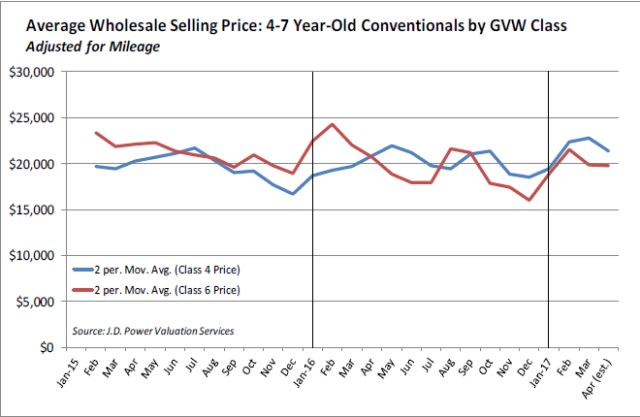
Average wholesale selling prices for four to seven year old Class 4 and Class 6 trucks (Source: JD Power)
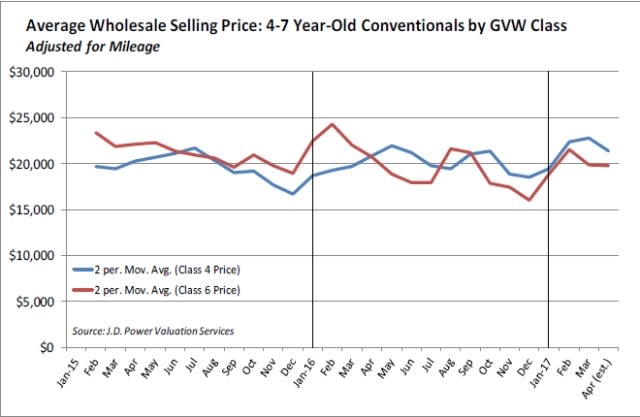
Average wholesale selling prices for four to seven year old Class 4 and Class 6 trucks (Source: JD Power)
Commercial truck analysts at J.D. Power Valuation Services note in their May 2017 Commercial Truck Guidelines Industry Update that pricing of used commercial vehicles began to level out despite higher volume during April 2017.
Major findings in the free monthly report also point out:
The used commercial truck retail channel is still showing typical depreciation.
Pricing should level out in the upcoming months.
Class 8 auction pricing has leveled out despite higher volume.
The average selling prices of late-model trucks are actually trending upward.
Medium-duty segments are generally holding up well. Cabovers and lighter GVW conventional trucks are performing the best.
Starting with Class 3-4 cabovers, the mix of trucks sold through auction and wholesale channels continued to trend newer, with lower-mileage. March’s average pricing was $22,475, which beat February’s five-year record. This figure was $981 (4.6%) higher than February, and $4,597 (25.7%) higher than March 2016. Unlike pricing, volume has not been particularly impressive in 2017. Buyers appear to be most interested in the newest, lowest mileage equipment.
Looking at conventionals, average pricing for both Class 4 and Class 6 pulled back in March, with Class 4 trucks continue to bring more money than Class 6. Specifically, Class 4 trucks averaged $21,060 in March. This figure is $3,418 (14%) lower than February, and $331 (1.6%) higher than March 2016. Class 6 trucks averaged $18,568 in March. This figure is $2,632 (12.4%) lower than February, and $2,816 (13.2%) lower than March 2017.
Volume for Class 4 was identical to last month, while volume for Class 6 was moderately higher. Demand should continue to incrementally improve in upcoming months for trucks of all GVW classes
When asked about what flattening prices mean for the used commercial truck market, Chris Visser, senior commercial truck analyst at J.D. Power Valuation Services said, "This trend suggests the market is finding a bottom. Retail pricing still shows depreciation on par with late 2016, but we expect that channel to moderate as well."
So, what does this mean for the next few months? Visser went on to say, "Overall sentiment about the trucking economy is improving. It is possible we are finally seeing a degree of increased demand for used trucks. Values will continue to be impacted by returning supply, but the evidence is building that pricing has found its floor."
More Equipment

How Volvo Updated Its D13 for EPA 2027 [Watch]
Volvo’s updated D13 promises lower emissions without sacrificing performance or fuel economy. Take a closer look at what changed inside the engine in this HDT Spotlight video.
Read More →
Michelin Tire Improves Efficiency and Durability for Regional Fleets
The Michelin X Multi Energy D2 is a regional haul drive tire engineered to help fleets improve fuel efficiency, durability and traction in demanding stop-and-go operations.
Read More →
ZF Expands Commercial Vehicle Push in North America
ZF is expanding its North American commercial-vehicle presence with new transmission applications, electrification, trailer technology and autonomous-driving systems.
Read More →
Tesla Wants a Self-Driving Semi. Are Cameras Enough?
Could Tesla’s camera-only autonomous driving technology work on an 80,000-pound Semi? In this commentary, HDT's Deborah Lockridge takes a look at Tesla, Cybercab, and how autonomous trucks see the road.
Read More →
Kodiak: Driverless Long-Haul Truck Launch on Track for 2026
Kodiak AI says its driverless long-haul safety case is 93% complete and it remains on track to begin commercial operations by year-end 2026.
Read More →
What DOT’s Automated Vehicle Strategy Means for Trucking
The U.S. Department of Transportation issued a new automated-vehicle strategy that outlines plans for driverless-truck regulations, cross-state freight corridors, and federal safety standards.
Read More →
East Coast Port Launches $45M Electric Truck Push
The Port Authority of New York and New Jersey announced millions in incentives for zero-emission drayage trucks, yard tractors, and new charging hubs near the port.
Read More →
PlusAI Going Public to Fund Autonomous Truck Launch
A SPAC deal could provide PlusAI with up to $300 million as it works toward a 2027 commercial launch of factory-built autonomous trucks.
Read More →
NHTSA Moves to Rewrite Truck Fuel-Economy Rules
The National Highway Traffic Safety Administration says it lacks authority to regulate medium- and heavy-duty truck engines separately from complete vehicles, but the existing standards have not yet been eliminated.
Read More →
Detroit Opens Orders for EPA 2027 Engines
Detroit isn’t starting from scratch to meet EPA 2027 diesel emissions standards. Its Gen 6 DD13 and DD15 engines keep much of today’s platform while updating the fuel and aftertreatment systems.
Read More →