




Labatt Breweries Orders 10 Volvo Electric VNR Trucks
Labatt’s Breweries has placed the single largest order of Volvo VNR Electric Trucks in Canada to date.

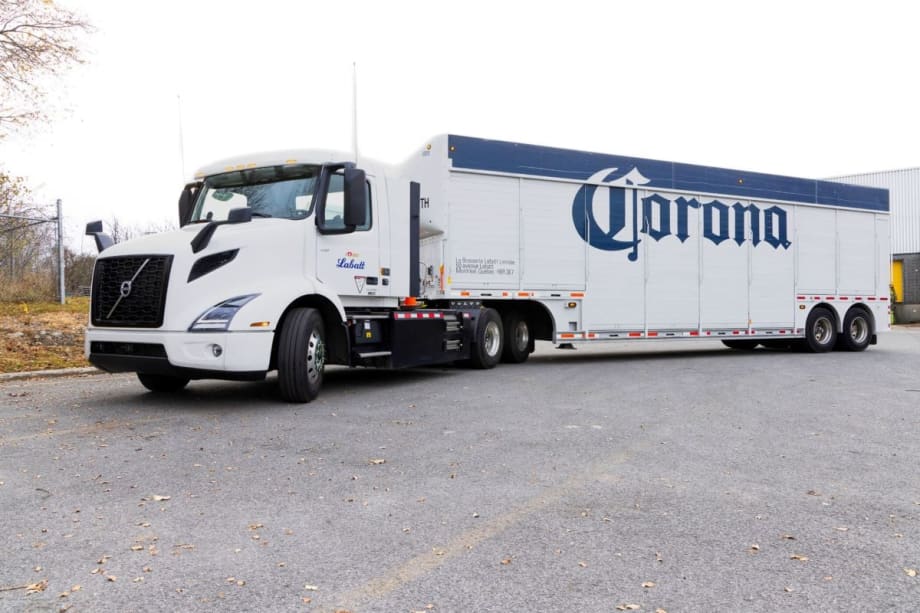
Volvo Trucks North America customer Labatt Breweries of Canada has added ten Volvo VNR Electric trucks to its fleet to transport Labatt’s beer and ready-to-drink-beverage portfolio from distribution centers in Montreal and Bois-des-Filion to customers throughout Quebec.
Photo: Volvo Trucks North America
Volvo Trucks North America customer Labatt Breweries of Canada, one of the country’s most leading beverage companies, has added ten Volvo VNR Electric trucks to its fleet.
The order marks a significant milestone in sustainable transportation for the company, Labatt’s said.
The trucks will transport Labatt’s beer and ready-to-drink-beverage portfolio from distribution centers in Montreal and Bois-des-Filion to customers in Montreal and on the north shore of Montreal.
“We have seen increasing demand for battery-electric vehicles (BEV) in Canada, particularly in Ontario and Quebec, helping customers make progress towards their decarbonization goals by adopting BEVs,” said Matthew Blackman, managing director for Canada, Volvo Trucks North America. “We are proud to support Labatt’s leadership in sustainable transportation solutions and their commitment to minimizing their environmental impact with these zero-tailpipe emission trucks.”
A Zero-Tailpipe Emission Solution
Labatt’s Volvo VNR Electric trucks feature a four-battery configuration, providing a range of up to 370 km (230 miles) on a single charge. The trucks will operate on daily routes that range from 50 to 110 km.
With the ability to charge up to 80% in about 60 minutes, these trucks offer operational flexibility depending on distance traveled, route optimization, and driver efficiency.
The Volvo VNR Electric truck is a zero-tailpipe emission solution designed to meet the needs of fleet operators engaged in local and regional distribution, including pickup and delivery, as well as food and beverage transportation.
Labatt’s deployment of ten Volvo VNR Electric trucks is a key part of its strategy to reduce greenhouse gas emissions. To support the transition to battery-electric vehicles, Labatt has developed onsite charging infrastructure at its distribution centers.
Volvo Dealers Lead on Training and Funding
GSH Camions Volvo Montréal, one of the first Volvo Trucks Certified Electric Vehicle Dealers in Canada, led driver training. The dealership is helping Labatt’s drivers understand how to optimize the range of the Volvo VNR Electric. This includes how to leverage regenerative braking benefits to add power back to the battery.
Labatt’s said its drivers have expressed satisfaction with the vehicle’s quiet operation, which provides a more comfortable driving experience and reduces noise pollution in local communities during deliveries.
“Labatt is committed to innovation and sustainability, and these Volvo VNR Electric trucks represent an additional step towards our goal of achieving net-zero emissions across our operations nationwide by 2040,” said Sarah Genetti, senior director of procurement and sustainability at Labatt Breweries of Canada. “We believe in leading change and investing in technologies that create long-term value for our customers, the environment, and the communities we serve.”
In addition to vehicle deployment, GSH Camions Montreal supported Labatt in navigating available funding opportunities to offset the initial investment in battery-electric trucks and charging infrastructure.
Labatt secured funding through the federal Incentives for Medium- and Heavy-Duty Zero-Emissions Vehicles (iMHZEV) program and Quebec’s Écocamionnage program, underscoring the critical role government support plays in accelerating the transition to clean transportation.
More Fuel Smarts

How Volvo Updated Its D13 for EPA 2027 [Watch]
Volvo’s updated D13 promises lower emissions without sacrificing performance or fuel economy. Take a closer look at what changed inside the engine in this HDT Spotlight video.
Read More →
Diesel Price Spike Shortens Payback for Natural Gas Trucks, Report Says
Energy Vision estimates fleets could recover the higher purchase price of an RNG-fueled Class 8 tractor in 1.3 to 2.8 years under current fuel-price scenarios.
Read More →
Calstart Becomes Catalyst Mobility, Reflecting Broader Focus
Calstart is now Catalyst Mobility, reflecting the nonprofit’s growing national role in clean transportation, including zero-emission trucks, infrastructure and incentive programs.
Read More →

Record Diesel Prices Squeeze Trucking Fleets
Average U.S. diesel prices have climbed to nearly $6 a gallon, surpassing the 2022 record as tight refinery capacity and Middle East disruptions keep fuel costs elevated.
Read More →
How Fuel Delivery Shapes Engine Performance
Fuel delivery depends on more than what happens at the injector. For fleet, maintenance and technical professionals, looking at the full path from pump to injector can provide useful context for understanding engine performance.
Read More →
East Coast Port Launches $45M Electric Truck Push
The Port Authority of New York and New Jersey announced millions in incentives for zero-emission drayage trucks, yard tractors, and new charging hubs near the port.
Read More →
California Bill Could Shed Light on Electric Truck Prices
Why do battery-electric Class 8 trucks remain so expensive? A California bill headed to Gov. Gavin Newsom would give fleets and state agencies more visibility into what manufacturers charge.
Read More →
Detroit Opens Orders for EPA 2027 Engines
Detroit isn’t starting from scratch to meet EPA 2027 diesel emissions standards. Its Gen 6 DD13 and DD15 engines keep much of today’s platform while updating the fuel and aftertreatment systems.
Read More →
Zero-Emission Truck Corridor Planned for West Coast
California, Oregon, Washington, British Columbia and Baja California are coordinating plans for truck charging and hydrogen fueling from Canada to Mexico.
Read More →
A Closer Look at Kenworth’s Electric T880E Vocational Truck [Video]
Learn more about Kenworth's T880E battery-electric vocational truck at the Paccar Technical Center, including its range, applications, upfitting considerations, and PTO options, in this HDT Spotlight video.
Read More →