




Kodiak: Autonomous Trucks Nearly Ready for Real World
Kodiak Robotics Chief Technology Officer Andreas Wendel told HDT that 2024 will be the year autonomous trucks make the leap from experimental technology to operational fleet assets.

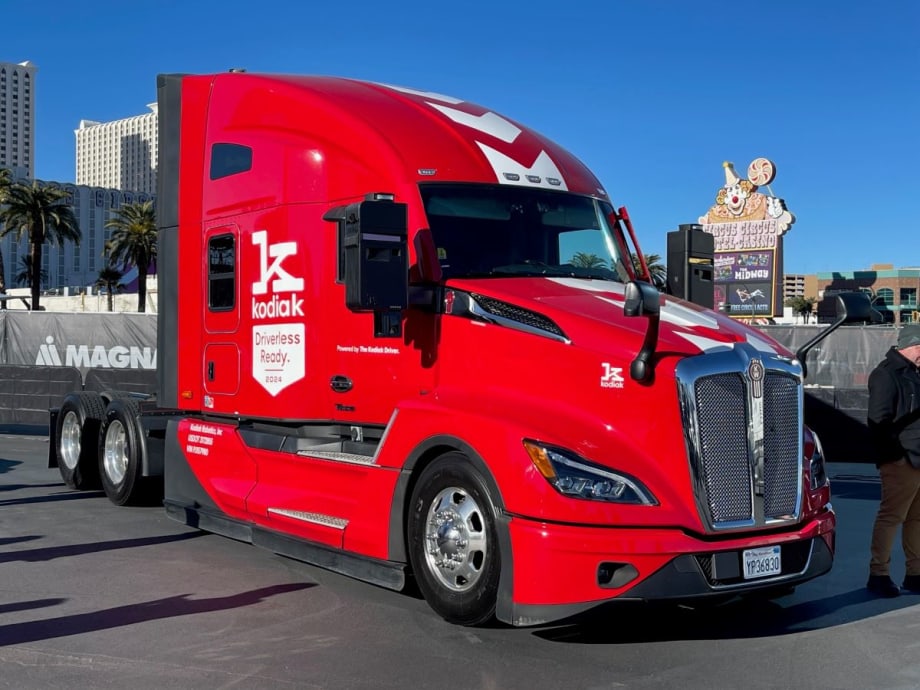
Kodiak Robotics said that the addition of new sensors and AI learning will make 2024 a transition year for its autonomous truck technology.
Photo: Jack Roberts
The red Kenworth T680 was gorgeous, gleaming in the cold Las Vegas sunlight (although it was a little unsettling to see the Circus Circus Casino clown ominously lurking over the truck’s hood).
It was early January at the CES technology expo and I was standing on a large, windswept lot outside the West Hall of the Las Vegas Convention Center. With me was Andreas Wendel, chief technology officer for Kodiak. The red Kenworth we were examining is fitted with Kodiak Robotics’ latest autonomous control technology. Wendel showed me around the truck to talk about the new enhancements and features Kodiak has introduced and the company’s fast-moving plans for the future of autonomous trucking.
Modular Pods and Additional Sensors
The Kenworth on display at CES 2024 was fitted with the sixth generation of the Kodiak Driver autonomous technology. Kodiak engineers have focused a lot of time and energy on refining the exterior sensor arrays on the truck to make them more effective and safer.
“Now all of our sensors are located in sensor pods mounted on the cab of the truck,” Wendel explained. He pointed to a large, rear-view mirror assembly near the A-pillars of the truck, fitted with various futuristic components and a gleaming mirror-like surface near the top.
“The mirror you see is a long-range lidar system,” he said. “And there is an additional lidar array at the bottom of the sensor pod. There are four lidar systems in all. And those systems work in conjunction, rotating 360 degrees in order to tell Kodiak Driver what is in front of the truck, behind the truck, and to the sides of the truck.”
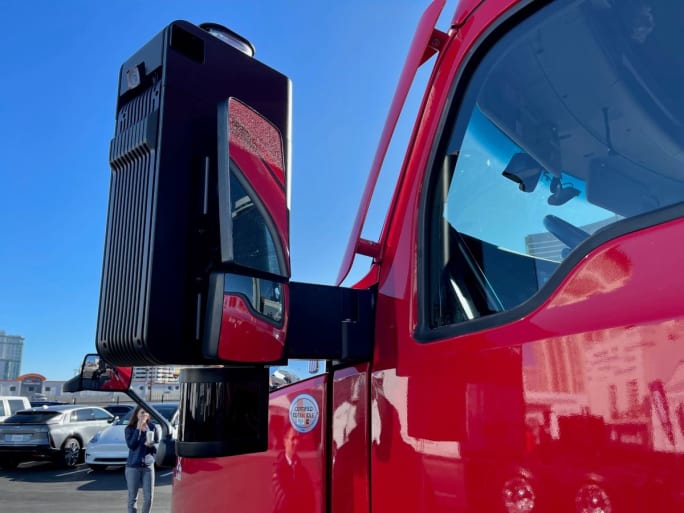
Kodiak has added various new sensors to the rear-view mirror/sensor pod assembly mounted outside the truck.
Photo: Jack Roberts
The lidar systems are augmented by four cameras on each side of truck.
“Those cameras are focused on the blind spots to the front and sides of the cab,” Wendel said. “The also give long-range scans toward the front and back of the truck. We have six radar systems, as well -- three on each sensor pod. One looks forward. One looks backwards. And we’ve just added an additional system that monitors the sides of the truck. We did that because we noticed that when the truck is stopped at a T-intersection, we want to see oncoming traffic pretty far out before they attempt to get onto the highway. And this new radar helps us track those vehicles better.”
But “seeing” the world around a truck is just the start. Human drivers also depend on hearing various sounds to operate a vehicle safely. That's why also new are microphones mounted on the sensor pods that let Kodiak Driver hear emergency vehicles and other important sounds both inside and outside the cab of the truck.
“And we can use AI to help train the system to listen for and understand things that don’t quite sound like they’re supposed to," he said.
New Emergency Beacons for Autonomous-Truck Breakdowns
Another new, common-sense feature on the Kodiak sensor pods are large, bright, emergency beacons situated at the top of the pod assembly.
“Obviously an autonomous truck cannot put warning triangles out on the road when there’s a problem,” Wendel said. “So we’ve asked the Federal Motor Carrier Safety Administration for an exemption from the requirement to place warning triangles out when a breakdown occurs.”
In place of those triangles, the flashing emergency beacons on top of the sensor pods will warn approaching vehicles that a truck is stalled and to proceed with caution.
Easing Calibration Concerns
In order to drive safely on public roads, correct calibration of sensors is critical for autonomous vehicles. Wendel said an additional advantage to the Kodiak sensor pod design is that no additional calibrations have to be performed when they are installed on a truck.
“We actually calibrate the sensors in the factory and ship them out pre-calibrated,” Wendel explained. “I’ve been developing autonomous driving technology for over 10 years. I’ve done a lot of sensor calibrations in the field in that time. And I can tell you that it's really hard to determine the right targets in the field or find the right kinds of structures you need to calibrate those sensors properly.”
Wendel said the new Kodiak Driver sensor pods can be replaced quickly by technicians with minimal additional training in about the time it takes to change a tire on a truck.
“The entire process takes about 10 to 15 minutes,” he added. “Once the pod is mounted on the truck, it needs a small refinemen, but it’s actually a pretty straightforward process to dial it in. And then it’s ready to go.”
Wendel said the modular, pre-calibrated sensor pod design helps keep the trucks on the road making money and not costing money in the shop. “The design really maximizes fleet uptime,” he said, "and that’s really what our customers want from autonomous trucks.”
A Watershed Year for Autonomous Tech
There have been enhancements under the hood of truck equipped with Kodiak Driver as well, according to Wendel.
“This is really where most of our new features on Kodiak Driver have been focused,” he said. “We now have redundant steering systems on the truck and triple-redundant braking systems, as well.”
There are also dual, redundant power systems to make sure all the electronic components work properly at all times. The processing speeds of the computers running the autonomous control system have been maxed-out to deal with any driving situation the truck finds itself in.
“What this means is that any single point of failure does not cause the vehicle to lose control,” Wendel explained. “And so, from that point of view, we feel this is really the safest autonomous truck architecture you could imagine being out today.,”
Kodiak: Nearly Ready for True Driverless Operation
The upshot of all of these new features, Wendel added, is that Kodiak is really driverless ready today. “It’s taken us about five years and two-and-a-half million miles to get to this point,” Wendel said. “We’ve hauled more than 5,000 paying loads on public roads with Kodiak Driver. We’ve refined our system to the point that it can safely and easily adapt to hauling a dry van, to hauling a flatbed, to a reefer to hauling liquids.”
That’s because Kodiak Driver’s AI-enhanced operating system learns not only from the runs it makes under autonomous control, but also from the human drivers when they take over in various driving conditions.
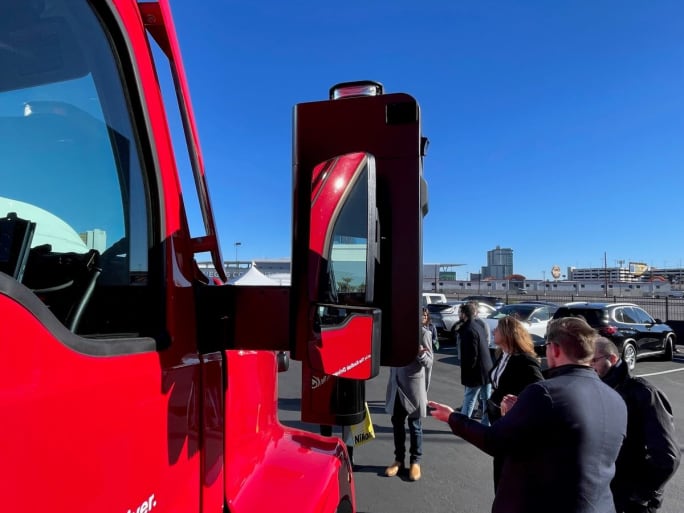
Another new Kodiak Driver safety feature is a flashing warning light located at the top of the sensor pod to warn oncoming vehicles when a truck is disabled.
Photo: Jack Roberts
All of those real-world driving experiences are constantly being augmented by ongoing computer simulations that can mimic or re-create any driving situation or circumstance imaginable.
“All of this work really gives us a priority of what should we fix next, what is important, how do we do compare to humans in terms of the behavior out there,” Wendel said.
"That is why, taken as a whole, we believe that this year – 2024 – we believe that we can push that bar so high up that we can actually demonstrate that Kodiak Driver safety is on par with a human driver. That's when we will launch it. Not before. But think we are just about there. So, we really feel that 2024 is going to be an important year for us and for autonomous trucks.”
More Equipment

How Volvo Updated Its D13 for EPA 2027 [Watch]
Volvo’s updated D13 promises lower emissions without sacrificing performance or fuel economy. Take a closer look at what changed inside the engine in this HDT Spotlight video.
Read More →
Michelin Tire Improves Efficiency and Durability for Regional Fleets
The Michelin X Multi Energy D2 is a regional haul drive tire engineered to help fleets improve fuel efficiency, durability and traction in demanding stop-and-go operations.
Read More →
ZF Expands Commercial Vehicle Push in North America
ZF is expanding its North American commercial-vehicle presence with new transmission applications, electrification, trailer technology and autonomous-driving systems.
Read More →
Tesla Wants a Self-Driving Semi. Are Cameras Enough?
Could Tesla’s camera-only autonomous driving technology work on an 80,000-pound Semi? In this commentary, HDT's Deborah Lockridge takes a look at Tesla, Cybercab, and how autonomous trucks see the road.
Read More →
Kodiak: Driverless Long-Haul Truck Launch on Track for 2026
Kodiak AI says its driverless long-haul safety case is 93% complete and it remains on track to begin commercial operations by year-end 2026.
Read More →
What DOT’s Automated Vehicle Strategy Means for Trucking
The U.S. Department of Transportation issued a new automated-vehicle strategy that outlines plans for driverless-truck regulations, cross-state freight corridors, and federal safety standards.
Read More →
East Coast Port Launches $45M Electric Truck Push
The Port Authority of New York and New Jersey announced millions in incentives for zero-emission drayage trucks, yard tractors, and new charging hubs near the port.
Read More →
PlusAI Going Public to Fund Autonomous Truck Launch
A SPAC deal could provide PlusAI with up to $300 million as it works toward a 2027 commercial launch of factory-built autonomous trucks.
Read More →
NHTSA Moves to Rewrite Truck Fuel-Economy Rules
The National Highway Traffic Safety Administration says it lacks authority to regulate medium- and heavy-duty truck engines separately from complete vehicles, but the existing standards have not yet been eliminated.
Read More →
Detroit Opens Orders for EPA 2027 Engines
Detroit isn’t starting from scratch to meet EPA 2027 diesel emissions standards. Its Gen 6 DD13 and DD15 engines keep much of today’s platform while updating the fuel and aftertreatment systems.
Read More →