





Hydrogen: Truly Green Power
Hydrogen-Fuel-Cell Trucks Going to Work at SoCal Ports
A new pair of Kenworth trucks powered by a scaled-up version of Toyota’s latest hydrogen fuel cell technology will soon be working in drayage operations at southern California's ports.
December 10, 2020
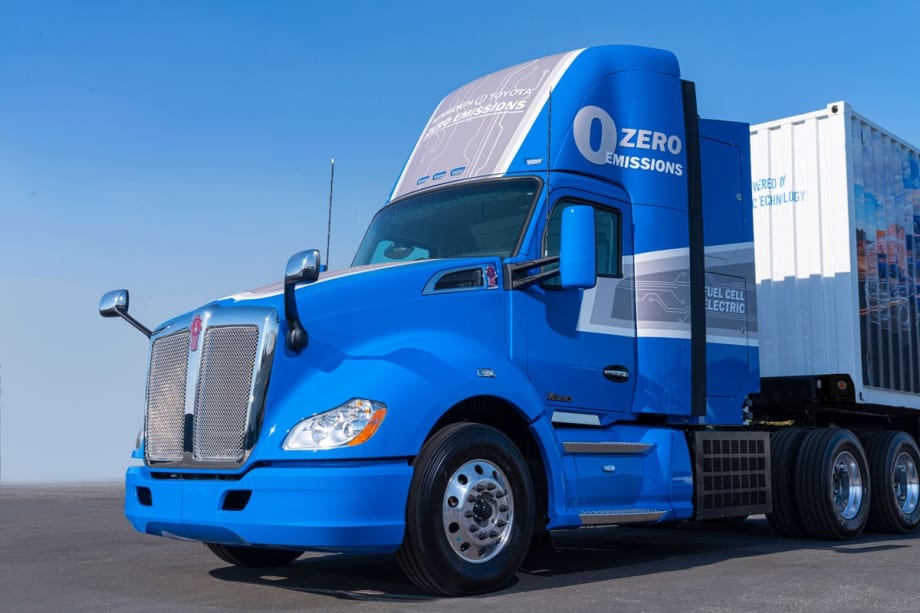
Toyota and Kenworth have been jointly developing hydrogen fuel cell technology for Class 8 trucks since 2017.
Photo: Toyota
3 min to read
Toyota's next-generation fuel cell electric technology is now powering a pair of production-intent prototype Class 8 Kenworths that will go to work at the Southern California ports.
The first two fuel-cell electric heavy duty Class 8 trucks built under the Zero and Near Zero Emissions Freight Forwarding (ZANZEFF) project sponsored by the state of California will go to Toyota Logistics Services and Southern Counties Express. Each will receive a Kenworth T680 Class 8 truck powered by a Toyota fuel cell electric drivetrain. Both of these zero-emissions trucks will be used for drayage operations in the ports of Los Angeles and Long Beach.
Toyota and Kenworth have been collaborating on hydrogen fuel cell technology together since 2017, putting Toyota hydrogen fuel cells in Kenworth T680 truck chassis. According to the Japanese OEM, these T680 trucks use a scaled-up version of the new hydrogen fuel cell powertrain found in the 2021 Toyota Mirai sedan that goes on sale this month. Using that technology, engineers at Toyota Motor North America Research and Development have developed a set of production-intent prototype trucks that are being prepared to run drayage routes at the ports of L.A. and Long Beach to validate their performance, efficiency and drivability.
Toyota said the new trucks have been designed to be flexible enough to meet the needs of a wide variety of OEM truck makers. Recent refinements include a more compact hydrogen storage cabinet behind the cab, which houses six hydrogen tanks with the same capacity as previous prototypes while a new, more powerful lithium-ion battery helps smooth out the power flow to the electric motors. In this configuration, the second-generation fuel cell system delivers over 300 miles of range at a full load weight of 80,000 lbs., all while demonstrating exceptional drivability, quiet operation, and zero harmful emissions, according to Toyota.
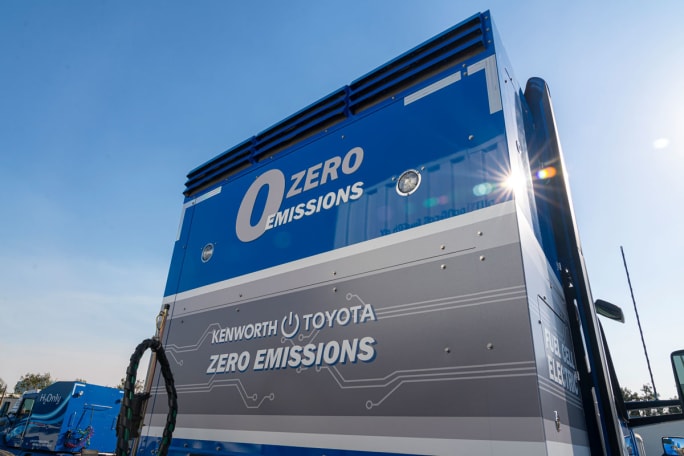
The second-generation system features a more compact hydrogen storage cabinet behind the cab, which houses six hydrogen tanks with the same capacity as previous prototypes.
Photo: Toyota
"This is an important step in the transition to emissions-free heavy-duty trucks," said Andrew Lund, chief engineer, Toyota Motor North America Research and Development. "Our first prototype trucks proved that a fuel cell electric powertrain was capable of hauling heavy cargo on a daily basis. These new prototypes not only use production-intent hardware, they will also allow us to start looking beyond drayage into broader applications of this proven technology."
An additional eight trucks will be delivered in 2021 as part of the ZANZEFF program. Three of the eight trucks will go to United Parcel Service for its port operations, while two of the eight trucks will go to Total Transportation Services, another prominent port operator. Toyota Logistics Services will also receive three additional trucks.
Development of the Kenworth T680 FCEV is part of a $41 million Zero and Near-Zero Emissions Freight Facilities (ZANZEFF) grant awarded by the California Air Resources Board, with the Port of Los Angeles as the prime applicant.
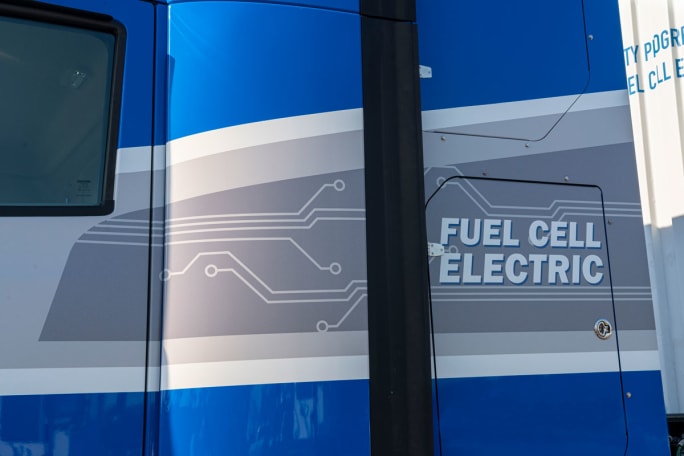
The second-generation fuel cell system delivers over 300 miles of range at a full load weight of 80,000 lbs.
Photo: Toyota
Reducing airborne pollution at the Ports of L.A. and Long Beach is an important driver of this program, Toyota said, noting that its Environmental Challenge 2050 initiative aims to almost completely eliminate CO2 emissions from our vehicles, operations and supply chain by 2050. Converting the drayage trucks that currently serve these ports to electric drivetrains would move us closer to that goal while improving the quality of life of operators, workers, and communities in and around the ports.
More Fuel Smarts

How Volvo Updated Its D13 for EPA 2027 [Watch]
Volvo’s updated D13 promises lower emissions without sacrificing performance or fuel economy. Take a closer look at what changed inside the engine in this HDT Spotlight video.
Read More →
Diesel Price Spike Shortens Payback for Natural Gas Trucks, Report Says
Energy Vision estimates fleets could recover the higher purchase price of an RNG-fueled Class 8 tractor in 1.3 to 2.8 years under current fuel-price scenarios.
Read More →
Calstart Becomes Catalyst Mobility, Reflecting Broader Focus
Calstart is now Catalyst Mobility, reflecting the nonprofit’s growing national role in clean transportation, including zero-emission trucks, infrastructure and incentive programs.
Read More →

Record Diesel Prices Squeeze Trucking Fleets
Average U.S. diesel prices have climbed to nearly $6 a gallon, surpassing the 2022 record as tight refinery capacity and Middle East disruptions keep fuel costs elevated.
Read More →
Sponsored•September 9, 2026
How Fuel Delivery Shapes Engine Performance
Fuel delivery depends on more than what happens at the injector. For fleet, maintenance and technical professionals, looking at the full path from pump to injector can provide useful context for understanding engine performance.
Read More →
East Coast Port Launches $45M Electric Truck Push
The Port Authority of New York and New Jersey announced millions in incentives for zero-emission drayage trucks, yard tractors, and new charging hubs near the port.
Read More →
California Bill Could Shed Light on Electric Truck Prices
Why do battery-electric Class 8 trucks remain so expensive? A California bill headed to Gov. Gavin Newsom would give fleets and state agencies more visibility into what manufacturers charge.
Read More →
Detroit Opens Orders for EPA 2027 Engines
Detroit isn’t starting from scratch to meet EPA 2027 diesel emissions standards. Its Gen 6 DD13 and DD15 engines keep much of today’s platform while updating the fuel and aftertreatment systems.
Read More →
Zero-Emission Truck Corridor Planned for West Coast
California, Oregon, Washington, British Columbia and Baja California are coordinating plans for truck charging and hydrogen fueling from Canada to Mexico.
Read More →
A Closer Look at Kenworth’s Electric T880E Vocational Truck [Video]
Learn more about Kenworth's T880E battery-electric vocational truck at the Paccar Technical Center, including its range, applications, upfitting considerations, and PTO options, in this HDT Spotlight video.
Read More →