




ISEE Unveils Auto-Coupling System for Autonomous Yard Trucks
ISEE has developed an AI-powered trailer coupling system for autonomous yard tractors.

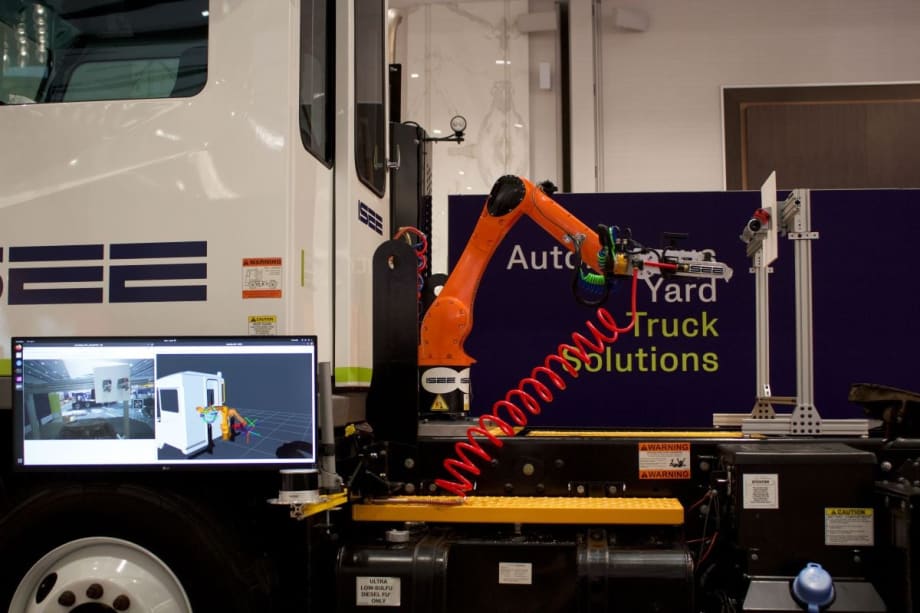
Using AI-powered auto-coupling technology, the ISEE trailer auto-coupling system autonomously identifies the precise locations and orientations of the trailer air connectors for both the service and parking brakes.
Photo: ISEE
At the Manifest supply chain technology showcase, ISEE, an autonomous vehicle company, unveiled its fully automated, AI-powered trailer auto-coupling system for autonomous yard trucks.
ISEE’s technology autonomously couples the trailer and connects the airlines without any trailer modifications, adapters, markers, or remote control.
AI-Enabled Robotic Arms
The ISEE trailer auto-coupling system integrates a six-axis robotic arm on the back of the autonomous yard truck cab. Using AI-powered auto-coupling technology, the system autonomously identifies the precise locations and orientations of the trailer air connectors for both the service and parking brakes.
Because gladhands can vary in location, orientation and type from one trailer to another. This makes the process of finding and attaching them a challenging task for a robotic system.
By leveraging experience and data from over 10,000 operational moves in customer sites, ISEE’s AI-powered system is trained to precisely identify and connect the airbrake lines autonomously. This eliminates the necessity for remote control or attaching extra adapters to the trailers.
Efficiency and Safety Enhancements
Automating the trailer coupling process eliminates the need for staff to manually couple and decouple trailer airlines, ISEE said in a press release. This significantly enhances safety and simplifies management, the company added.
ISEE cited U.S. Bureau of Labor Statistics reports that almost 30% of injuries in the trucking industry occur when drivers slip or fall while working. Stepping outside the cab to perform tasks such as connecting the trailer air lines poses a risk, including slippery steps and the cab's average height of four feet from the ground. The company said its system can help reduce the number of injuries by allowing its automated system to perform those tasks.
“Our latest AI-powered trailer auto-coupling technology leverages generative AI models for data augmentation and feature generation. This technology adopts an end-to-end approach to train gladhand type and pose in a consistent fashion, ensuring adaptability and versatility in our AI systems across diverse gladhand variations and environmental conditions,” said Yibiao Zhao, ISEE CEO and co-founder. “The robot arm is adept at attaching and detaching the gladhands, skillfully locating and handling them in any position, akin to human dexterity.”
The new AI-powered trailer auto-coupling technology augments ISEE’s existing, auto-coupling solution that customers are using today, the company said.
The existing solution uses a trailer adapter that standardizes various trailer connectors in a consistent location across the trailer fleet. These adapters can be clipped onto trailers as they enter the yard and are removed when the trailer departs.
As a result, ISEE said customers can now choose which level of trailer automation they prefer, making its solution a good for both customers who control their fleet or utilize a captive pool of trailers for their campus.
More Equipment

How Volvo Updated Its D13 for EPA 2027 [Watch]
Volvo’s updated D13 promises lower emissions without sacrificing performance or fuel economy. Take a closer look at what changed inside the engine in this HDT Spotlight video.
Read More →
Michelin Tire Improves Efficiency and Durability for Regional Fleets
The Michelin X Multi Energy D2 is a regional haul drive tire engineered to help fleets improve fuel efficiency, durability and traction in demanding stop-and-go operations.
Read More →
ZF Expands Commercial Vehicle Push in North America
ZF is expanding its North American commercial-vehicle presence with new transmission applications, electrification, trailer technology and autonomous-driving systems.
Read More →
Tesla Wants a Self-Driving Semi. Are Cameras Enough?
Could Tesla’s camera-only autonomous driving technology work on an 80,000-pound Semi? In this commentary, HDT's Deborah Lockridge takes a look at Tesla, Cybercab, and how autonomous trucks see the road.
Read More →
Kodiak: Driverless Long-Haul Truck Launch on Track for 2026
Kodiak AI says its driverless long-haul safety case is 93% complete and it remains on track to begin commercial operations by year-end 2026.
Read More →
What DOT’s Automated Vehicle Strategy Means for Trucking
The U.S. Department of Transportation issued a new automated-vehicle strategy that outlines plans for driverless-truck regulations, cross-state freight corridors, and federal safety standards.
Read More →
East Coast Port Launches $45M Electric Truck Push
The Port Authority of New York and New Jersey announced millions in incentives for zero-emission drayage trucks, yard tractors, and new charging hubs near the port.
Read More →
PlusAI Going Public to Fund Autonomous Truck Launch
A SPAC deal could provide PlusAI with up to $300 million as it works toward a 2027 commercial launch of factory-built autonomous trucks.
Read More →
NHTSA Moves to Rewrite Truck Fuel-Economy Rules
The National Highway Traffic Safety Administration says it lacks authority to regulate medium- and heavy-duty truck engines separately from complete vehicles, but the existing standards have not yet been eliminated.
Read More →
Detroit Opens Orders for EPA 2027 Engines
Detroit isn’t starting from scratch to meet EPA 2027 diesel emissions standards. Its Gen 6 DD13 and DD15 engines keep much of today’s platform while updating the fuel and aftertreatment systems.
Read More →