




International Trucks Says Goodbye to Navistar Name
It’s the end of an era for Navistar International — and the beginning of a new one — as the Traton subsidiary announced a rebrand and name change to International.

The rebranding of Navistar as International is driven by a shift in strategy to transform the business into a solutions provider, not just a truck maker.
Photo: International
It’s the end of an era for Navistar International — and the beginning of a new one — as the Traton subsidiary announced a rebrand and name change to International.
On Sept. 25, Navistar Inc. announced its plan to rebrand and change its name to International Motors LLC effective Oct. 1.
Two brands will remain separate: IC Bus and Fleetrite.
The rebranding reflects a new more dedicated focus on customer solutions beyond the trucks themselves and positions the company to move forward while rebuilding International's reputation in the marketplace.
“I think we've got a great reputation in certain sectors of the market, but we recognize the need to go back out and recapture that, to reinvigorate our brand,” Dan Kayser, executive vice president of commercial operations, told reporters in an advance briefing on the announcement.
'New' International Focuses on Customer Solutions
The rebranding is driven by a shift in strategy to transform the business into a solutions provider, not just a truck maker. That includes simplifying and streamlining the customer and user experience and offering services such as parts, maintenance, financing, connectivity, and charging.
For instance, in the coming months, current tools such OnCommand Connection and International 360 will come together under a new digital customer interface called My International. This will gather all customer solutions and data, including service contracts, financing, and fleet management, in one place.
“We want to have a company that very much drives to the center of what our customers are looking for,” Kayser said.
The way the company goes to market going forward, he said, is to focus on driving greater customer value.
“There's a lot more that drives customer value than just a vehicle,” he said.
“Creating this value is achieved by offering a solution, a full solution, to solve our customers’ pain points, meaning we really want to get … a deep understanding of the customers and bring to them a full solution beyond just a vehicle that will solve for those pain points.”
Up Next: New Flagship Class 8 Truck
Not that vehicles aren’t important, of course.
“Over the last several years, we've been pretty busy, honestly, somewhat quietly, busy in the marketplace with products," Kayser said.
The S13 integrated powertrain, the newest IC bus, the International MV, the eMV, the new HV, and the HX severe-service truck rolled out recently.
“These are all recent launches or refreshes that we're focused around various parts of the market," Kayser said. "The next big one for us is the Class 8 market, specifically the on-highway tractor.”
Asked for more details, Kayser answered, “I would just say that think about this as the future of our on-highway truck. This would be the flagship of the brand.”
The company also plans to build on the battery-electric vehicle technology of its eMV medium-duty truck, leveraging components and technology from parent company Traton.
Recent International Advances
Kayser highlighted some of International’s recent activities, including:
The S13 Integrated Powertrain, which started production at the beginning of this year. “This powertrain has allowed our on-highway tractor, the LT, to actually lead the industry by at least 5% in fuel economy,” he said. That’s a new announcement, determined with the help of third-party testing. Some customers, he said, are even achieving higher gains.
The launch of the International HX severe-duty vocational truck, which has been so popular that it has been a challenge to build enough trucks to meet demand.
Refreshed the medium-duty MV series
Announced a new suite of comprehensive ownership solutions for battery-electric vehicles,
Refreshed the Class 6/7 HV series, which should make its official debut next year.
Launched the next generation school bus, which Kayser said uses the MV platform to modernize the school bus.
Brought back financial services to provide full financing offers to customers.
“These investments are part of our long term strategy to really return to the stature that we once had … really dedicated to customer-centric innovation and superior industrial design," Kayser said.
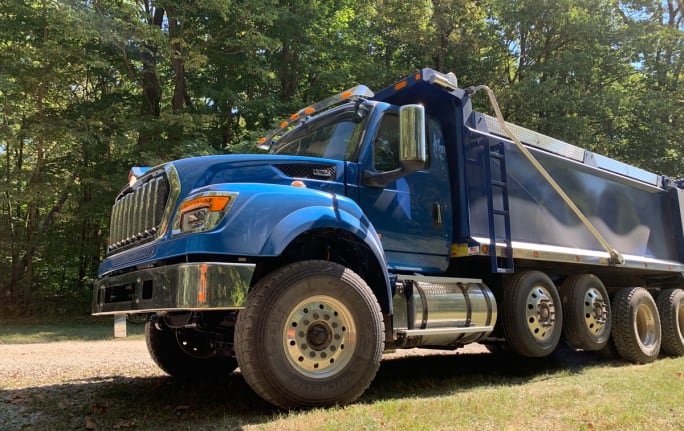
The company showed off a pre-production version of the new International HV truck with S13 powertrain to reporters.
Photo: Deborah Lockridge
Focusing on Quality and Stabilizing Supply Chains
Meeting customer needs also means focusing on quality, Kayser said, and that includes stabilizing International’s supply chain and manufacturing. Earlier this year, its sales were hurt by slower-than-expected delivery of frame rails and axles, and then it racked up an 8,000-truck backlog after a fire at its only mirror supplier.
“We just went through a very difficult pandemic period where it was difficult to meet customer demands, customer needs,” he said.
“So we're keenly focused on stabilizing the supply chain for the future, so that we can really meet market demand where it is in any given cycle… to ensure that when the product hits the customer, it’s ready to go, and the customer will have a great experience.”
Why Now for International Rebrand?
“Companies typically undergo a transformation like this for one of three reasons,” Kayser said. “One, a new leader comes in with a new vision. Number two, shareholder demands to address underperformance, or three, disruption from evolving technology or new competitors entering the market.
“For us, interestingly, it’s really all three of these things that's driving us to really start this as the new era, the new chapter.”
On top of that, customers are different. Their needs have changed.
Twenty years ago, Kayser noted, trucking fleet operators weren’t as sophisticated when it came to truly understanding how their equipment and their business were performing.
“Now we have customers that can measure to the third decimal place how well the trucks are performing, with real data,” he said.
It became apparent, even before the 2021 Traton acquisition, he said, that the company was “going to have to look at the world differently, because the customers understand the value proposition of your product much deeper than they did before.”
The change is part of a broader transformation which has been ongoing since 2021.
Over the past three years or so, since becoming a part of Traton, the Navistar team has been through a thorough process of brand evaluation and strategy development.
“That told us three things,” said Megan Troppito, corporate communications leader, in that briefing. “The International brand is strong. It's time to invest and build equity in that brand. And we can leverage it as a catalyst for growth, so it can be a change agent for us.”
International Looks to its Roots
Company executives again and again referred to the company’s roots in its rebranding as International.
Its history reaches back to the early 1800s with the invention of the first mechanical harvesting machine, the McCormick Reaper. In the early 1900s it merged with several other agricultural equipment firms to form International Harvester, which by 1910 was the fourth largest company in the U.S.
In the 1980s, following challenging economic times, International Harvester sold off its agricultural division and the IH name, and the company reintroduced itself as Navistar International Corp.
The Navistar brand took a big hit as it struggled to meet U.S. Environmental Protection Agency diesel engine emissions regulations for 2010, opting to pursue a different strategy from the selective catalytic reduction aftertreatment favored by other truck makers. In the following decade, it faced excessive warranty claims on its Maxxforce engines, as well as litigation from customers, the Securities and Exchange Commission, and from the EPA, the latter of which it settled in 2021.
In 2021, Navistar International Corp. merged with Traton SE, joining Traton’s existing brands of Scania, MAN, Volkswagen Truck & Bus, and RIO.
“This is the thing I want to stress: We're playing a long game," Kayser said. "And I haven't been able to say that for a while. International is fully playing a long game, grounded in our roots, but also showing who we intend to be in the marketplace.”
More Equipment

How Volvo Updated Its D13 for EPA 2027 [Watch]
Volvo’s updated D13 promises lower emissions without sacrificing performance or fuel economy. Take a closer look at what changed inside the engine in this HDT Spotlight video.
Read More →
Michelin Tire Improves Efficiency and Durability for Regional Fleets
The Michelin X Multi Energy D2 is a regional haul drive tire engineered to help fleets improve fuel efficiency, durability and traction in demanding stop-and-go operations.
Read More →
ZF Expands Commercial Vehicle Push in North America
ZF is expanding its North American commercial-vehicle presence with new transmission applications, electrification, trailer technology and autonomous-driving systems.
Read More →
Tesla Wants a Self-Driving Semi. Are Cameras Enough?
Could Tesla’s camera-only autonomous driving technology work on an 80,000-pound Semi? In this commentary, HDT's Deborah Lockridge takes a look at Tesla, Cybercab, and how autonomous trucks see the road.
Read More →
Kodiak: Driverless Long-Haul Truck Launch on Track for 2026
Kodiak AI says its driverless long-haul safety case is 93% complete and it remains on track to begin commercial operations by year-end 2026.
Read More →
What DOT’s Automated Vehicle Strategy Means for Trucking
The U.S. Department of Transportation issued a new automated-vehicle strategy that outlines plans for driverless-truck regulations, cross-state freight corridors, and federal safety standards.
Read More →
East Coast Port Launches $45M Electric Truck Push
The Port Authority of New York and New Jersey announced millions in incentives for zero-emission drayage trucks, yard tractors, and new charging hubs near the port.
Read More →
PlusAI Going Public to Fund Autonomous Truck Launch
A SPAC deal could provide PlusAI with up to $300 million as it works toward a 2027 commercial launch of factory-built autonomous trucks.
Read More →
NHTSA Moves to Rewrite Truck Fuel-Economy Rules
The National Highway Traffic Safety Administration says it lacks authority to regulate medium- and heavy-duty truck engines separately from complete vehicles, but the existing standards have not yet been eliminated.
Read More →
Detroit Opens Orders for EPA 2027 Engines
Detroit isn’t starting from scratch to meet EPA 2027 diesel emissions standards. Its Gen 6 DD13 and DD15 engines keep much of today’s platform while updating the fuel and aftertreatment systems.
Read More →