





California Makes $100 Million in Funds Available for ZEV Fleet Conversions
Hyzon Unveils Hydrogen Fuel Cell Refuse Truck
Hyzon and New Way Trucks have released the first-ever hydrogen-powered refuse truck in North America.
May 17, 2024
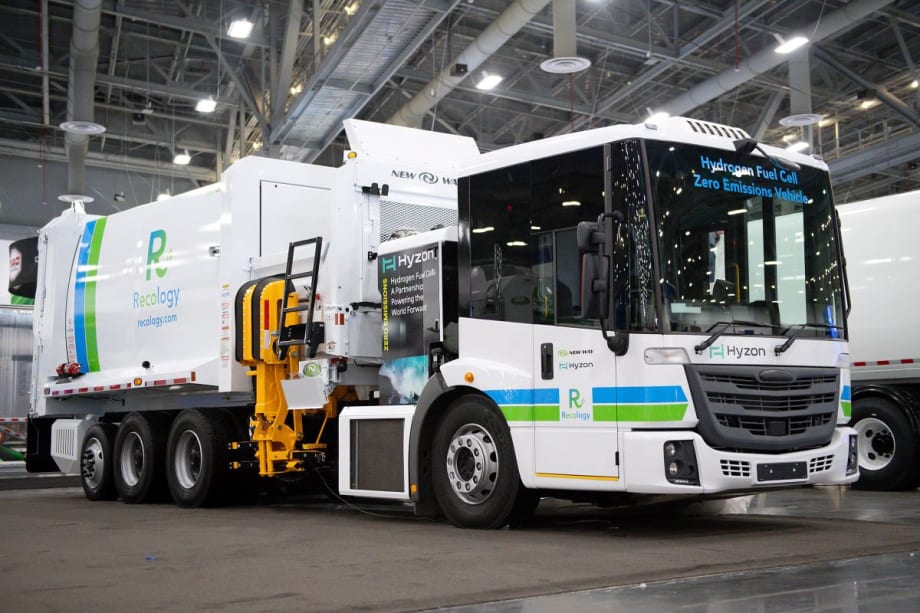
Hyzon said its new hydrogen fuel cell refuse truck is capable of 1,200 cart lifts a day and has a range of more than 125 miles.
Photo: Hyzon Motors
3 min to read
Hydrogen fuel cell technology developer Hyzon and New Way Trucks, a privately held refuse truck body manufacturer, are showcased a hydrogen fuel cell-powered electric refuse truck at Waste Expo, May 7-9 at the Las Vegas Convention Center. The companies say the vehicle is the first-ever hydrogen-powered refuse truck in North America.
This debut to the U.S. market follows February's announcement of the Joint Development Agreement (JDA) between New Way and Hyzon. The agreement combines both companies' expertise to develop zero-emission refuse collection solutions.
"Building on Hyzon's fuel cell electric refuse vehicle experience in Australia, Hyzon and New Way's strategic partnership assembled a historic vehicle to eliminate emissions within a hard-to-abate industry," said Hyzon CEO Parker Meeks. "This is evidence of our shared mission to provide North American refuse collection fleets with an alternative power solution that both meets zero emissions requirements and performs the hard work a refuse truck needs to deliver day in and day out."
1,200 Cart Lifts and 125 Miles
Refuse is a demanding application for alt-fuel trucks. Hyzon said its hydrogen fuel cells are tough enough to provide consistent power over 125 miles, including up to 1,200 cart lifts and trips to the transfer station.
The truck features New Way's Sidewinder XTR automated side loader. This arm features up to a 12-foot reach and large 6-cubic-yard hopper for sustainable refuse collection.
"As a growing market leader with a long history in building high-performance refuse collection equipment, New Way is in a unique position to be able to bring this sustainable, alternative power solution to waste haulers looking to meet decarbonization objectives and other clean energy requirements," said Dan Ross, chief sales officer, New Way.
Both New Way and Hyzon said they look forward to further technology and performance development with the Class 8 FCEV. This will take place as more information is gathered during customer demonstrations occurring throughout the rest of 2024.
San Francisco Trials
Following Waste Expo, the truck will begin test runs on routes in California. These will start with San Francisco waste hauler Recology.
Recology is an employee-owned solid waste and recycling collection and processing company with a commitment to sustainable operations at its core.
Recology has long shown its commitment to sustainable transportation, according to Hyzon. The company recently achieved its goal to power its fleet with more than 90 percent renewable or alternative fuels. Hyzon said the company now sees the demo of this first-of-its-kind hydrogen-powered truck as an opportunity to be on the forefront of helping decarbonize the industry.
"As a leader in fleet sustainability, we're proud to partner with New Way and Hyzon to bring the first hydrogen fuel cell electric collection vehicle to test in our communities in California," said Recology CEO Sal Coniglio. "Recology has been preparing to transition our fleet to zero emission vehicles for nearly six years, and we've yet to see a hydrogen fuel cell powered refuse truck on the market during that time. This development is a major milestone, and we're thrilled to be the first to demo this technology to help move our business and the industry forward."
More Fuel Smarts

How Volvo Updated Its D13 for EPA 2027 [Watch]
Volvo’s updated D13 promises lower emissions without sacrificing performance or fuel economy. Take a closer look at what changed inside the engine in this HDT Spotlight video.
Read More →
Diesel Price Spike Shortens Payback for Natural Gas Trucks, Report Says
Energy Vision estimates fleets could recover the higher purchase price of an RNG-fueled Class 8 tractor in 1.3 to 2.8 years under current fuel-price scenarios.
Read More →
Calstart Becomes Catalyst Mobility, Reflecting Broader Focus
Calstart is now Catalyst Mobility, reflecting the nonprofit’s growing national role in clean transportation, including zero-emission trucks, infrastructure and incentive programs.
Read More →

Record Diesel Prices Squeeze Trucking Fleets
Average U.S. diesel prices have climbed to nearly $6 a gallon, surpassing the 2022 record as tight refinery capacity and Middle East disruptions keep fuel costs elevated.
Read More →
Sponsored•September 9, 2026
How Fuel Delivery Shapes Engine Performance
Fuel delivery depends on more than what happens at the injector. For fleet, maintenance and technical professionals, looking at the full path from pump to injector can provide useful context for understanding engine performance.
Read More →
East Coast Port Launches $45M Electric Truck Push
The Port Authority of New York and New Jersey announced millions in incentives for zero-emission drayage trucks, yard tractors, and new charging hubs near the port.
Read More →
California Bill Could Shed Light on Electric Truck Prices
Why do battery-electric Class 8 trucks remain so expensive? A California bill headed to Gov. Gavin Newsom would give fleets and state agencies more visibility into what manufacturers charge.
Read More →
Detroit Opens Orders for EPA 2027 Engines
Detroit isn’t starting from scratch to meet EPA 2027 diesel emissions standards. Its Gen 6 DD13 and DD15 engines keep much of today’s platform while updating the fuel and aftertreatment systems.
Read More →
Zero-Emission Truck Corridor Planned for West Coast
California, Oregon, Washington, British Columbia and Baja California are coordinating plans for truck charging and hydrogen fueling from Canada to Mexico.
Read More →
A Closer Look at Kenworth’s Electric T880E Vocational Truck [Video]
Learn more about Kenworth's T880E battery-electric vocational truck at the Paccar Technical Center, including its range, applications, upfitting considerations, and PTO options, in this HDT Spotlight video.
Read More →