





Watch this HDT 2020 video: Hyundai Fuel-Cell Push Includes Heavy-Duty Trucks
Hyundai Premieres Xcient Fuel Cell Tractor for North America
More than three years after Hyundai Motor first showed off a hydrogen-powered concept truck in the U.S., the company has debuted the commercialized model of the Xcient fuel cell tractor.
May 4, 2023
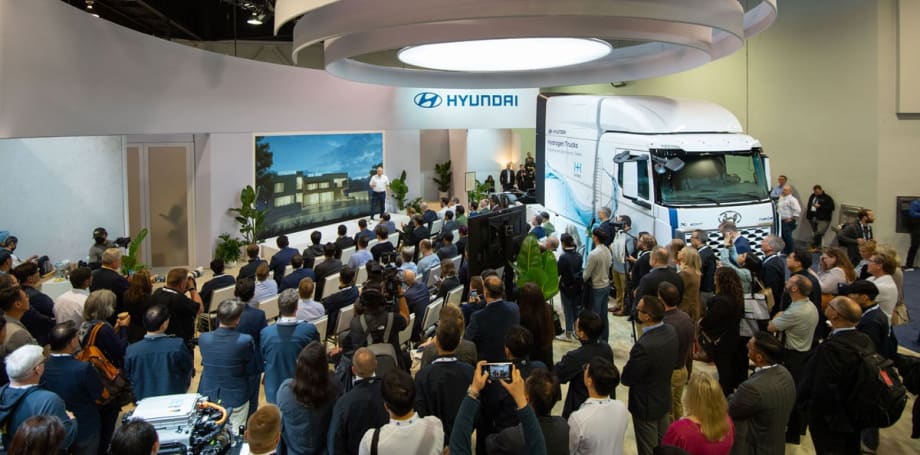
There was a crowd for the Hyundai fuel-cell Xcient debut.
Photo: GNA/ACT Expo
3 min to read
More than three years after Hyundai Motor first showed off a hydrogen-powered concept truck in the U.S., the company has debuted the commercialized model of the Xcient fuel cell tractor.
The first indication we had that Hyundai was considering a hydrogen-powered tractor for North America was in 2019, where it showed off a futuristic fuel-cell-electric concept vehicle. As is the case with concept vehicles, what’s entering the U.S. market is a more workaday vehicle, a fuel-cell version of its Xcient Euro-style cabover.
Hyundai premiered the 6x4 Excient fuel-cell tractor for the North American commercial vehicle market at the Advanced Clean Transportation Expo in Anaheim, California.
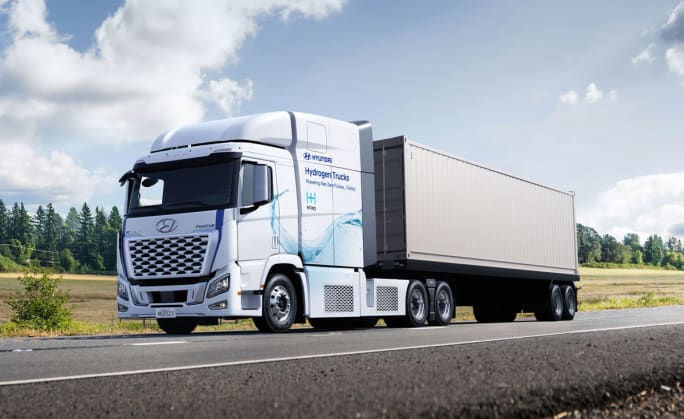
The FCEV Xcient has already racked up miles of operation in five countries.
Photo: Hyundai
First launched in 2020, Xcient Fuel Cell has been deployed in five countries — Switzerland, Germany, Israel, Korea and New Zealand — and has accumulated more than 4 million miles so far.
The model shown at the event is the 6x4 tractor equipped with two 90 kW hydrogen fuel cell systems (total 180 kW power) and a 350 kW e-motor. Its gross combination weight is a maximum 82,000 lbs and it offers a driving range of over 450 miles per charge even when fully loaded, according to the company.
The FCEV Xcient
The day-cab 6x4 Xcient shown is 346 inches long, 102 inches wide, 161 inches high, with a 223-inch wheelbase. Hyundai said the COE design provides better visibility, fewer blind spots, and easier maneuvering in tight quarters.
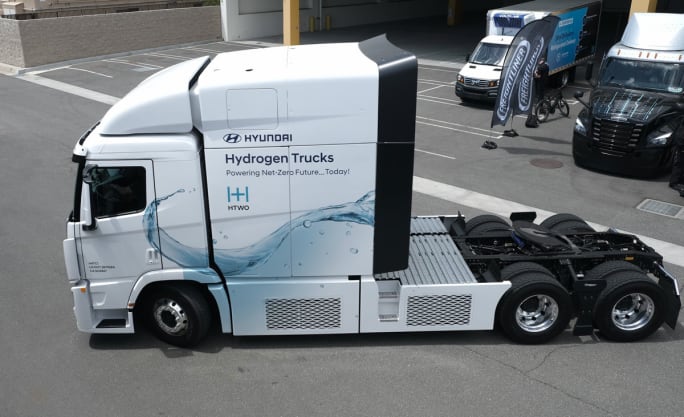
A fuel-cell Hyundai Xcient at the ride-and-drive portion of ACT Expo.
Photo: Jim Park
A V-shaped mesh grille maximizes airflow over the fuel cell stack for improved cooling. There’s a fixed step bumper for easy windshield access, LED headlamps and rear combination tail lamps.
Easy-access door steps provide access to the cab. An 8-inch touchscreen provides infotainment and connects to a driver’s mobile device, and there’s integrated wireless mobile phone charging. There’s a “truck-on” alert if drivers exit the cab with it still running. An extra-wide-angle lens paired with the 8-inch screen gives drivers a view behind the vehicle. The driver’s seat has heated coils and a cooling ventilation system. A utility mode shuts down drivetrain and steering power when parked but still powers HVAC, lighting and multimedia systems.
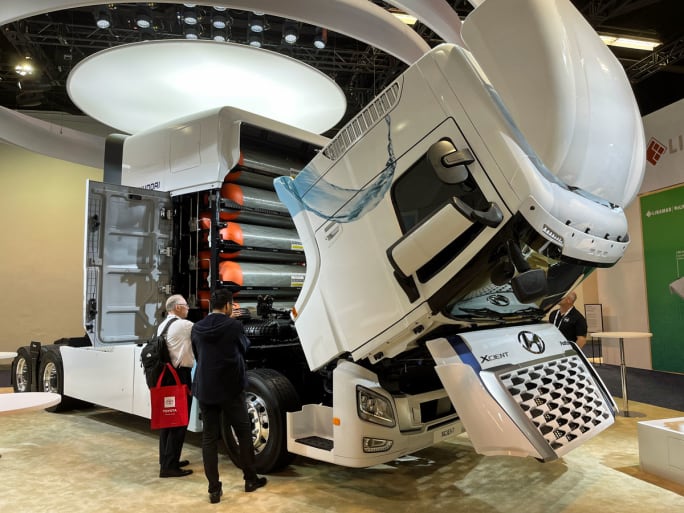
It's an unusual sight to see a Euro-style Class 8 cabover at a U.S. show.
Photo: Jim Park
In case of a crash, the hydrogen tank shuts off to minimize the risk of electric shock and collateral accidents. An easy hill start system prevents the truck from rolling back when starting again on a steep slope.
Integrated Hydrogen Ecosystem
Hyundai officials shared their commitment to hydrogen mobility and the company’s ambition to foster the development of a clean hydrogen ecosystem.
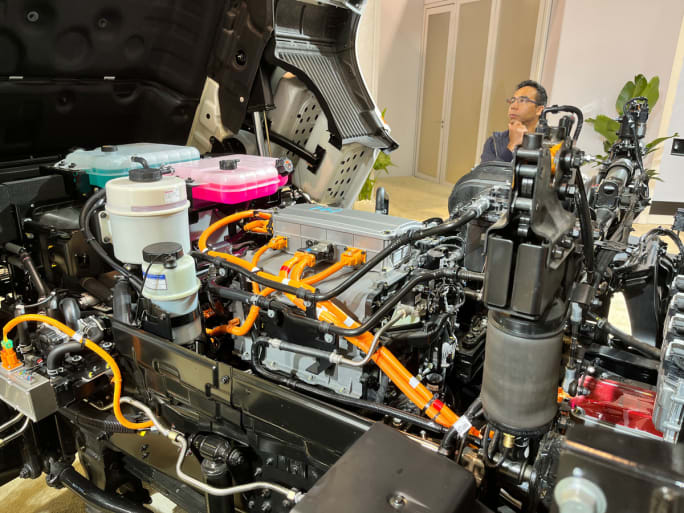
Under the "hood" or in this case, under the tilted-up cab) of the Hyundai Xcient fuel-cell truck.
Photo: Jim Park
“We firmly believe that hydrogen is one of the most powerful and pragmatic solutions for achieving our vision of 'Progress for Humanity' with emission-free mobility as a fundamental pillar for a sustainable society,” said Ken Ramirez, EVP and head of global commercial vehicle and hydrogen fuel cell business at Hyundai Motor. “We now look beyond mobility toward an integrated hydrogen ecosystem, from production of hydrogen to its storage, transport and delivery.”
The company said it will leverage local partnerships to establish a hydrogen commercial vehicle value chain. Earlier this year, Hyundai announced a joint effort with FirstElement Fuel to test Hyundai’s Xcient fuel cell heavy-duty trucks in California, fueling at FirstElement Fuel’s True Zero network of hydrogen refueling stations, as well as with a high-capacity mobile refueler.
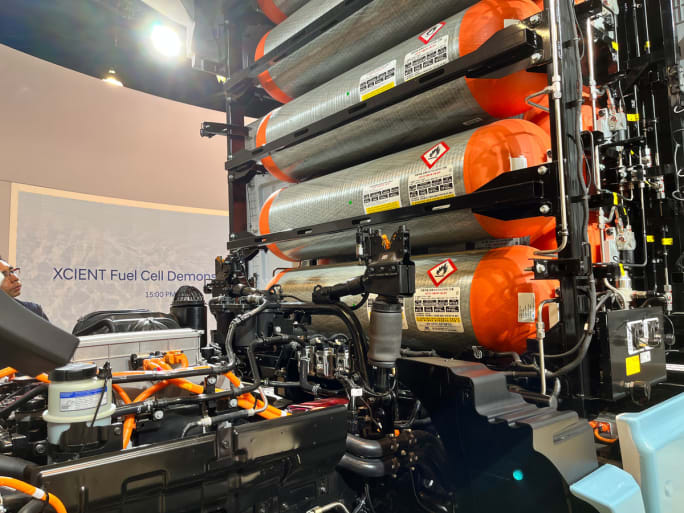
The fuel-cell Xcient offers a driving range of over 450 miles per charge even when fully loaded, according to the company.
Photo: Jim Park
More Equipment

Tesla Wants a Self-Driving Semi. Are Cameras Enough?
Could Tesla’s camera-only autonomous driving technology work on an 80,000-pound Semi? In this commentary, HDT's Deborah Lockridge takes a look at Tesla, Cybercab, and how autonomous trucks see the road.
Read More →
Kodiak: Driverless Long-Haul Truck Launch on Track for 2026
Kodiak AI says its driverless long-haul safety case is 93% complete and it remains on track to begin commercial operations by year-end 2026.
Read More →
What DOT’s Automated Vehicle Strategy Means for Trucking
The U.S. Department of Transportation issued a new automated-vehicle strategy that outlines plans for driverless-truck regulations, cross-state freight corridors, and federal safety standards.
Read More →
East Coast Port Launches $45M Electric Truck Push
The Port Authority of New York and New Jersey announced millions in incentives for zero-emission drayage trucks, yard tractors, and new charging hubs near the port.
Read More →
PlusAI Going Public to Fund Autonomous Truck Launch
A SPAC deal could provide PlusAI with up to $300 million as it works toward a 2027 commercial launch of factory-built autonomous trucks.
Read More →
NHTSA Moves to Rewrite Truck Fuel-Economy Rules
The National Highway Traffic Safety Administration says it lacks authority to regulate medium- and heavy-duty truck engines separately from complete vehicles, but the existing standards have not yet been eliminated.
Read More →
Detroit Opens Orders for EPA 2027 Engines
Detroit isn’t starting from scratch to meet EPA 2027 diesel emissions standards. Its Gen 6 DD13 and DD15 engines keep much of today’s platform while updating the fuel and aftertreatment systems.
Read More →
Carrier Transicold Adds All-Electric TRU for Stationary Cold Storage
Carrier Transicold’s new Vector 8200 all-electric transport refrigeration unit gives fleets a diesel-free option for temporary refrigerated and frozen trailer storage.
Read More →
A Closer Look at Kenworth’s Electric T880E Vocational Truck [Video]
Learn more about Kenworth's T880E battery-electric vocational truck at the Paccar Technical Center, including its range, applications, upfitting considerations, and PTO options, in this HDT Spotlight video.
Read More →
Kenworth T880E Brings EV Power to Vocational Trucks
A closer look at the Kenworth T880E’s range, charging, powertrain and upfit options — and where fleets are showing the most interest.
Read More →