




Hyliion Acquires Battery Division of Gentherm
Hyliion has acquired the battery division of vehicle electrification company Gentherm and announced strategic partnerships with both Toshiba and Dana.

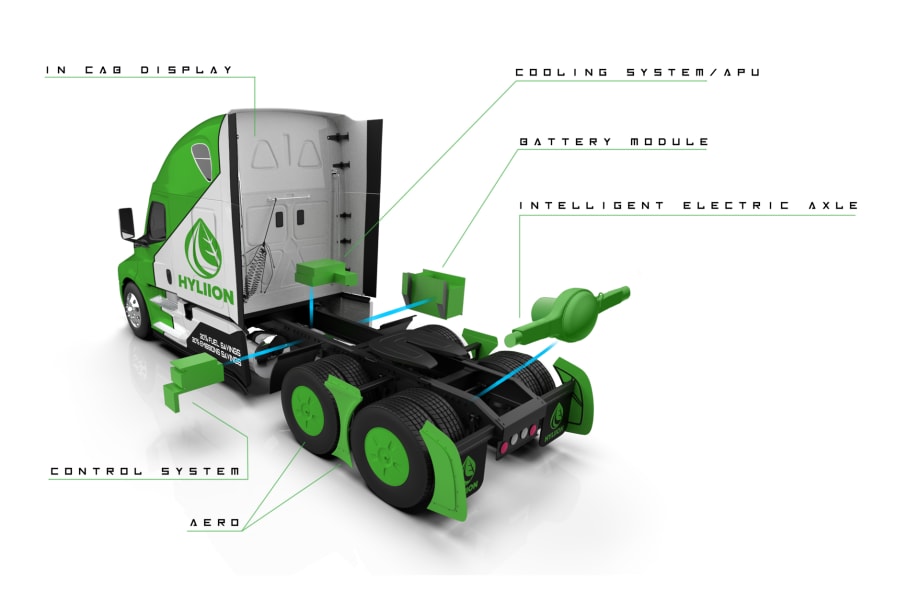
Hyliion has announced strategic partnerships with Toshiba and Dana, as well as the acquisition of Gentherm’s battery division.
Photo courtesy Hyliion
Hyliion has announced the acquisition of Gentherm’s battery division. the company made the move as a way to drive growth and innovation into its intelligent hybrid electric technology it says can transform any Class 8 truck into a diesel hybrid electric-powered vehicle, according to spokesmen. Gentherm’s team of battery experts will be joining Hyliion as well.
The Gentherm battery system was already a critical component of Hyliion’s 6x4HE solution.
“Batteries are a critical component of any hybrid vehicle. The acquisition provides us with control over the complete battery management supply chain from manufacturing and packaging to software development,” said Thomas Healy, founder and CEO of Hyliion. “This is a huge strategic advantage for us.”
Hyliion also announced a strategic partnership with Toshiba. Hyliion will act as Toshiba’s preferred packaging and cooling partner in the U.S. Hyliion also announced a new collaboration with auto industry giant Dana, which offers proprietary cooling technology to improve the thermal management of Hyliion battery systems.
“By cost effectively transforming any semi-truck into a hybrid electric, Hyliion is providing the trucking industry a unique opportunity to capitalize on the vehicle electrification trend," said Darel Reed, National Sales Manager at Toshiba.
Hyliion's 6x4HE electrification system is designed to capture wasted energy when traveling downhill and apply that power when traveling uphill to keep the engine in its most efficient operating range. Hyliion's hybrid electrification system can deliver fuel savings of up to 30%, reduced emissions, and instant telematics, according to the company. The system is designed for easy installation and can be implemented onto new trucks or retrofitted onto any Class 8 vehicle. The company expects its recent acquisition and strategic partnerships to allow Hyliion to take their hybrid solution a step further.
“The path to fully electrified long-haul fleets has many challenges. Long haul semi-trucks average 600 miles a day. Electric semi-trucks, including Tesla’s, are restricted by 300 to 500 miles on a single charge,” said Healy. “Unless we re-grid the entire country to accommodate power consumption with grids as large as entire cities, a hybrid solution is the only answer that makes sense for long hauls.”
“We’re thrilled to welcome our new battery team to Hyliion. The battery technology they created is stellar and gives us a clear strategic advantage," added Healy.
Related: Electric Axle Offers Fuel Savings for Long-Haul Operations
More Fuel Smarts

How Volvo Updated Its D13 for EPA 2027 [Watch]
Volvo’s updated D13 promises lower emissions without sacrificing performance or fuel economy. Take a closer look at what changed inside the engine in this HDT Spotlight video.
Read More →
Diesel Price Spike Shortens Payback for Natural Gas Trucks, Report Says
Energy Vision estimates fleets could recover the higher purchase price of an RNG-fueled Class 8 tractor in 1.3 to 2.8 years under current fuel-price scenarios.
Read More →
Calstart Becomes Catalyst Mobility, Reflecting Broader Focus
Calstart is now Catalyst Mobility, reflecting the nonprofit’s growing national role in clean transportation, including zero-emission trucks, infrastructure and incentive programs.
Read More →

Record Diesel Prices Squeeze Trucking Fleets
Average U.S. diesel prices have climbed to nearly $6 a gallon, surpassing the 2022 record as tight refinery capacity and Middle East disruptions keep fuel costs elevated.
Read More →
How Fuel Delivery Shapes Engine Performance
Fuel delivery depends on more than what happens at the injector. For fleet, maintenance and technical professionals, looking at the full path from pump to injector can provide useful context for understanding engine performance.
Read More →
East Coast Port Launches $45M Electric Truck Push
The Port Authority of New York and New Jersey announced millions in incentives for zero-emission drayage trucks, yard tractors, and new charging hubs near the port.
Read More →
California Bill Could Shed Light on Electric Truck Prices
Why do battery-electric Class 8 trucks remain so expensive? A California bill headed to Gov. Gavin Newsom would give fleets and state agencies more visibility into what manufacturers charge.
Read More →
Detroit Opens Orders for EPA 2027 Engines
Detroit isn’t starting from scratch to meet EPA 2027 diesel emissions standards. Its Gen 6 DD13 and DD15 engines keep much of today’s platform while updating the fuel and aftertreatment systems.
Read More →
Zero-Emission Truck Corridor Planned for West Coast
California, Oregon, Washington, British Columbia and Baja California are coordinating plans for truck charging and hydrogen fueling from Canada to Mexico.
Read More →
A Closer Look at Kenworth’s Electric T880E Vocational Truck [Video]
Learn more about Kenworth's T880E battery-electric vocational truck at the Paccar Technical Center, including its range, applications, upfitting considerations, and PTO options, in this HDT Spotlight video.
Read More →