




How Will Election Affect the Quagmire in Washington?
The results of the November election could have profound effects on three important issues for the heavy-vehicle industry: Trade, transportation/infrastructure, and energy and the environment.

Who wins the White House will make a difference in trade, infrastructure, and energy policy.
HDT Graphic
The November election could have profound effects on three important issues for the heavy-vehicle industry: Trade, transportation/infrastructure, and energy and the environment, said Ann Wilson, senior vice president of government affairs with the Motor Vehicle Manufacturers Association.
When asked to present about the state of government affairs as the election approaches, Wilson said, “The word that came to mind was quagmire – a difficult, complicated, or unpleasant situation which is not easy to avoid or escape from. I would argue that, unfortunately, Washington, D.C., is in a quagmire.
"This is not something that has happened overnight, or even in the last four years,” she told attendees of Heavy Duty Dialogue, a virtual event put on by the Heavy Duty Manufacturers Association arm of MEMA on Sept. 15.
Wilson outlined three areas of vital interest to the audience of heavy-duty manufacturers and suppliers as well as the larger trucking industry, and how the election could affect them.
Few people believe it is likely that the House of Representatives will turn Republican in the election, nor that either party will get a 60-vote hold over the Senate.
If President Trump wins re-election and the Democrats still hold the House, Wilson said, “the optimistic part of me believes you would see a lot of the moderate Democrats in the House reaching out to moderate Republicans in the Senate to craft policy they can get through and get signed by the President. House members have to get re-elected again in two years, and if they can’t demonstrate they can get anything moving, those chances of re-election get smaller.”
She referred to National Journal analysis that said a clean sweep for the Democrats to take the White House and all of Congress is seen as a medium likelihood. Seen as high likelihood is for the House and Senate to remain under their current control and the White House to change either way.
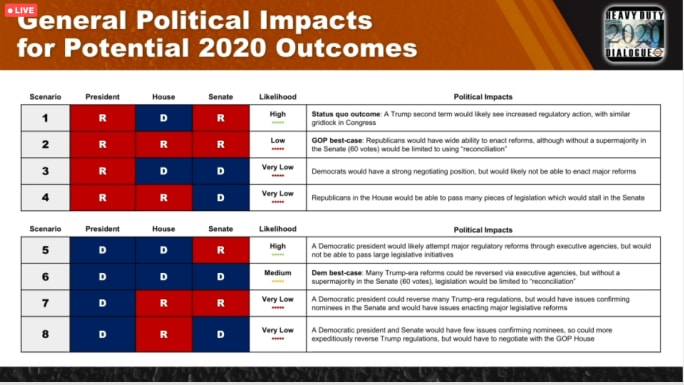
The most likely scenarios see the House and Senate remaining under the same party control as currently.
Screen shot, Heavy Duty Dialogue virtual event
Trade and Tariffs
President Trump has used tariffs and quotas to try addressing trade imbalances, as well as issues in China, such as intellectual property theft.
“China remains a difficult situation with tariffs, and the tariff situation is such that Democrats agree with the President that tariffs are necessary to address the problems with trade with China,” Wilson said, although they may not always agree on the details.
MEMA, she said, has argued that tariffs may be a way to address imbalances, but they are not the right way to force changes to technical transfer or IP laws, “but that is an argument that is ongoing.”
If President Trump wins the election, we’ll likely see increased trade skirmishes, including with the EU, a continued “America First” agenda with an emphasis on bilateral agreements. If Vice President Biden takes over the White House, you will likely see decreased tariffs, the U.S. reengagement with the World Trade Organization, and potential coordination with other countries to address issues with China.
“If the Democrats are in the White House, I don’t think you’ll see a lot of immediate change,” Wilson said.
“If you’re paying tariffs on goods coming from China, they will continue into next year, whether we have Biden or Trump as a president. But I think what Biden will try to do is work with other global players and look for opportunities to put pressure on China with other players to address IP violations and technology transfer concerns.” She does not think that renegotiation of the U.S.-Mexico-Canada trade agreement that replaced NAFTA and went into effect in July will be renegotiated.
Infrastructure
The last transportation reauthorization happened in 2015 with the FAST Act, which expires at the end of September. Wilson said it’s likely that Congress will manage to agree on a short-term reauthorization package that just extends the current authorization through the end of the year or into January.
“However, it won’t be permanent, and it won’t address the underlying issues that are always addressed during reauthorization bills,” she said, citing as an example getting relief from the federal excise tax, one area that trucking interests from HDMA to the American Trucking Associations to the Owner-Operator Independent Drivers Association agree on.
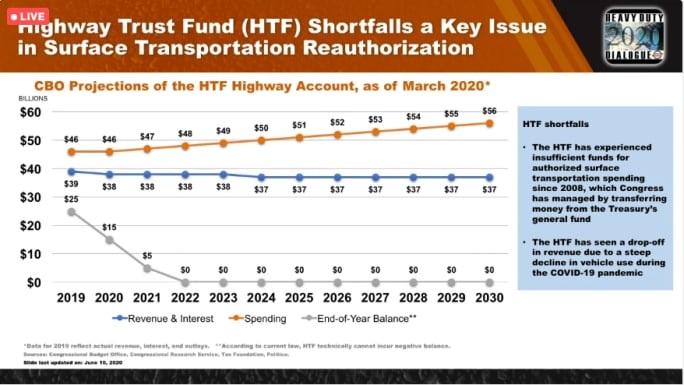
The Highway Trust Fund is running out of money.
Screen shot, Heavy Duty Dialogue virtual event
Reuathorization bills not only set out the funding that goes to state and local governments to address highway and other transportation needs, she said. “It’s also the vehicle used to promote policy change at the DOT, climate change and environmental policy, and other requirements in the transportation world.”
Democrats want significant changes to the administration’s environmental policy goals and earlier this year passed a massive reauthorization bill focusing on “green” transportation. It was basically dead on arrival in the Senate, which had a much more modest plan and said it was not going to address sweeping environmental changes in a transportation bill.
“But the real problem is money,” Wilson said. “In 18 months, by 2022, the Highway Trust Fund is going to run out of money.” More fuel-efficient vehicles, less miles traveled during this year’s recession, electric vehicles not paying fuel taxes, are all among the reasons the trust fund is running out of money.
“No matter who wins the presidency or has control of Congress, this is the number one issue that they have to address before we can move forward with a long-term transportation reauthorization bill.”
If President Trump wins in November, you can expect to see a major infrastructure package, but size, financing, and permitting reforms are likely barriers. You’ll likely see more public-private partnerships, more interesting in tolling, and more emphasis on states and local governments figuring out how to pay for infrastructure.
A Biden win would also likely see a major package passed, but focused on expanding green projects, efficiency improvements, and mass transit, as well as trucking safety regulations.
“You’ll see a lot of requirements, mandates, for safety technologies, for the environment, for electric vehicles,” she said. “When it comes to funding, you’ll see the federal government continue to assume a lot of the risks and requirements overall for funding operations.
“We all know transportation bills are a great way to provide stimulus, a great opportunity overall for any president to put their fingerprint on domestic policy,” Wilson said. “But we’ll see a very, very different view depending on who’s at 1600 Pennsylvania Avenue.”
Energy and the Environment
California continues to play a central role in pushing for environmental policies that significantly affect transportation. The Environmental Protection Agency is moving at a more cautious pace.
“One thing we have to keep in mind is the global environment,” Wilson said, noting that China is moving forward on technology such as electric trucks, “and China’s ability to move forward is going to define where we are in technology.”
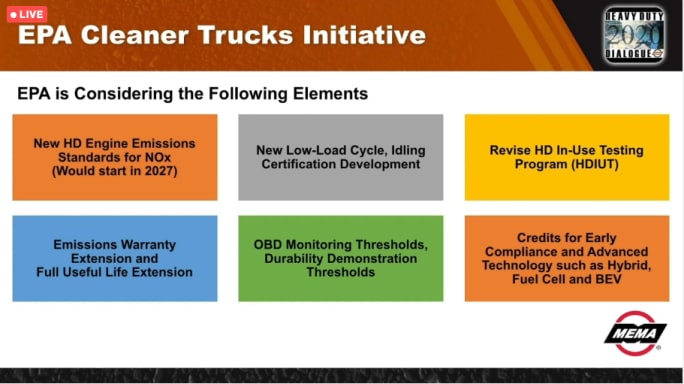
EPA's Cleaner Trucks Initiative is unlikely to be published before the election.
Screen shot, Heavy Duty Dialogue virtual event
EPA continues to work on its Cleaner Trucks initiative and is looking at many of the same things California has been regulating – Nox standards, vehicle idling, emissions testing, warranty programs, onboard diagnostics, and credits. “We had expected EPA to move this summer with its proposal, but now I doubt we will see anything before the election,” Wilson said.
If President Trump stays in the White House, we will continue to see pro-industry executive officials and no new major environmental regulations. If Vice President Biden wins, you can expect to see emissions standards reinstated and expanded, and new regulations and incentives to meet climate change goals.
“All you have to do is look at the Democratic Platform,” she said, which calls for the entire U.S. school bus fleet to be converted to zero-emission vehicles in five years, among other things.
“You’re going to see a Biden Administration take a strident view for electric and low-emission vehicles,” she said. “Not just for personal vehicles, but also commercial motor vehicles.”
When it comes to infrastructure and energy/environmental issues, she said, “We see two diametrically opposed views on what the federal government’s role is.”
More Fleet Management

Why Private Fleets Are Taking More Freight
Private fleets are putting their own trucks on demanding customers and high-cost lanes as companies seek greater control over service, costs, and capacity.
Read More →
Color Match Smarter: Tools That Restore & Perform
For fleet managers and collision repair professionals keeping heavy-duty trucks on the road, getting the color right the first time isn't just about appearance — it's about efficiency, turnaround time, and bottom-line results. Discover how today's digital color tools are transforming the repair process from guesswork to precision.
Read More →
FMCSA Pauses Biennial-Update Enforcement Amid Motus Transition
Carriers whose updates were due on or after June 1 have more time, while FMCSA works to stabilize its new registration system and warns of phishing sites impersonating its new carrier registration system, Motus.
Read More →


2026 Blueprint for Countering Smarter Supply Chain Theft
Cargo theft is no longer just the cost of doing business. It's a multi-billion-dollar criminal enterprise exploiting vulnerabilities across your fleet, drivers, and supply chain.
Read More →
How Telematics Improves Visibility, Control, and Performance in Refrigerated Fleets
Explore how telematics help refrigerated fleets improve visibility, uptime, efficiency, compliance, and cargo protection across connected cold chain operations.
Read More →
What the U.S.-Canada Trade War Means for Trucking
Escalating U.S.-Canada tariffs could disrupt cross-border freight, reduce truck volumes, raise costs, and create new uncertainty for carriers on both sides of the border.
Read More →
What Are Trucking’s Top Concerns for 2026?
The American Transportation Research Institute wants to know what's worrying trucking fleet managers, drivers, and other stakeholders in its annual Industry Issues survey.
Read More →
American Trucking Associations Looks for a New Leader
ATA President and CEO Chris Spear abruptly left his job at the association on August 21, at a pivotal time for the trucking industry.
Read More →
Public Wi-Fi Cybersecurity Risks: How Truck Drivers and Fleets Can Protect Their Data
Public Wi-Fi can expose truck drivers and fleets to credential theft, malware, and other cyber threats. Here’s how to reduce the risk on the road.
Read More →
For Nicky Cupp, Fleet Innovation Starts With Frustration
HDT Truck Fleet Innovator Nicky Cupp turns everyday pain points at Fraley & Schilling into opportunities for better technology and smarter processes.
Read More →