





Related: HDT's Top Green Fleets of 2017
How 3 SmartWay Excellence Honorees Cut Their Carbon Footprint
Three recipients of SmartWay's 2017 Excellence Award detail their best practices for increasing fuel efficiency and reducing carbon footprints, from intermodal to alternative fuels.
January 18, 2018
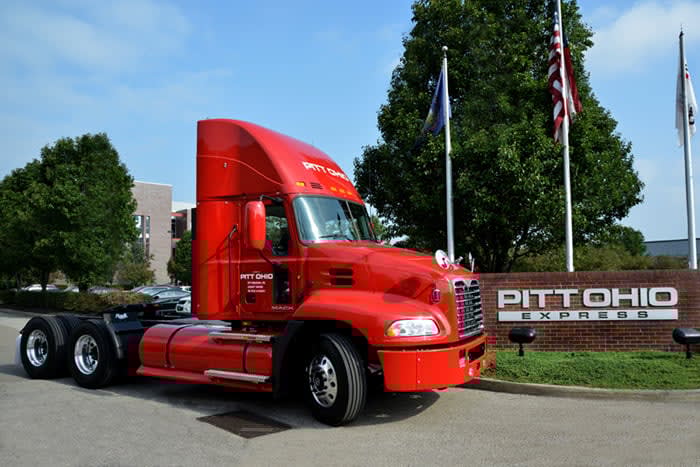
The expanded use of CNG-powered trucks has helped Pitt Ohio reduce both its carbon footprint and fuel costs. Photo: Mack Trucks
4 min to read
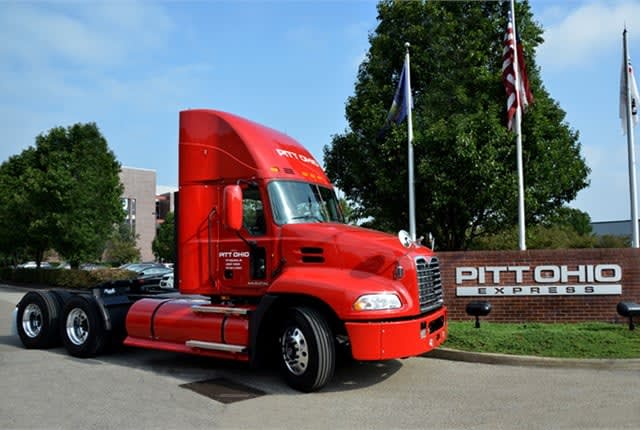
The expanded use of CNG-powered trucks has helped Pitt Ohio reduce both its carbon footprint and fuel costs. Photo: Mack Trucks
The U.S. Environmental Protection Agency’s SmartWay sustainability program recently announced its 2017 Excellence Award winners. The annual event honors SmartWay participants that lead their industries in improving freight efficiency and contributing to cleaner air within their supply chains. The awardees are chosen from over 3,600 companies and organizations participating in SmartWay program.
This week, three of the program’s Excellence Award fleet honorees detailed the best practices that have helped gain recognition by SmartWay for their efforts in reducing their corporate carbon footprint and meet major sustainability goals set by their companies.
Kimberly-Clark Takes the Lead in Sustainability
Stelios Chrysandreas is the North American transportation manager for paper products producer Kimberly-Clark. Chrysandreas is based in Knoxville, Tennessee, and tasked with delivering the lowest cost transportation costs and best possible service for the giant paper producer.
Kimberly-Clark joined SmartWay in 2006 when the company realized it needed an independent way of measuring how well it was doing on meeting its internal sustainability goals compared to the rest of the paper and transportation industries, Chrysandreas said during a webinar hosted by SmartWay on Jan. 17. Within a couple of years, however, he realized that SmartWay was an enabler that would help him expand the importance of Kimberly-Clark’s transportation division and play a larger role in the company’s sustainability plan.
Chrysandreas said he realized early on that as a large shipper, Kimberly-Clark had a big responsibility to talk to the outside carriers it was using and get them involved in SmartWay as well. And as that process unfolded, it led to fewer carriers unloading trucks and more drop-and-hook operations, which Chrysandreas said reduces both wait times for driver as well as idle time for vehicles.
Another key Kimberly-Clark tactic was to target the increased use of intermodal to move its goods. Chrysandreas said this went hand in hand with making large investments to improve its services, including building new distribution centers near major customers in order to reduce dray mileage from intermodal yards, as well as expanding relationships with additional intermodal partners.
Most of the challenges his team faced, Chrysandreas recalled, came from within Kimberly-Clark, particularly older managers with memories of slow-moving boxcars who resisted moving freight from OTR trucks to railroads. He credits the railroads with helping educate doubters and eliminating most of those initial concerns.
As a result, today Chrysandreas says about 40% of Kimberly-Clark’s products today are moved by intermodal, which he said helps all Americans by taking trucks off the road and easing congestion, while reducing Kimberly-Clark’s diesel fuel costs and easing concerns over the ongoing driver shortage.
Pitt Ohio Takes Steps Toward Electric Trucks
Justine Russo, director of sustainability and business intelligence for Pitt Ohio, spoke in the webinar about her team’s efforts to maximize customer service while reducing waste keeping costs down.
Russo said sustainability can be difficult to track and quantify in transportation applications, adding that using data can make it easier for managers like her to see the impact those efforts have within an organization. Still, she noted, the benefits of enhancing fuel economy are very real for fleets. At Pitt Ohio, just a 1.5% increase in tractor-trailer fuel efficiency had significant positive impacts on both diesel fuel costs and reducing carbon output.
Alternative fuels have been a key part of Pitt Ohio’s sustainability efforts, too, Russo said. The fleet currently operates 33 compressed-natural-gas powered tractors. The company already is working on bringing electric trucks into the operational fold in the near future and looking at installing renewable energy sources such as wind turbines and solar panel arrays to create a Pitt Ohio micro-power grid to power them. This move, she noted, would deliver a completely non-carbon means of powering trucks for the fleet. But, she noted, the technology to achieve those goals was still a few years away from being practical. “But,” she said, “it is coming fast.”
Knichel Logistics Says Intermodal More Efficient
SmartWay’s final presenter was Jon Krystek, chief operating officer for Knichel Logistics, an intermodal, LTL and over-the-road fleet based in Gibsonia, Pennsylvania.
Founded in 2003, Knichel has been working steadily to shift as much freight from highway to rail in order to see both green solutions and economic savings for the company. “Intermodal is four times more efficient than truckload at moving freight,” Krystek said. “In fact, one train can carry the load of 280 tractor-trailers, which makes it a far more environmentally friendly means of shipping.”
However, he said, fleets making the transition to intermodal have to be cautious. Intermodal times, while comparable to truckload transit times, might not be a good fit for fleets hauling expedited goods. But, he noted, in longer-length hauls, intermodal pricing can be particularly price competitive with motor carrier pricing, yielding up to 40% cost savings. Intermodal can also be a significant source of capacity for fleets, he added, particularly in peak seasons when truck capacity tightens.
For more on SmartWay’s 2017 Excellence Award Honorees, visit https://www.epa.gov/smartway/smartway-excellence-awardees
More Fleet Management

Sponsored•September 16, 2026
Color Match Smarter: Tools That Restore & Perform
For fleet managers and collision repair professionals keeping heavy-duty trucks on the road, getting the color right the first time isn't just about appearance — it's about efficiency, turnaround time, and bottom-line results. Discover how today's digital color tools are transforming the repair process from guesswork to precision.
Read More →
FMCSA Pauses Biennial-Update Enforcement Amid Motus Transition
Carriers whose updates were due on or after June 1 have more time, while FMCSA works to stabilize its new registration system and warns of phishing sites impersonating its new carrier registration system, Motus.
Read More →
Sponsored•September 14, 2026
2026 Blueprint for Countering Smarter Supply Chain Theft
Cargo theft is no longer just the cost of doing business. It's a multi-billion-dollar criminal enterprise exploiting vulnerabilities across your fleet, drivers, and supply chain.
Read More →


Sponsored•September 1, 2026
How Telematics Improves Visibility, Control, and Performance in Refrigerated Fleets
Explore how telematics help refrigerated fleets improve visibility, uptime, efficiency, compliance, and cargo protection across connected cold chain operations.
Read More →
What the U.S.-Canada Trade War Means for Trucking
Escalating U.S.-Canada tariffs could disrupt cross-border freight, reduce truck volumes, raise costs, and create new uncertainty for carriers on both sides of the border.
Read More →
What Are Trucking’s Top Concerns for 2026?
The American Transportation Research Institute wants to know what's worrying trucking fleet managers, drivers, and other stakeholders in its annual Industry Issues survey.
Read More →
American Trucking Associations Looks for a New Leader
ATA President and CEO Chris Spear abruptly left his job at the association on August 21, at a pivotal time for the trucking industry.
Read More →
Public Wi-Fi Cybersecurity Risks: How Truck Drivers and Fleets Can Protect Their Data
Public Wi-Fi can expose truck drivers and fleets to credential theft, malware, and other cyber threats. Here’s how to reduce the risk on the road.
Read More →
For Nicky Cupp, Fleet Innovation Starts With Frustration
HDT Truck Fleet Innovator Nicky Cupp turns everyday pain points at Fraley & Schilling into opportunities for better technology and smarter processes.
Read More →
Adam Buttgenbach’s Approach to Electric Trucks: Start With Where They Fit
HDT Truck Fleet Innovator Adam Buttgenbach helped PepsiCo build one of North America’s largest EV fleets by focusing on where electric trucks make operational sense.
Read More →