





Report: Interstate Must Be Rebuilt to Meet Supply Chain Needs
House Highway Bill Step Forward on Infrastructure Funding
The House passed a five-year highway bill, but there's still a long way to go before there's a real agreement on infrastructure funding on Capitol Hill.
July 1, 2021
The House of Representatives got a highway bill passed in under a month.
Image: HDT Graphic
5 min to read
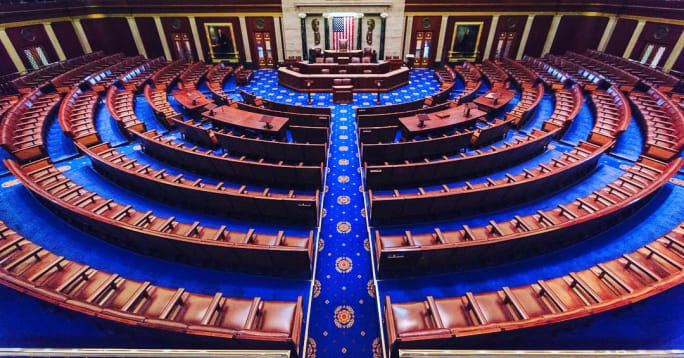
In a mostly party-line vote of 222-201, the U.S. House of Representatives approved a $715 billion, five-year transportation bill on July 1, just before the July 4 recess.
Introduced less than a month ago by Rep. Peter DeFazio, D-Oregon, the Investing in a New Vision for the Environment and Surface Transportation in America Act (the INVEST in America Act for short), would spend $343 billion on roads, bridges and safety, $109 billion on transit, and $95 billion to passenger and freight rail. It would also commit $117 billion to drinking water infrastructure and more than $51 billion to wastewater infrastructure.
The bill is similar to last year's INVEST in America Act, approved by the House in the last Congress but which failed to advance to the Senate.
This is the latest version of the classic five-year “highway bill.” It’s unlikely it will get through the Senate in its current form, although there is talk of using the budget reconciliation process to pass a Democrat-supported bill in the Senate. Others want to wait and see what happens with more bipartisan measures.
The Senate is working on its own bill, the bipartisan Surface Transportation Investment Act of 2021. That bill, while it does not include an increase in minimum insurance, calls for an automatic emergency braking mandate, language involving side underride guards, and the DRIVE-Safe Act setting up a pilot program for younger truck drivers.
This INVEST in America is separate from President Biden’s massive $2.2 trillion American Jobs Plan, and from the bipartisan deal for a $579 billion infrastructure proposal endorsed by President Biden, although it shares some similarities with the bipartisan plan.
INVEST in America Act
Among other provisions, the INVEST in America Act:
extends FY2021 enacted levels through FY2022 for federal-aid highway, transit, and safety programs;
reauthorizes for FY2023-FY2026 several surface transportation programs, including the federal-aid highway program, transit programs, highway safety, motor carrier safety, and rail programs;
addresses climate change, including strategies to reduce the climate change impacts of the surface transportation system and a vulnerability assessment to identify opportunities to enhance the resilience of the surface transportation system and ensure the efficient use of federal resources;
revises Buy America procurement requirements for highways, mass transit, and rail;
establishes a rebuild rural bridges program to improve the safety and state of good repair of bridges in rural communities;
implements new safety requirements across all transportation modes; and
directs DOT to establish a pilot program to demonstrate a national motor vehicle per-mile user fee to restore and maintain the long-term solvency of the Highway Trust Fund and achieve and maintain a state of good repair in the surface transportation system.
The American Association of State Highway and Transportation Officials called the bill “a major step toward reauthorization of the federal surface transportation program,” said Jim Tymon, AASHTO executive director, in a statement.
“With infrastructure investment being the top national priority, AASHTO continues to call for a bipartisan bill that strengthens and builds upon formula-based funding to states, while maintaining the flexibility necessary to allow states to deliver national transportation priorities including equity; resiliency; carbon reduction; safety for all roadway users; improving project delivery; and maintaining and improving their transportation assets.”
A group called Transportation for America, an advocacy organization made up of local, regional and state leaders, praised the bill, calling it “an overdue paradigm shift toward accomplishing measurable outcomes that prioritizes repair, safety, and access.” It hits the group’s core principles: It prioritizes maintenance, addresses safety concerns related to things such as how states set speed limits, and addresses how well the transportation system connects people to jobs and the things they need.
“We congratulate the House of Representatives for passing the INVEST Act, a transportation bill that commits to a fix it first approach, prioritizing safety over speed, and connecting people to jobs and essential services—whether they drive or not,” said Beth Osborne, director of Transportation for America.
Trucking Reaction
American Trucking Associations President and CEO Chris Spear said in a statement that the bill is “a significant step toward enacting the kind of comprehensive infrastructure package our nation needs. The investments in this bill will enable the country to grow, not just economically, but they will improve safety and the environment….We encourage the Senate to advance companion legislation this summer, and ATA will support these critical investments while working to improve upon it throughout the legislative process.”
The Teamsters Union applauded the bill, saying that not only would the nation's roads, bridges, transit, rail, and water infrastructure receive the federal investment they need, but it would also put in place “critical labor and safety reforms for transportation workers.”
A new motor carrier accountability provision added through an amendment would require all motor carriers to certify that they comply with all labor and safety laws prior to renewing or acquiring their registration with the U.S. Department of Transportation.
"Under this new legislation, Amazon, its Delivery Service Partners, and other trucking companies across the country, would be responsible for any labor law and workplace safety violations when they apply for their DOT registration,” said Teamsters chief James Hoffa.
The provision also requires the DOT to formally study the correlation between compensation and safety in all trucking and delivery operations nationwide, noted the Teamsters.
The Owner-Operator Independent Drivers Association, however, called the bill “a vote against truckers,” citing provisions such as a 167% increase to minimum insurance on motor carriers, from $750,000 to $2 million.
EV Charging at Rest Areas
Groups representing travel centers and other fuel retailers weren’t happy about some of the bill’s provisions.
NATSO, representing the nation’s truckstops and travel plazas; NACS, the National Association of Convenience Stores; and SIGMA: America’s Leading Fuel Marketers, issued a statement criticizing the bill, with NATSO President and CEO Lisa Mullings citing “harmful provisions that will discourage the private sector from making investments in electric vehicle charging infrastructure.”
While the bill includes funding for electric vehicle charging infrastructure, the groups said provisions to place EV charging stations at Interstate rest area “create impediments to private sector investment in EV charging.”
“Such commercial services at rest areas have been shown to reduce private investment in those services at interstate exits resulting in less, not more, of those offerings for motorists,” the groups said.
More Fleet Management

Sponsored•September 16, 2026
Color Match Smarter: Tools That Restore & Perform
For fleet managers and collision repair professionals keeping heavy-duty trucks on the road, getting the color right the first time isn't just about appearance — it's about efficiency, turnaround time, and bottom-line results. Discover how today's digital color tools are transforming the repair process from guesswork to precision.
Read More →
FMCSA Pauses Biennial-Update Enforcement Amid Motus Transition
Carriers whose updates were due on or after June 1 have more time, while FMCSA works to stabilize its new registration system and warns of phishing sites impersonating its new carrier registration system, Motus.
Read More →
Sponsored•September 14, 2026
2026 Blueprint for Countering Smarter Supply Chain Theft
Cargo theft is no longer just the cost of doing business. It's a multi-billion-dollar criminal enterprise exploiting vulnerabilities across your fleet, drivers, and supply chain.
Read More →


Sponsored•September 1, 2026
How Telematics Improves Visibility, Control, and Performance in Refrigerated Fleets
Explore how telematics help refrigerated fleets improve visibility, uptime, efficiency, compliance, and cargo protection across connected cold chain operations.
Read More →
What the U.S.-Canada Trade War Means for Trucking
Escalating U.S.-Canada tariffs could disrupt cross-border freight, reduce truck volumes, raise costs, and create new uncertainty for carriers on both sides of the border.
Read More →
What Are Trucking’s Top Concerns for 2026?
The American Transportation Research Institute wants to know what's worrying trucking fleet managers, drivers, and other stakeholders in its annual Industry Issues survey.
Read More →
American Trucking Associations Looks for a New Leader
ATA President and CEO Chris Spear abruptly left his job at the association on August 21, at a pivotal time for the trucking industry.
Read More →
Public Wi-Fi Cybersecurity Risks: How Truck Drivers and Fleets Can Protect Their Data
Public Wi-Fi can expose truck drivers and fleets to credential theft, malware, and other cyber threats. Here’s how to reduce the risk on the road.
Read More →
For Nicky Cupp, Fleet Innovation Starts With Frustration
HDT Truck Fleet Innovator Nicky Cupp turns everyday pain points at Fraley & Schilling into opportunities for better technology and smarter processes.
Read More →
Adam Buttgenbach’s Approach to Electric Trucks: Start With Where They Fit
HDT Truck Fleet Innovator Adam Buttgenbach helped PepsiCo build one of North America’s largest EV fleets by focusing on where electric trucks make operational sense.
Read More →