




Penske and Hitachi Launch Large-Scale Electric Truck Charging Depot
Hitachi Energy and Penske Truck Leasing have launched a large-scale, centralized electric truck charging solution near Stockton, California.

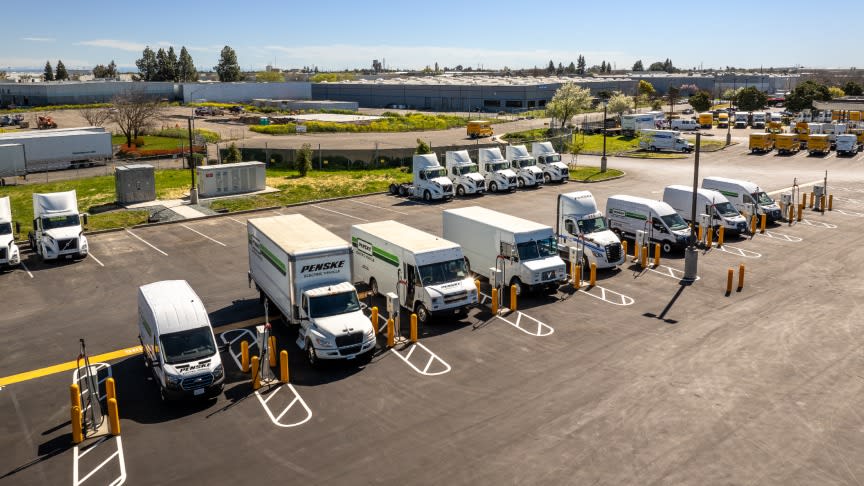
Hitachi and Penske said their new electric charging depot reduces space requirements up to 60 percent compared to conventional charging systems.
Photo: Hitachi
Hitachi America, Hitachi Energy, and Penske Truck Leasing announced a large-scale, centralized electric truck charging solution. This project supports Penske’s electric truck deployments for its customers in the Stockton, California, area.
For this pilot initiative, Hitachi Energy supplied Penske with its Grid-eMotion Fleet EV charging system. The integrated direct current (DC) fast-charging solution is designed to scale up and deliver multi-megawatt level charging capabilities.
Scalable High-Capacity Charging
The new system can reduce space requirements up to 60% compared to conventional charging systems, according to the announcement. It also cuts cabling needs up to 40%.
“Investing in our capabilities with electric vehicles and charging solutions is crucial as our customers seek to decarbonize their fleets and comply with emissions regulations,” said Art Vallely, president, Penske Truck Leasing.
“Robust public and private charging infrastructures are essential to ensure the viability of commercial electric trucks in the future.”
Vallely said Penske has been a pioneer in adopting battery-electric commercial vehicles and has made substantial investments in testing, maintaining, and expanding charging infrastructure to support these vehicles.
The company has been testing and operating EV trucks across its leasing, rental and logistics fleets in various industries, including retail, manufacturing, grocery, quick-service restaurant chains, medical, automotive parts, and others.
Charging for 10 Trucks at Once
Hitachi Energy’s Grid-eMotion Fleet charging system in Stockton is already being used to charge a growing number of EVs across light-, medium- and heavy-duty applications, the company said.
Its 10-pedestal system can charge as many as 10 trucks on-site up to 100 kW or five trucks up to 200kW.
“We’re excited to be working with Hitachi on deployment of this cutting-edge technology,” said Drew Cullen, senior vice president of fuels and facility services at Penske, noting that this installation will provide real-world experience. “When we were first introduced to the Grid-eMotion solution, we were impressed with its capability and flexibility and what that could mean for our customers."
This collaboration extends Hitachi’s existing partnerships with Penske Corp., rooted in the IndyCar racing series. The two have a joint commitment to expedite fleet-wide emissions reduction through widespread electric charging station deployment.
Hitachi and Penske also are exploring smart charging solutions using artificial intelligence to optimize vehicle charging processes.
"This project presents an ideal opportunity to highlight the benefits of charging systems designed specifically for fleets and how they can support the transition to a more sustainable mode of operations,” said Alireza Aram, general manager, grid integration business, North America, Hitachi Energy.
Hicham Abdessamad, chairman and CEO of Hitachi America, said the project "demonstrates how we can move electric fleets from niche to mainstream solutions ... to address commercial and public transportation electrification."
More Fuel Smarts

How Volvo Updated Its D13 for EPA 2027 [Watch]
Volvo’s updated D13 promises lower emissions without sacrificing performance or fuel economy. Take a closer look at what changed inside the engine in this HDT Spotlight video.
Read More →
Diesel Price Spike Shortens Payback for Natural Gas Trucks, Report Says
Energy Vision estimates fleets could recover the higher purchase price of an RNG-fueled Class 8 tractor in 1.3 to 2.8 years under current fuel-price scenarios.
Read More →
Calstart Becomes Catalyst Mobility, Reflecting Broader Focus
Calstart is now Catalyst Mobility, reflecting the nonprofit’s growing national role in clean transportation, including zero-emission trucks, infrastructure and incentive programs.
Read More →

Record Diesel Prices Squeeze Trucking Fleets
Average U.S. diesel prices have climbed to nearly $6 a gallon, surpassing the 2022 record as tight refinery capacity and Middle East disruptions keep fuel costs elevated.
Read More →
How Fuel Delivery Shapes Engine Performance
Fuel delivery depends on more than what happens at the injector. For fleet, maintenance and technical professionals, looking at the full path from pump to injector can provide useful context for understanding engine performance.
Read More →
East Coast Port Launches $45M Electric Truck Push
The Port Authority of New York and New Jersey announced millions in incentives for zero-emission drayage trucks, yard tractors, and new charging hubs near the port.
Read More →
California Bill Could Shed Light on Electric Truck Prices
Why do battery-electric Class 8 trucks remain so expensive? A California bill headed to Gov. Gavin Newsom would give fleets and state agencies more visibility into what manufacturers charge.
Read More →
Detroit Opens Orders for EPA 2027 Engines
Detroit isn’t starting from scratch to meet EPA 2027 diesel emissions standards. Its Gen 6 DD13 and DD15 engines keep much of today’s platform while updating the fuel and aftertreatment systems.
Read More →
Zero-Emission Truck Corridor Planned for West Coast
California, Oregon, Washington, British Columbia and Baja California are coordinating plans for truck charging and hydrogen fueling from Canada to Mexico.
Read More →
A Closer Look at Kenworth’s Electric T880E Vocational Truck [Video]
Learn more about Kenworth's T880E battery-electric vocational truck at the Paccar Technical Center, including its range, applications, upfitting considerations, and PTO options, in this HDT Spotlight video.
Read More →