





Dig Deeper: 9 Keys to Drawing a Roadmap to Zero Fleet Emissions
Hirschbach, Lineage Logistics Deploy Electric Yard Trucks
Hirschbach Motor Lines has deployed five Orange EV battery-electric yard trucks to Lineage Logistics facilities in the Kansas City area.
April 6, 2023
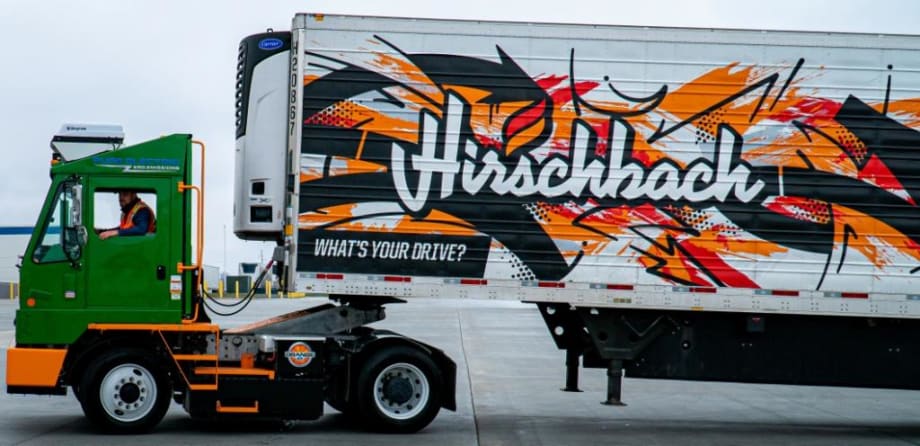
Hirschbach plans to convert 20% of its spotter fleet to EV by the third quarter.
Photo: Orange EV
2 min to read
Hirschbach Motor Lines has deployed five Orange EV battery-electric yard trucks to Lineage Logistics facilities in the Kansas City area.
Hirschbach, based in Dubuque, Iowa, is providing zero-emission spotting services for two Lineage facilities in Kansas. Lineage’s core business is storing, handling, and transporting temperature-controlled food products.
“The Spot by Hirschbach team has been focused on bringing technology into the customer yards that we service, and Orange EV’s electric yard trucks are an exciting next step for us to continue to do the right thing for our customer, our driver team, and the environment,” said Kevin Lage, Hirschbach’s senior director commercial team. “Our goal is to have 20% of our spotter fleet converted to EV by Q3 of 2023.”
Orange EV trucks use electricity and have a maximum powertrain efficiency of more than 90%. At the Lineage sites in Kansas, Hirschbach operates Orange EV yard trucks up to 20 hours a day, six days a week. Under these heavy-use conditions, switching from diesel to electric eliminates more than 100 tons of carbon dioxide per truck annually along with diesel particulate matter, nitrogen oxides, and other pollutants emitted as a result of diesel combustion, according to the announcement.
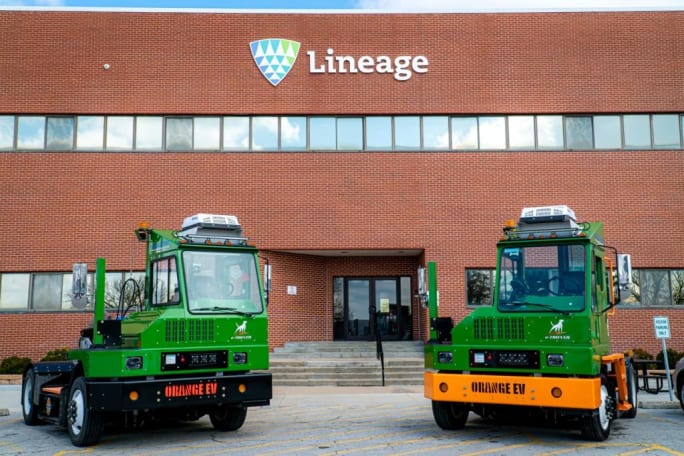
At the Lineage sites in Kansas, Hirschbach operates Orange EV yard trucks up to 20 hours a day, six days a week.
Photo: Orange EV
To further reduce carbon emissions, Lineage has deployed 10 additional Orange EV yard trucks at sites in California. Five of those Lineage-owned units operate at the Lineage Colton-Agua Mansa facility in Colton, California, the first facility in the Lineage network able to produce 100% of its energy consumption onsite.
Both Hirschbach and Lineage have long been focused on energy efficiency and supply chain efficiency.
Hirschbach has won multiple EPA SmartWay Excellence Awards, in part by aggressively reducing empty route miles and idling time to reduce emissions and maximize fuel economy.
Lineage also participates in the Environmental Protection Agency’s SmartWay Transport Partnership and has been recognized by the Department of Energy for four consecutive years. Lineage has made a Climate Pledge commitment to be net-zero carbon emissions by 2040.
Hirschbach recently received Lineage Logistics' first-ever National Truckload Carrier of the Year and Dedicated Truckload Carrier of the Year awards.
“Increasing supply chain efficiency can sometimes require considerable reimagining of operations,” said Zack Ruderman, Orange EV VP of sales and marketing. “Switching to electric yard trucks, however, can be a seamless transition.”
In fact, the North American Council for Freight Efficiency concluded after its first Run on Less - Electric demo that electric yard tractors may be a great first step for fleets interested in learning more about electrification in commercial vehicle applications.
More Fuel Smarts

How Volvo Updated Its D13 for EPA 2027 [Watch]
Volvo’s updated D13 promises lower emissions without sacrificing performance or fuel economy. Take a closer look at what changed inside the engine in this HDT Spotlight video.
Read More →
Diesel Price Spike Shortens Payback for Natural Gas Trucks, Report Says
Energy Vision estimates fleets could recover the higher purchase price of an RNG-fueled Class 8 tractor in 1.3 to 2.8 years under current fuel-price scenarios.
Read More →
Calstart Becomes Catalyst Mobility, Reflecting Broader Focus
Calstart is now Catalyst Mobility, reflecting the nonprofit’s growing national role in clean transportation, including zero-emission trucks, infrastructure and incentive programs.
Read More →

Record Diesel Prices Squeeze Trucking Fleets
Average U.S. diesel prices have climbed to nearly $6 a gallon, surpassing the 2022 record as tight refinery capacity and Middle East disruptions keep fuel costs elevated.
Read More →
Sponsored•September 9, 2026
How Fuel Delivery Shapes Engine Performance
Fuel delivery depends on more than what happens at the injector. For fleet, maintenance and technical professionals, looking at the full path from pump to injector can provide useful context for understanding engine performance.
Read More →
East Coast Port Launches $45M Electric Truck Push
The Port Authority of New York and New Jersey announced millions in incentives for zero-emission drayage trucks, yard tractors, and new charging hubs near the port.
Read More →
California Bill Could Shed Light on Electric Truck Prices
Why do battery-electric Class 8 trucks remain so expensive? A California bill headed to Gov. Gavin Newsom would give fleets and state agencies more visibility into what manufacturers charge.
Read More →
Detroit Opens Orders for EPA 2027 Engines
Detroit isn’t starting from scratch to meet EPA 2027 diesel emissions standards. Its Gen 6 DD13 and DD15 engines keep much of today’s platform while updating the fuel and aftertreatment systems.
Read More →
Zero-Emission Truck Corridor Planned for West Coast
California, Oregon, Washington, British Columbia and Baja California are coordinating plans for truck charging and hydrogen fueling from Canada to Mexico.
Read More →
A Closer Look at Kenworth’s Electric T880E Vocational Truck [Video]
Learn more about Kenworth's T880E battery-electric vocational truck at the Paccar Technical Center, including its range, applications, upfitting considerations, and PTO options, in this HDT Spotlight video.
Read More →