





Watch: Driving Hino's XL Tandem Straight Truck (Video)
Hino Turns to Cummins for Engines, Accelerates Electric Truck Development
Hino Trucks announced its will produce medium- and heavy-duty Hino trucks with Cummins engines for sale in North America and accelerate its development of battery-electric trucks.
March 12, 2021
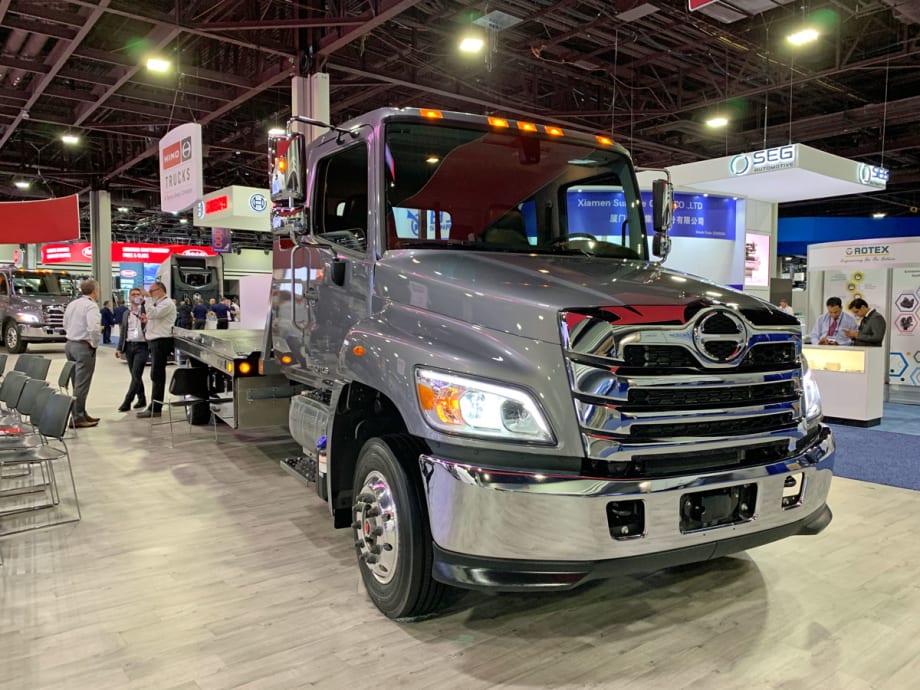
Hino plans to make the Cummins B6.7 engine available in its L Series (shown here at the North American Commercial Vehicle Show in 2019) by the end of 2021.
Photo: Deborah Lockridge
3 min to read
Hino Trucks announced its will produce medium- and heavy-duty Hino trucks with Cummins engines for sale in North America and accelerate its development of battery-electric trucks.
During the virtual 2021 NTEA Work Truck Week, Hino said it intends to offer Cummins B6.7 and L9 engines in Hino's L and XL Series models by the end of 2021.
Hino plans to redirect the engineering and other resources it would have used to develop engines to accelerate the development of the battery-electric vehicle portion of Project Z, the company's development path to zero emission vehicles. The company had previously announced plans to develop and produce a full range of Class 4 through 8 battery electric trucks by 2024. It is now planning to begin low-volume production of BEV models in the fourth quarter of 2022, ramping up to full production by the end of 2023.
Hino will begin production of Cummins-powered trucks at Hino plants in West Virginia and Woodstock, Canada, in October 2021, using engines built by Cummins at the engine maker’s Rocky Mount Engine Plant in North Carolina.
The company plans to make the Cummins B6.7 engine available in the L Series by the end of 2021, initially offering the engine in two ratings: 240 hp and 260 hp. The B6.7 will be paired with Allison's 2000 and 3000 Series transmissions.
Starting in 2022, the Cummins L9 engine will be available in Hino's XL Series model, initially in three ratings: 300 hp, 330 hp, and 360 hp. The L9 can be paired with Allison's 3000 or 3500 Series transmission or an Eaton manual.
Hino and Cummins will continue to evaluate additional opportunities to collaborate on powertrain strategies in the future.
Late in 2020, Hino announced it was pausing truck production in the U.S. and Canada until it could meet new 2021-emissions engine certification test requirements for new model years of the A09C, J08E, and J05E Hino diesel engines for North America truck models.
Hino is not the only truck maker turning to Cummins for its medium-duty engines.
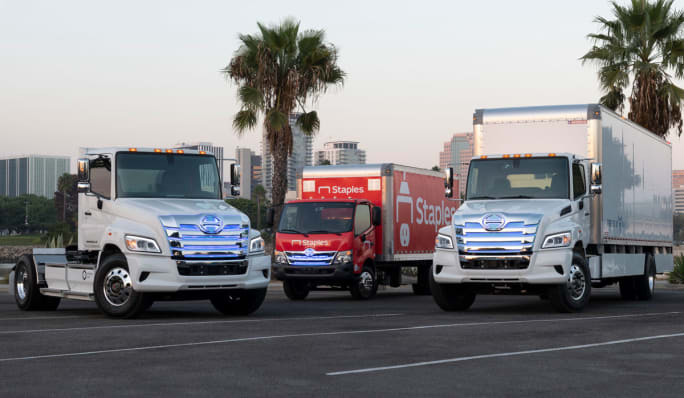
Hino said it now can accelerate its Project Z zero-emissions vehicles development.
Photo: Hino
“Our industry is in the midst of a generational shift from traditional vehicles to zero emission vehicles,” noted Hino's Glenn Ellis, Senior VP of Customer Experience. “This new partnership is in line with the recent shift we have seen among other OEMs who are looking to strong industry partners to help offset their growing R&D investments into new ZEVs.”
Last month, Isuzu and Daimler both announced deals with Cummins for medium-duty engines.
Isuzu and Cummins announced agreements for a global mid-range diesel powertrain and an advanced engineering collaboration, marking another step forward in the Isuzu Cummins Powertrain Partnership (ICPP).
Daimler Trucks and Buses announced that Cummins will take over the development, production and delivery of medium-duty engines for its vehicles around the world by the second half of the decade. It said the deal would enable it to accelerate its development efforts on alternative and emerging technologies, including non-diesel engines.
More Equipment

How Volvo Updated Its D13 for EPA 2027 [Watch]
Volvo’s updated D13 promises lower emissions without sacrificing performance or fuel economy. Take a closer look at what changed inside the engine in this HDT Spotlight video.
Read More →
Michelin Tire Improves Efficiency and Durability for Regional Fleets
The Michelin X Multi Energy D2 is a regional haul drive tire engineered to help fleets improve fuel efficiency, durability and traction in demanding stop-and-go operations.
Read More →
ZF Expands Commercial Vehicle Push in North America
ZF is expanding its North American commercial-vehicle presence with new transmission applications, electrification, trailer technology and autonomous-driving systems.
Read More →
Tesla Wants a Self-Driving Semi. Are Cameras Enough?
Could Tesla’s camera-only autonomous driving technology work on an 80,000-pound Semi? In this commentary, HDT's Deborah Lockridge takes a look at Tesla, Cybercab, and how autonomous trucks see the road.
Read More →
Kodiak: Driverless Long-Haul Truck Launch on Track for 2026
Kodiak AI says its driverless long-haul safety case is 93% complete and it remains on track to begin commercial operations by year-end 2026.
Read More →
What DOT’s Automated Vehicle Strategy Means for Trucking
The U.S. Department of Transportation issued a new automated-vehicle strategy that outlines plans for driverless-truck regulations, cross-state freight corridors, and federal safety standards.
Read More →
East Coast Port Launches $45M Electric Truck Push
The Port Authority of New York and New Jersey announced millions in incentives for zero-emission drayage trucks, yard tractors, and new charging hubs near the port.
Read More →
PlusAI Going Public to Fund Autonomous Truck Launch
A SPAC deal could provide PlusAI with up to $300 million as it works toward a 2027 commercial launch of factory-built autonomous trucks.
Read More →
NHTSA Moves to Rewrite Truck Fuel-Economy Rules
The National Highway Traffic Safety Administration says it lacks authority to regulate medium- and heavy-duty truck engines separately from complete vehicles, but the existing standards have not yet been eliminated.
Read More →
Detroit Opens Orders for EPA 2027 Engines
Detroit isn’t starting from scratch to meet EPA 2027 diesel emissions standards. Its Gen 6 DD13 and DD15 engines keep much of today’s platform while updating the fuel and aftertreatment systems.
Read More →