




Heavier Trucks Pass Test, Vermont Says
At first glance, the safety results of the heavy-truck pilot test in Vermont are not good news. In the year-long test, accidents were up on both Interstate and non-Interstate roads, a point that the Truck Safety Coalition, which opposes heavier trucks, has been quick to highlight. But in fact the safety data are not conclusive, and the test showed improvements in productivity, fuel efficiency and emissions, says a top Vermont transportation official
At first glance, the safety results of the heavy-truck pilot test in Vermont are not good news. In the year-long test, accidents were up on both Interstate and non-Interstate roads, a point that the Truck Safety Coalition, which opposes heavier trucks, has been quick to highlight. But in fact the safety data are not conclusive, and the test showed improvements in productivity, fuel efficiency and emissions, says a top Vermont transportation official.
In the 2010 pilot test, Vermont and Maine were granted an exemption from the federal 80,000-pound limit on Interstate highways, in effect allowing trucks weighing up to 100,000 pounds on those roads.
The issue is a major concern to those states, which have argued long and hard that this relief will let them get heavier trucks off rural roads onto the safer Interstates and improve their ability to compete in their regional economy. But it also has national implications, because the Truck Safety Coalition and its allies see a threat in any loosening of federal weight restrictions, and trucking interests view it as a test case for the reforms they seek.
Safety Groups Decry Crashes
Preliminary numbers on the safety and operational aspects of the test in Vermont recently became available when the Truck Safety Coalition posted them on its website after obtaining a draft Federal Highway Administration report through a Freedom of Information Act request.
Among the key findings are crash statistics that appear to contradict Vermont's contention that getting heavier trucks onto the Interstate would improve safety.
Crashes on non-Interstate roads increased 24%, from 208 in 2009 to 258 in 2010, while crashes on Vermont Interstates increased 10%, from 50 to 55. Fatal crashes on Interstates jumped 200%, from one in 2009 to three in 2010. And injury crashes on non-Interstates rose 28% from 39 in 2009 to 50 in 2010.
"The industry's duplicitous and untrustworthy assertions (concerning the shift of traffic from rural to Interstate roads) used to advance a dangerous policy are brought to light for what they truly are - corporate greed at the expense of public safety," said Julie Magnan, the Coalition's Vermont Coordinator, in a statement.
Daphne Izer, founder of Parents Against Tired Truckers, added in a statement: "Congress must stop this deadly exemption right now. This special interest pilot project used motorists as human guinea pigs in a killer experiment. The results are clear - more deaths, more dangerous trucks, more damage to our already compromised infrastructure, and more costs - which are not paid for by the industry but by the taxpayers."
Not so fast...
The draft study also says that the trucks involved in the crashes were not necessarily participating in the test.
Moreover, said Chris Cole, director of policy, planning and intermodal development at the Vermont Agency of Transportation, the numbers of fatal crashes are statistically inconclusive.
"In 2007 we had three fatalities, none on the Interstates, all on the non-Interstates," he said. "In 2008 we had five, two on the Interstates and three on non-Interstates. In 2009, we had one on the Interstates and three on the non-Interstates. In 2010, the non-Interstate goes up by one and the Interstate goes up by two, for a total of seven."
But these numbers do not tell the story, he said. "They are small numbers, but if you use them on a percentage basis, as the anti-truck or pro-safety groups, however you want to term them, did, it provides a misleading representation of the actual facts."
In any case, he added, the additional fatalities in 2010 all involved non-test trucks. "It didn't have anything to do with the pilot."
This analysis was echoed by Darrin Roth, director of highway operations at American Trucking Associations, which supports the pilot project.
"The increase in fatal crashes (in 2010) from four to seven is not a statistically significant increase," he said. He also pointed out that just 5% of vehicle miles traveled in the test were done by the six-axle trucks carrying heavier loads. "You can hardly reach the conclusion that they were responsible for the increase (in fatal crashes).
Cole added that statistics for injury crashes counter concerns raised over the statistics for fatality crashes. In 2007 there were 68 injury crashes on non-Interstates and 18 on Interstates. In 2010, with double the amount of commercial traffic, there were 11 injury crashes on the Interstates, he said.
"So one could argue that we increased substantially the amount of trucks and heavy trucks on the Interstates and accidents involving an injury crash actually went down by seven crashes. And on the non-Interstates, which vehicles had moved off of, there were 50 crashes, a reduction of 15."
The study had no explanation for why the overall number of crashes increased on non-Interstates during 2010, despite a lower rate of vehicle miles traveled.
Cole's perspective is that the one-year data are a snapshot that does not tell the full story. It is more important, he said, that crashes on non-Interstates declined overall between 2005 and 2010. "If you average it all out, (2010) is still below average," he said.
Keeping Trucks Off State Roads
The public reaction in Vermont is overwhelming support for the pilot, Cole said.
From a "common-sense, Vermont frame of reference," as he put it, the state is small and rural with state roads running through many towns. "It's just not appropriate to have these (trucks) on a state highway system when we have an Interstate system that is built for this traffic."
With respect to the issue of competitiveness, Cole described Vermont as an island surrounded by New York, Massachusetts, New Hampshire and the Province of Quebec, all of which allow heavier trucks on their Interstates.
"So when they need to get across Vermont, they leave the Interstate that they arrived on and get on our state highway system until they can pick up an Interstate on the other side."
That puts these trucks on Vermont state roads where they don't belong, he said. It also puts Vermont at a competitive disadvantage for attracting business, as well as for its own trucking industry because the five-axle trucks that Vermont carriers must buy for their Interstates cannot compete well outside of the state, he said.
On the operational side, the test indicated that heavier trucks accomplished what they were expected to accomplish.
Vehicle miles of truck travel went down in 2010 as a result of the overall decrease in trucks carrying 80,000 pounds, and the increase in those carrying 100,000 pounds, the study says. This resulted in the equivalent of a 6% to 7% reduction in fuel consumption, amounting to about $1.36 million.
In addition, the combination of fewer miles and better fuel economy on Interstates led to almost a 1% reduction in greenhouse gas emissions, the study said.
ATA's Roth said that what was predicted to happen in terms of VMT on non-Interstates versus Interstates actually did happen. "There's very little doubt that it was due to the pilot program," he said.
Cole said he has no concerns at all about continuing to allow the heavier trucks on Vermont Interstates.
"It's just safer for these vehicles to be out on the Interstates than sharing the road with pedestrians and bicycles, and operating in our village centers," he said.
"It's a common sense conclusion."
What's next
The question of continuing the test is now up to Congress. The pending Department of Transportation appropriations bill contains provisions that would give both Vermont and Maine permanent authority to permit the heavier trucks on their Interstates. That bill has cleared the House but still is working its way through the Senate, where the provisions could face opposition.
The politics of the issue were on display last summer at a hearing where
More Drivers
Trucker Path Expands Reserved Parking Network
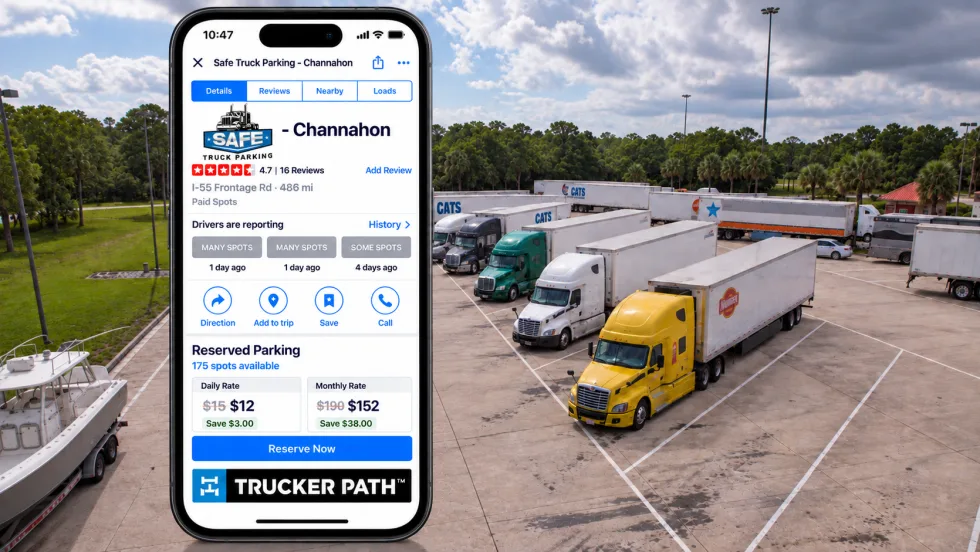
Trucker Path has added close to 6,000 more truck parking spaces to its Trucker Path Reserved Parking Network with the addition of Safe Truck Parking.
Read More →
EEOC Sues Texas Trucking Company Over Driver Age Limits
The agency says Trancasa USA rejected applicants over 65 and applied tougher driving-record standards to those over 60.
Read More →
Nussbaum, Roehl Announce Second Driver Pay Increase This Year
This year has seen a swath of major truck driver pay increases as freight capacity has tightened.
Read More →
From One Generation to the Next: How Mentorship Builds Safer Truck Drivers
After three decades in trucking, Harold Perry shares what he's learned about driver safety, mentorship, and helping the next generation build confidence behind the wheel.
Read More →
Truck Drivers Need More Than Another Alert
Fleets have more visibility into truck health, safety events, and driver activity than ever. The next challenge is turning all that information into useful guidance for the person who has to decide what to do next.
Read More →
FMCSA Removes 110 Truck Driver Training Schools from Certified ELDT List
Federal regulators also are targeting more than 160 additional training providers and launching a nationwide audit of third-party CDL skills testers as part of a broader crackdown on trucking fraud.
Read More →
Hours of Service Pilot Programs: FMCSA Readies for 2027 Rollout
Two pilot programs could eventually reshape hours-of-service rules, giving truck drivers options to pause their 14-hour clock or use longer split sleeper rest periods.
Read More →
Medical Cards, English Proficiency Reshape Roadcheck Violations
Medical-card violations jumped to the top of the driver out-of-service list during CVSA’s 2026 International Roadcheck, while English-language proficiency violations appeared among the leading violations for the first time.
Read More →
Driver Trust Can Make or Break the Success of Fleet Safety Technology
New Teletrac Navman research suggests that onboarding, transparency about driver data, and positive feedback can play a significant role in how commercial drivers respond to safety and coaching technology.
Read More →
EEOC Sues KLLM Over Alleged Sex Discrimination in Driver Training
KLLM is facing a federal sex-discrimination lawsuit over policies the EEOC alleges put female truck driver trainees at a disadvantage.
Read More →